Biography · Chemist no. 56 of 350
Roald Hoffmann: The Chemist Who Wrote Poetry and Explained Reactions with Orbitals
Roald Hoffmann (born 1937) is an American theoretical chemist who shared the 1981 Nobel Prize in Chemistry with Kenichi Fukui. His name is permanently attached to the Woodward-Hoffmann rules, the isolobal analogy and the extended Hückel method. He is also a poet, essayist and playwright, and as a child he survived the Second World War in occupied Europe. His life shows that a scientist can also be a writer and a humanist. This biography follows his journey from a small town in Poland to Cornell University, and explains his science in a way useful for JAM, NET and GATE students.
Early Life and Family
Roald Hoffmann was born on 18 July 1937 in Złoczów, then in Poland and now Zolochiv in Ukraine, as Roald Safran. His family was Jewish. After the German invasion his father, Hillel Safran, was killed in 1943 by the Nazis. Roald, then a small boy, and his mother Clara were hidden for about a year and a half in the attic of a Ukrainian family's house, in a small space where they had to remain quiet. They survived, and after the war his mother married Paul Hoffmann, who became Roald's stepfather and whose surname he took. The family spent some time in displaced persons camps and then moved to the United States in 1949 when Roald was eleven. He learnt English quickly in New York.
Education and Mentors
Hoffmann studied at Stuyvesant High School and then Columbia University, where he earned a B.A. in chemistry in 1958. He did his PhD at Harvard University, completing it in 1962 under William N. Lipscomb, who later won the Nobel Prize for work on boranes, and with Martin Gouterman. At Harvard he was a Junior Fellow in the Society of Fellows from 1962 to 1965, where he had freedom to explore ideas. He worked with the great synthetic chemist R. B. Woodward and together they developed the rules of orbital symmetry. In 1965 he moved to Cornell University.
Career Timeline
| Year | Event |
|---|---|
| 1937 | Born in Złoczów, Poland (18 July) |
| 1943-1944 | Hidden with his mother during the Nazi occupation after his father's death |
| 1949 | Emigrated to the United States |
| 1958 | B.A. from Columbia University |
| 1962 | PhD from Harvard under William Lipscomb |
| 1962-1965 | Junior Fellow, Harvard Society of Fellows; work with Woodward |
| 1965 | Joined Cornell University; first Woodward-Hoffmann papers |
| 1970 | Published The Conservation of Orbital Symmetry with Woodward |
| 1981 | Nobel Prize in Chemistry, shared with Kenichi Fukui |
| 1990 | Hosted the TV series The World of Chemistry |
| 2001 | Play Oxygen, written with Carl Djerassi |
Major Scientific Contributions
1. Extended Hückel method
Hoffmann developed a simple quantum chemical method which includes all valence electrons. It allowed him to study the shapes and bonding of many molecules, organic and inorganic, using only a modest computer.
2. Woodward-Hoffmann rules
With Woodward he showed that pericyclic reactions are controlled by conservation of orbital symmetry. In short, thermal electrocyclic ring closure of 4n π electron systems is conrotatory, of 4n+2 systems is disrotatory, and photochemical reactions are reversed. A thermal [4+2] cycloaddition is allowed, while a thermal [2+2] is forbidden.
Thermal:   4n e- → conrotatory     4n+2 e- → disrotatory
Photochem: 4n e- → disrotatory     4n+2 e- → conrotatory
3. Isolobal analogy
He showed how organic fragments like CH3, CH2 and CH resemble metal fragments such as Mn(CO)5, Fe(CO)4 and Co(CO)3. Read the companion post for details.
4. Solid-state and surface chemistry
He applied orbital ideas to extended solids, including how molecules bind to surfaces, and helped to connect chemistry with solid-state physics through concepts such as density of states and crystal orbital overlap.
Awards, Honours and Nobel Prize
The Nobel Prize in Chemistry 1981 was shared between Kenichi Fukui and Roald Hoffmann "for their theories, developed independently, concerning the course of chemical reactions". Hoffmann has also received the American Chemical Society Award in Pure Chemistry (1969), the US National Medal of Science (1983) and the Priestley Medal (1990), the highest honour of the American Chemical Society. He has been a member of the US National Academy of Sciences and holds many honorary degrees. In his Nobel Lecture he acknowledged the contribution of Woodward, who had died in 1979.
Personality, Struggles and Lesser-Known Facts
- A childhood of survival: He lost his father in the war and spent months hiding in an attic as a young child. He has spoken about these years in interviews and writings, and they shaped his thinking about humanity and ethics.
- Chemist and poet: He has published several volumes of poetry, as well as essays about the creative side of science. His books include The Same and Not the Same and Chemistry Imagined, written with the artist Vivian Torrence.
- Theatre: He co-wrote the play Oxygen with Carl Djerassi, which asks who deserves credit for discovering oxygen, a question that connects with the stories of Priestley, Scheele and Lavoisier.
- Teacher and communicator: He hosted the American television series The World of Chemistry and is known for clear lectures that explain difficult orbital ideas with simple pictures.
- Sharing credit: He often says that the orbital symmetry rules came from the partnership of an experimental synthetic chemist and a theoretical chemist, and he remembers Woodward warmly.
Legacy and Influence on Modern Chemistry
Hoffmann's work changed how chemists think about reactions. Before the Woodward-Hoffmann rules, many reactions seemed to behave mysteriously; afterwards, stereochemistry could be predicted. His isolobal analogy made organometallic chemistry easier to teach. Beyond science, he has argued for the value of language, ethics and the arts in the life of a scientist. Through his essays he has influenced how many chemists talk about their discipline.
Lessons for Students
- Combine different skills: Hoffmann worked at the border between theory and experiment, and between science and literature.
- Use simple models: His qualitative orbital pictures often explain more than complex calculations.
- Be resilient: A child who survived the war went on to win the Nobel Prize.
- Communicate clearly: A good idea is made stronger when it is explained well, an important skill for interviews and long-answer exams.
Quick Facts Box
- Born: 18 July 1937, Złoczów, Poland (now Zolochiv, Ukraine)
- Died: Living
- Nationality: American (born in Poland)
- Field: Theoretical and organometallic chemistry
- Famous for: Woodward-Hoffmann rules, extended Hückel method, isolobal analogy
- Nobel Prize: Chemistry 1981 (shared with Kenichi Fukui)
FAQ
Where did Roald Hoffmann work?
He has spent most of his career at Cornell University in Ithaca, New York, after his time at Harvard as a Junior Fellow.
With whom did Hoffmann share the Nobel Prize?
With Kenichi Fukui of Japan, in 1981, for theories explaining the course of chemical reactions.
Why was Woodward not awarded the 1981 Nobel Prize?
R. B. Woodward died in 1979, and Nobel Prizes are not given after death. He had already won the 1965 Nobel Prize in Chemistry for synthesis.
Is Roald Hoffmann also a writer?
Yes. He is a published poet and essayist, and co-wrote the play Oxygen.
Published by ABC Chemistry — IIT-JAM | CSIR-NET | GATE Chemistry Coaching. Visit abcchemistry.com
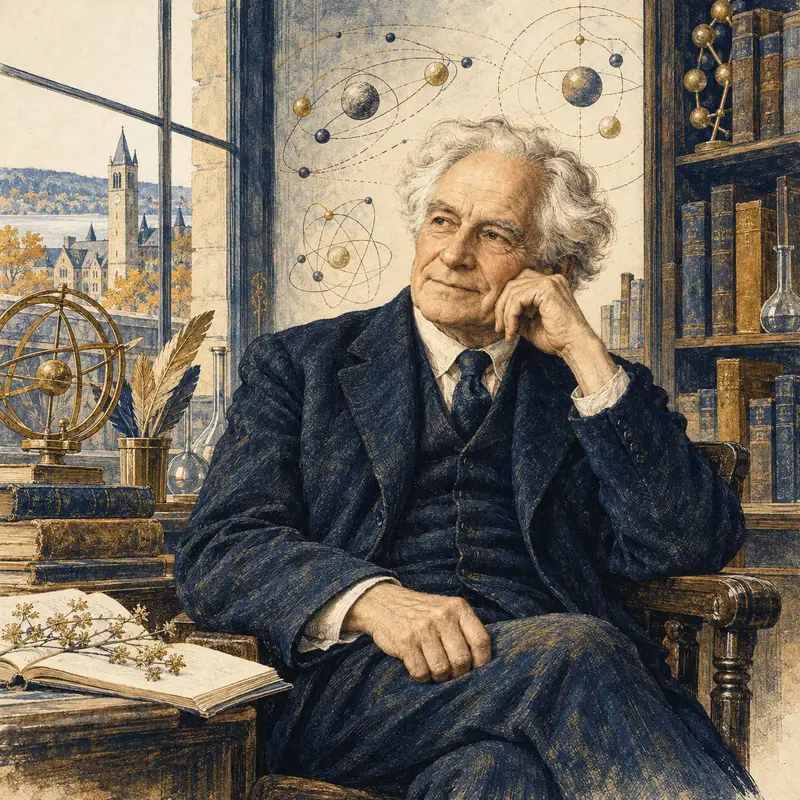
About the chemist
Roald Hoffmann
1937- · Poland/United States · Nobel Chemistry 1981
Woodward-Hoffmann rules; orbital symmetry