The discovery, explained · Chemist no. 56 of 350
The Isolobal Analogy: How Roald Hoffmann Linked Organic and Inorganic Chemistry
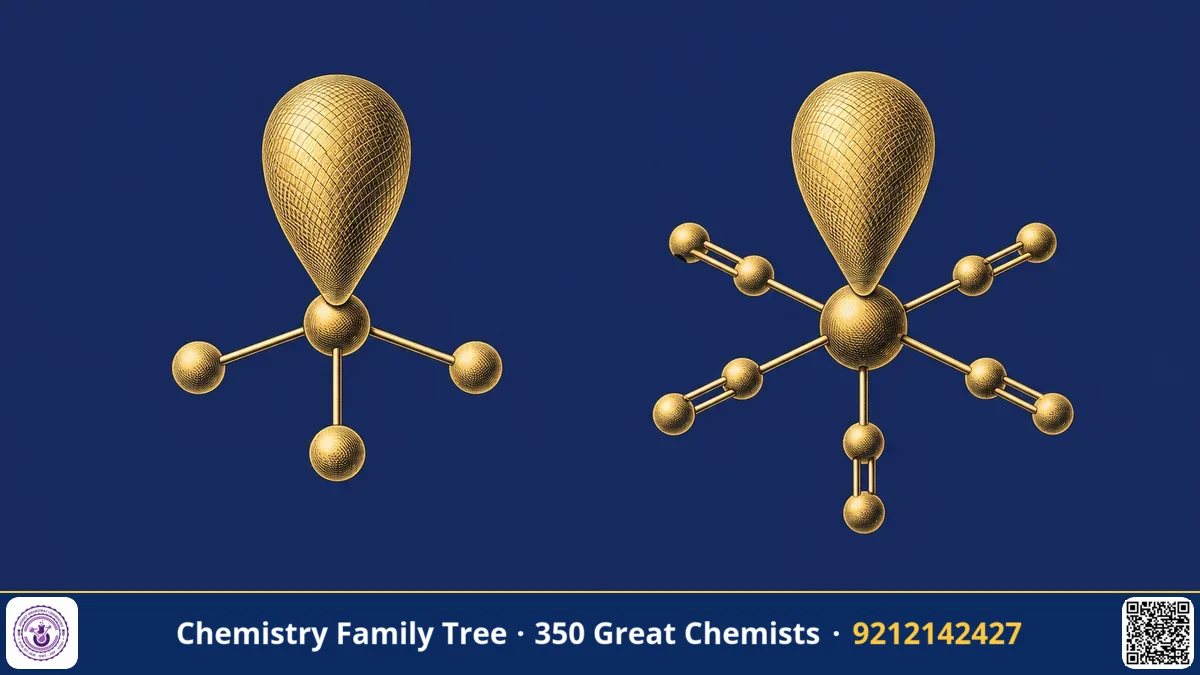
An organic chemist sees methane, ethane and cyclopropane. An inorganic chemist sees metal carbonyls, clusters and complexes. For a long time these two worlds seemed to speak different languages. Roald Hoffmann, who shared the 1981 Nobel Prize in Chemistry with Kenichi Fukui, built a bridge between them with a simple idea: the isolobal analogy. It says that a fragment such as CH3 and a fragment such as Mn(CO)5 have frontier orbitals of similar shape, symmetry and electron count, so they behave in similar ways. This idea is now a regular question topic in CSIR-NET and GATE inorganic chemistry. Hoffmann's computational method, called extended Hückel theory, is the tool that made it possible.
The Scientific Problem Before the Discovery
By the 1960s and 1970s, organometallic chemistry was growing very fast, thanks to ferrocene, metal carbonyls and metal clusters. But the structures and reactions of these compounds looked complicated. Organic chemistry had simple rules like valence bond ideas, hybridisation and the octet rule. Inorganic chemistry had crystal field theory and the 18-electron rule, but there was no easy way to see how one family of compounds was related to the other.
Chemists also needed a computational method that could handle large molecules containing metals. Accurate quantum mechanical calculations were too heavy for the computers of that time. A qualitative but reliable method was needed, one which could handle both organic and inorganic molecules and give a picture of bonding that chemists could understand.
The Discovery: Step by Step
- Extended Hückel method (1960s): Hoffmann developed a simple molecular orbital method based on Hückel's ideas but applied to all valence electrons, not just π electrons. It used overlap integrals and approximate orbital energies to give molecular orbital diagrams for molecules of any size. He used it in his work with R. B. Woodward on orbital symmetry and then on inorganic molecules.
- Fragment molecular orbital approach: Instead of calculating a big molecule at once, Hoffmann built it from smaller fragments, such as a metal with some ligands (MLn), and looked at how the frontier orbitals of fragments interact.
- The isolobal concept (1970s): By comparing fragments, he noticed that an organic fragment like CH3 and a metal fragment like Mn(CO)5 have a similar frontier orbital: one half-filled orbital pointing out in the direction of a missing ligand. He called such fragments isolobal.
- Nobel Lecture (1981): He summarised the idea in his lecture "Building Bridges Between Inorganic and Organic Chemistry".
The Chemistry Behind It
Definition
Two fragments are isolobal if the number, symmetry properties, approximate energy and shape of their frontier orbitals, and the number of electrons in them, are similar. The symbol is a double-headed arrow with a half circle, written as ←⊂→ in plain text.
Standard examples
| Organic fragment | Isolobal metal fragment | Electron count |
|---|---|---|
| CH3 (one singly occupied orbital) | Mn(CO)5, d7-ML5 | Each needs one electron to complete the shell |
| CH2 (two orbitals) | Fe(CO)4, d8-ML4 | Each needs two electrons |
| CH (three orbitals) | Co(CO)3, d9-ML3 | Each needs three electrons |
What does the analogy predict?
If two fragments are isolobal, they should form similar kinds of compounds. Therefore:
CH3-CH3            ←→   (CO)5Mn-Mn(CO)5       (dimer, M-M single bond)
CH3-Cl             ←→   (CO)5Mn-Cl
cyclopropane (CH2)3 ←→  Os3(CO)12 (three Os(CO)4 units in a triangle)
tetrahedrane (CH)4 ←→   Co4(CO)12 type cluster (four Co(CO)3 units)
Mn2(CO)10 has a Mn-Mn bond just like the C-C bond in ethane, and this is a textbook example. Another example is the alkyne complex Co2(CO)6(RC≡CR), where the two Co(CO)3 units, being isolobal with CH, make a tetrahedral C2Co2 core like tetrahedrane.
Why is it useful?
The analogy lets you apply organic intuition to inorganic and cluster chemistry. For example, the 18-electron rule for MLn fragments is equivalent to the octet rule for carbon. You can count how many electrons a fragment needs to reach the stable configuration and thereby predict how many bonds it makes. A d8 ML4 fragment acts like a carbene (CH2), so Fe(CO)4 can add to an alkene to form a metallacyclopropane-type structure, just as carbene adds to give cyclopropane.
Link to the Wade-Mingos rules
Hoffmann's fragment approach also supports the electron counting rules for clusters (Wade-Mingos rules), where a BH unit and metal fragments like Fe(CO)3 are treated as isolobal and contribute a similar number of skeletal electrons.
Applications Today
- Catalyst design: Organometallic catalysts for hydrogenation, hydroformylation and olefin metathesis are understood using fragment orbitals.
- Cluster chemistry: The relationship between boranes, carboranes and metal clusters is explained by the isolobal analogy.
- Solid-state chemistry: Hoffmann extended his approach to solids with band theory ideas, helping to explain structures of extended materials.
- Teaching: The isolobal idea is a way of teaching inorganic chemistry by using what students already know from organic chemistry.
- Computational chemistry: Extended Hückel calculations are still used for quick qualitative checks and for teaching molecular orbital theory.
Exam Corner
- CH3 is isolobal with Mn(CO)5 (d7-ML5); CH2 with Fe(CO)4 (d8-ML4); CH with Co(CO)3 (d9-ML3).
- Mn2(CO)10 is the organometallic analogue of ethane, with a Mn-Mn bond.
- Isolobal fragments have the same number, symmetry and shape of frontier orbitals and the same number of electrons in them.
- Hoffmann and Fukui shared the 1981 Nobel Prize for theories on the course of chemical reactions.
- Extended Hückel theory treats all valence electrons, unlike simple Hückel theory, which treats only π electrons.
Common Misconceptions
- "Isolobal means isoelectronic." Not the same. Isolobal fragments have similar frontier orbitals, but they can have different total electron counts.
- "Isolobal fragments are identical." They are only analogous, so they behave similarly, not identically.
- "Hoffmann's Nobel Prize was for the isolobal analogy." The 1981 prize was mainly for the theory of the course of chemical reactions, the orbital symmetry rules developed with Woodward. The isolobal analogy was the focus of his Nobel lecture.
Quick Revision Box
- Isolobal analogy: similar frontier orbitals in shape, symmetry, energy and electron occupation.
- d7-ML5 ≈ CH3; d8-ML4 ≈ CH2; d9-ML3 ≈ CH.
- Mn2(CO)10 ≈ ethane; Co2(CO)6(alkyne) ≈ tetrahedrane-type core.
- Extended Hückel method: all valence electrons included.
- Nobel Lecture 1981: "Building Bridges Between Inorganic and Organic Chemistry".
FAQ
What does isolobal mean?
Isolobal means "of equal lobes". Two fragments are isolobal when their frontier orbitals have similar shape, symmetry, energy and electron occupancy.
Why is Mn(CO)5 like CH3?
Mn(CO)5 is a 17-electron d7 fragment with a single half-filled orbital pointing toward the missing sixth ligand site, just like the singly occupied sp3-type orbital of the methyl radical.
What is extended Hückel theory?
It is a simple molecular orbital method that includes all valence orbitals and uses overlap and approximate energies to give orbital diagrams of molecules.
How is the isolobal analogy used in exams?
Questions typically ask you to identify isolobal pairs, predict the structure of clusters, or relate an organometallic compound to an organic analogue.
Published by ABC Chemistry — IIT-JAM | CSIR-NET | GATE Chemistry Coaching. Visit abcchemistry.com
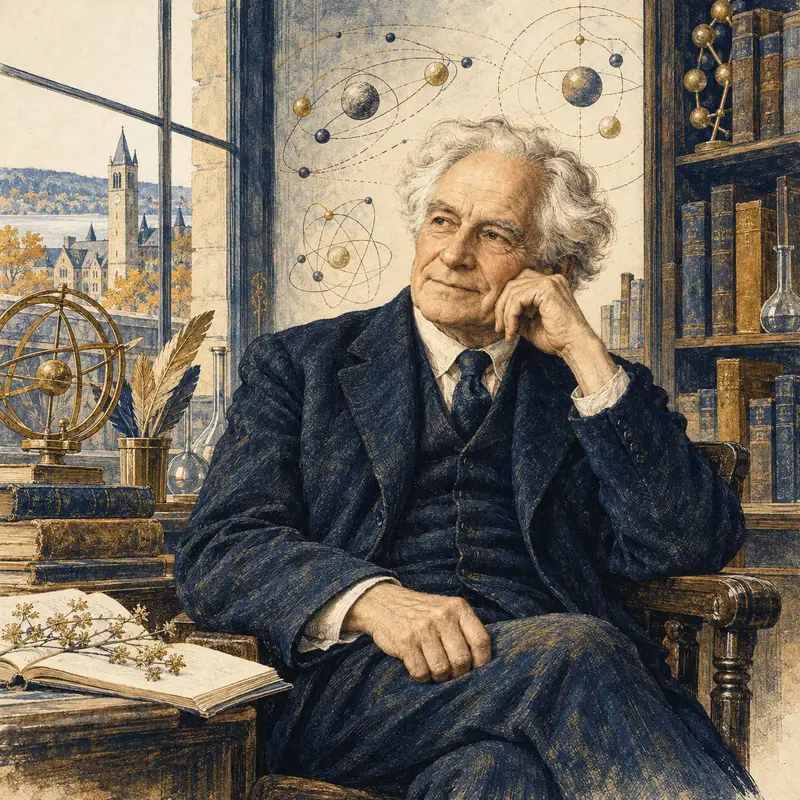
About the chemist
Roald Hoffmann
1937- · Poland/United States · Nobel Chemistry 1981
Woodward-Hoffmann rules; orbital symmetry