Biography · Chemist no. 253 of 350
Robert Wilhelm Bunsen (1811-1899): The Teacher and Experimenter of Heidelberg
Introduction
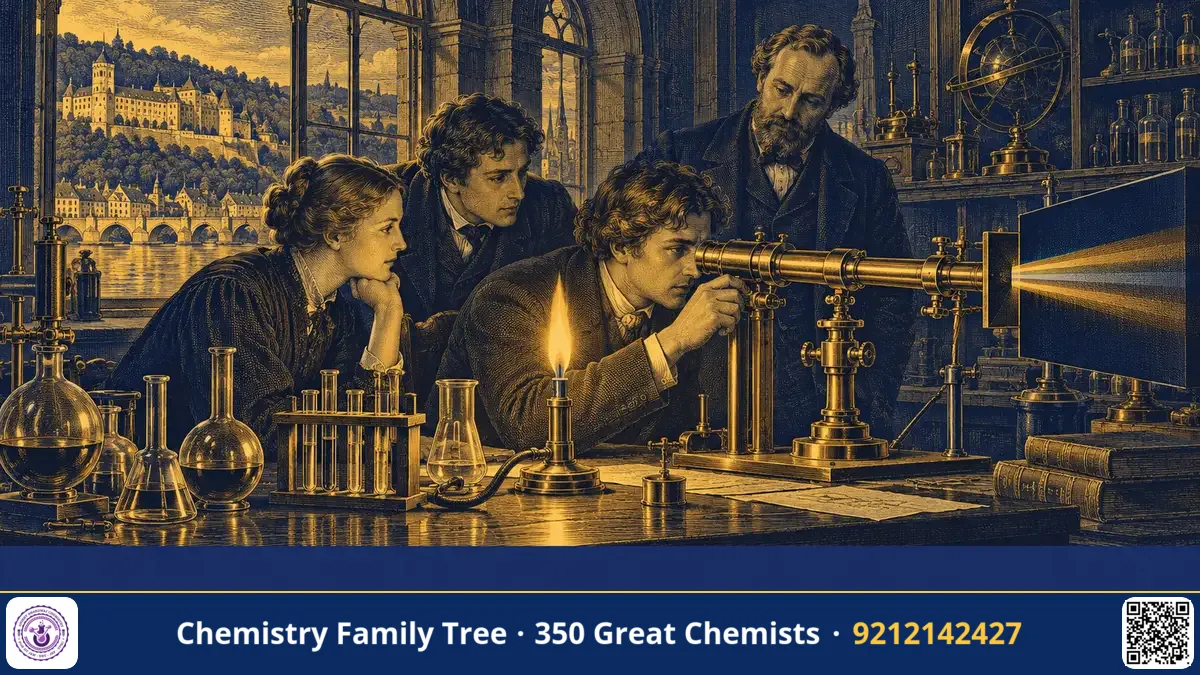
Robert Wilhelm Eberhard Bunsen was a German chemist whose name is known in every laboratory because of the Bunsen burner. He discovered caesium and rubidium with Kirchhoff, started spectrochemical analysis, invented the Bunsen cell, found an antidote for arsenic poisoning and trained many of the leading chemists of the next generation. His legacy in one line: a dedicated experimenter who gave chemistry its most familiar tools.
Early Life and Family
Bunsen was born on 31 March 1811 in Gottingen, Germany, the youngest of four sons. His father, Christian Bunsen, was professor and chief librarian at the University of Gottingen, a scholar of modern languages. The boy grew up in the atmosphere of a university town and went to school in Holzminden, where he attended the gymnasium. He was not married and spent his life in the laboratory, a fact often noted by his biographers.
Education and Mentors
Bunsen studied chemistry, physics, mineralogy and mathematics at the University of Gottingen from 1828 and took his doctorate in 1830, at the age of 19. He then received a government grant to travel. During 1832-1833 he visited Paris, where he met Gay-Lussac and others, and Berlin, where he met Mitscherlich, and he worked with Runge, who had discovered carbolic acid and aniline in coal tar. In Gottingen he had been taught by Friedrich Stromeyer, who discovered cadmium, and he had contacts with Wohler. These journeys made him familiar with the leading chemical laboratories of Europe.
Career Timeline
| Year | Event |
|---|---|
| 1811 | Born in Gottingen |
| 1830 | Doctorate, University of Gottingen |
| 1834 | Shows hydrated iron(III) oxide is an antidote to arsenic poisoning |
| 1836 | Teaches at the Polytechnic School at Kassel (succeeding Wohler) |
| 1838 | Professor at Marburg; works on cacodyl compounds |
| 1841 | Invents the Bunsen cell |
| 1846 | Travels to Iceland to study volcanic rocks and geysers |
| 1851 | Professor at Breslau |
| 1852 | Professor at Heidelberg, succeeding Leopold Gmelin |
| 1855 | Bunsen burner developed with Desaga |
| 1859-1861 | Spectral analysis with Kirchhoff; discovery of caesium and rubidium |
| 1889 | Retires from teaching |
| 1899 | Dies in Heidelberg on 16 August |
Major Scientific Contributions
- Cacodyl compounds (1837-1843): Study of arsenic-methyl compounds, among the early organometallic substances. These compounds are foul smelling and highly poisonous, and an explosion during this work cost Bunsen the sight of one eye.
- Arsenic antidote (1834): Freshly precipitated hydrated iron(III) oxide adsorbs and binds arsenic compounds in the stomach.
- Bunsen cell (1841): A cheaper alternative to the platinum used in Grove's cell, using a carbon electrode with zinc.
- Gas analysis and volcanic studies: He studied blast-furnace gases, the Icelandic geysers (with a theory of geyser action), and the chemistry of volcanic rocks.
- Photochemistry: With Henry Roscoe, he showed that the combination of hydrogen and chlorine under light depends on the product of intensity and time (the Bunsen-Roscoe reciprocity law).
- Spectroscopy: Spectral analysis with Kirchhoff, and the discovery of Cs and Rb.
- Laboratory tools: The burner, the filter pump, the grease-spot photometer, the ice calorimeter and others.
Bunsen-Roscoe law:  photochemical effect = I x t   (H2 + Cl2 -> 2 HCl under light)
As2O3 + hydrated Fe2O3 (adsorbs arsenic, insoluble complex)
Awards, Honours and Nobel Prize
Bunsen received the Copley Medal of the Royal Society in 1860. With Kirchhoff he shared the Davy Medal in 1877. He was elected a Foreign Member of the Royal Society and a member of many academies. He lived until 1899 and so saw the first Nobel Prize announcements only after his death; he did not receive one.
Personality, Struggles and Lesser-Known Facts
- He never married and gave his whole life to his work and students. He was known as a kindly man, loved by his students.
- His laboratory work was dangerous. Besides losing the sight in one eye from an explosion of cacodyl cyanide, he was also seriously poisoned by arsenic compounds at one time.
- He was famously indifferent to theory and writing. He published little compared with his influence, and he was said to prefer the practical side of chemistry.
- He did not patent the burner, and he allowed Desaga to manufacture it, so that it spread rapidly to other laboratories.
- Among those who studied in his Heidelberg laboratory were Henry Roscoe, Edward Frankland, Hermann Kolbe, Lothar Meyer, Dmitri Mendeleev for a time, Adolf von Baeyer and Victor Meyer.
Legacy and Influence on Modern Chemistry
Bunsen's laboratory at Heidelberg became one of the main centres of chemistry in Europe, and his students spread his methods around the world. Spectral analysis found helium in the Sun, thallium, indium, gallium and other elements, and led astronomers to determine the composition of stars. The caesium atomic clock is based on an element that he discovered. The Bunsen burner is a symbol of the chemistry laboratory. In Heidelberg, the street and institute carry his name, and in Germany the Bunsen Society for physical chemistry is named for him.
Lessons for Students
- Good tools make discoveries possible. A better flame led to a new science.
- Work together. His partnership with Kirchhoff, a physicist, combined two kinds of skill.
- Be careful in the laboratory. Bunsen's injuries show why safety is important.
- Share your ideas freely. He gave away the design of his burner, and it spread worldwide.
Quick Facts Box
- Born: 31 March 1811, Gottingen, Germany
- Died: 16 August 1899, Heidelberg, Germany
- Nationality: German
- Field: Chemistry, spectroscopy, photochemistry
- Famous for: Bunsen burner; spectral analysis; caesium and rubidium
- Nobel Prize: None; Copley Medal 1860
FAQ
What is Bunsen famous for?
He is famous for the Bunsen burner, for the discovery of caesium and rubidium and for starting spectroscopic analysis with Kirchhoff.
How did Bunsen lose his eye?
An explosion of an arsenic compound, cacodyl cyanide, in his laboratory cost him the sight of one eye.
Who were Bunsen's famous students?
They included Henry Roscoe, Edward Frankland, Hermann Kolbe, Lothar Meyer and Adolf von Baeyer.
Did Bunsen win a Nobel Prize?
No. He died in 1899, two years before the Nobel Prizes were first awarded.
Published by ABC Chemistry — IIT-JAM | CSIR-NET | GATE Chemistry Coaching. Visit abcchemistry.com
About the chemist
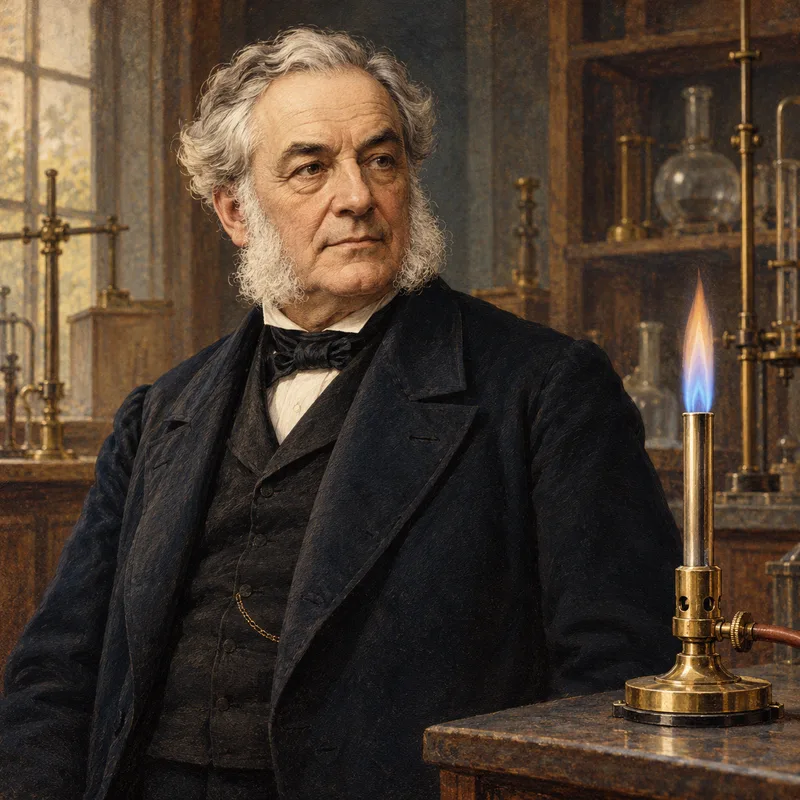
Robert Bunsen
1811-1899 · Germany
Bunsen burner; spectroscopy; discovered Cs and Rb