The discovery, explained · Chemist no. 253 of 350
Robert Bunsen: The Burner, the Spectroscope and Two New Elements
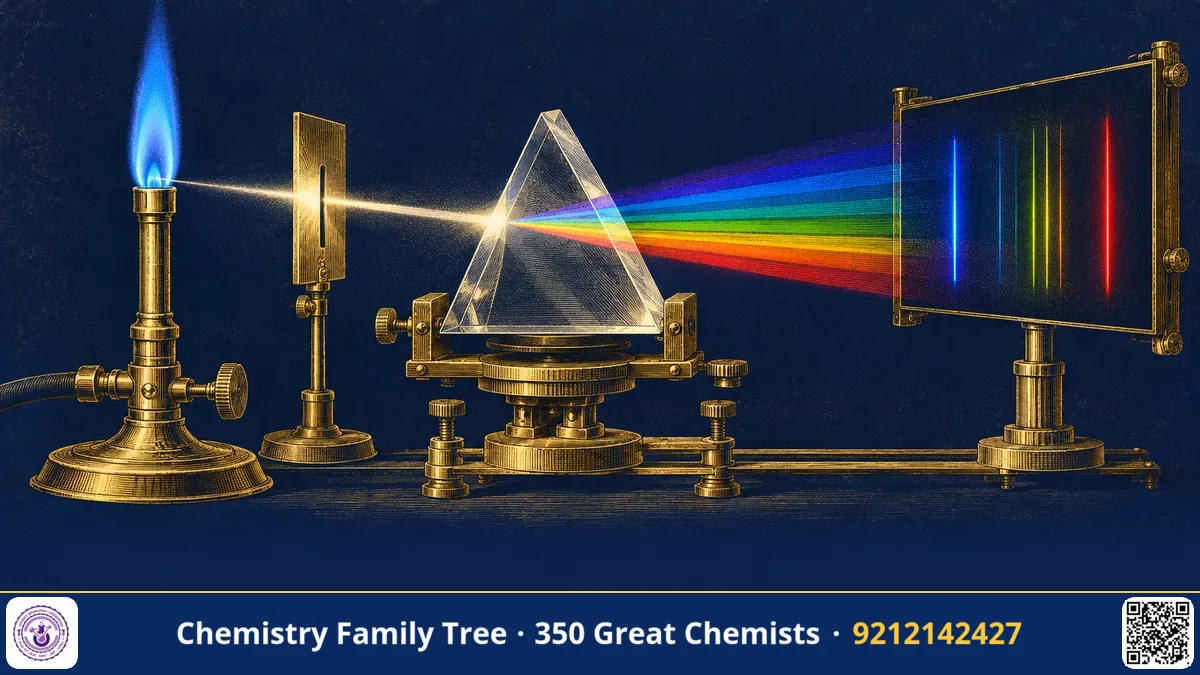
Every chemistry laboratory in India, from school to university, has a Bunsen burner. The clean, hot, nearly colourless flame made by this simple device allowed chemists to see the colours of metal salts. With his colleague Gustav Kirchhoff, Robert Wilhelm Bunsen (1811-1899) used this flame together with a prism to start spectroscopic analysis in 1859-1860, and using the new method they discovered two new elements: caesium (1860) and rubidium (1861). Bunsen also invented the zinc-carbon cell that carries his name, an antidote to arsenic poisoning and many laboratory tools. In this post we look at the burner, the flame tests, the discovery of the two alkali metals and the exam points.
The Scientific Problem Before the Discovery
In the 1850s the laboratory flame was a problem for analysis. Alcohol lamps and ordinary gas lamps gave flames that were luminous and sooty. Their own bright yellow light covered the colours given by metal salts in the flame. Chemists using the flame test to identify elements, a practice going back to Marggraf in the 1750s, found it hard to see weak colours.
There was also a problem of identification. Sodium gives an intense yellow colour, which hides the lilac of potassium and the crimson of lithium. Chemists had no instrument to separate overlapping colours, and very small amounts of a new element in a mineral or spring water could never be detected by normal wet analysis.
The Discovery / Experiment
1. The Bunsen burner (1855)
Working at Heidelberg with the instrument maker Peter Desaga, Bunsen improved the design of burners earlier used by Faraday and others. Gas enters at the base through a small jet and rises up a vertical tube. Air enters through adjustable holes near the base, and the gas and air mix in the barrel before burning at the top.
- Air hole closed: a yellow, luminous, sooty flame that is cooler, due to incomplete combustion; glowing carbon particles give the yellow light.
- Air hole open: a blue, non-luminous flame with a hotter temperature of about 1500 C in the hottest zone, with complete combustion.
Complete combustion (blue flame):    CH4 + 2 O2 -> CO2 + 2 H2O
Incomplete combustion (yellow):      CH4 + O2 -> C (soot) + 2 H2O
The blue flame has an inner cone of unburnt gas and air, a middle zone of partial combustion, and an outer zone where combustion is complete, which is the hottest. In qualitative analysis, the inner zone is reducing and the outer zone oxidising.
2. Flame spectroscopy (1859-1860)
Bunsen realised that his nearly colourless flame could be used to study the light given by metals. Kirchhoff suggested viewing the flame light through a prism, and the two built a spectroscope: a collimator slit, a prism and a viewing telescope. Each element, heated in the flame, gave its own set of bright lines. This gave a unique "fingerprint" of the element, and very small amounts were enough.
| Element (salt) | Flame colour |
|---|---|
| Lithium | Crimson red |
| Sodium | Golden yellow |
| Potassium | Lilac (violet) |
| Calcium | Brick red |
| Strontium | Crimson / scarlet |
| Barium | Apple green |
| Copper | Blue-green |
3. Caesium (1860) and rubidium (1861)
Bunsen examined the mineral water from Durkheim in the Rhine region. Using the spectroscope, he saw two blue lines that did not belong to any known element. To get enough material, he evaporated about 44,000 litres of the water. He separated the alkali metals from the other salts by precipitation (for example, the removal of calcium, strontium and barium as carbonates and oxalates), and then separated the new element as the chloroplatinate, which is sparingly soluble. He named it caesium from the Latin caesius, sky blue.
The following year, in the mineral lepidolite, he found a new element that gave two deep red lines at the far end of the spectrum. He named it rubidium, from rubidus, dark red.
Cs: strong blue lines near 455.5 nm and 459.3 nm      (caesius = sky blue)
Rb: deep red lines near 780 nm and 795 nm              (rubidus = deep red)
Separation: M2PtCl6 (M = K, Rb, Cs) is sparingly soluble in water
The Chemistry Behind It
When a salt is placed in a flame, the heat gives energy to the atoms. An electron in the outer shell absorbs energy and jumps to a higher level (excited state). When it falls back, it releases energy as light of a definite wavelength, since the energy gap between levels is fixed.
E = h x nu = h c / lambda        (energy of the emitted photon)
Na: 3p -> 3s transition gives the D lines near 589 nm (yellow)
The alkali and alkaline earth metals show the effect strongly because their valence electrons are easily excited by the flame's temperature. Every element has its own set of energy levels, so each gives its own pattern. This is the basis of atomic emission spectroscopy, and the connection with the line spectra later explained by Bohr's model for hydrogen.
Caesium and rubidium are alkali metals of group 1, with a very low ionisation energy (Cs 376 kJ/mol, Rb 403 kJ/mol), and are strongly electropositive. Caesium is the most electropositive stable element, reacts explosively with water, and melts at about 28.4 C, so it is nearly liquid at room temperature.
2 Cs + 2 H2O -> 2 CsOH + H2 (violent)
Applications Today
- Bunsen burner: Still used for heating, sterilising loops in microbiology, flame tests and glassworking in labs all over India.
- Atomic clocks: The second is defined using the microwave transition of caesium-133 atoms at 9,192,631,770 Hz. Indian national standards labs use caesium clocks for time keeping.
- Atomic absorption and emission spectroscopy: Modern AAS, flame photometry and ICP-OES that measure sodium and potassium in blood, soil and water descend from Bunsen and Kirchhoff's method.
- Rubidium and caesium compounds: Used in photocells, special glass, drilling fluids (caesium formate) and in quantum research.
- Bunsen cell and photometer: Bunsen's carbon-zinc cell was used in early telegraphs and electroplating, and his grease-spot photometer measured light intensity.
Exam Corner
- Flame colours: Li crimson, Na golden yellow, K lilac, Ca brick red, Sr crimson, Ba apple green, Cu blue-green.
- Cs and Rb were the first elements discovered by spectroscopy (Bunsen and Kirchhoff, 1860-1861); name Cs from Latin for sky blue, Rb from deep red.
- Bunsen burner: with air holes open, blue non-luminous flame (complete combustion); closed, yellow luminous flame.
- Cobalt glass filters out the strong yellow of sodium so that potassium's lilac can be seen.
- Emission lines arise from electronic transitions from higher to lower energy levels: E = hc/lambda.
Common Misconceptions
- "Bunsen alone invented the burner." Earlier designs existed (Faraday), and the instrument maker Peter Desaga built the Heidelberg version with Bunsen.
- "Flame colour comes from the burning of the metal." It comes from emission by excited electrons returning to lower energy levels.
- "Sodium colour proves sodium is the main component." Sodium is so sensitive that traces give a strong yellow, which is why cobalt glass is used.
Quick Revision Box
- Robert Bunsen (1811-1899), German chemist, Heidelberg.
- 1855: Bunsen burner (with Desaga).
- 1859-1860: spectroscopy with Kirchhoff; Cs (1860), Rb (1861).
- Flame test colours: Li crimson, Na yellow, K lilac, Ca brick red, Ba green.
- Emission: E = hc/lambda from electron transitions.
- Caesium clock defines the second.
FAQ
Why is the Bunsen flame blue?
With air mixed in, the gas burns completely at high temperature without glowing carbon particles, so the flame is blue and non-luminous.
Why were caesium and rubidium found by spectroscopy?
They occur in very small amounts, so wet chemistry would have missed them. The distinct spectral lines revealed them.
Why is cobalt glass used in the potassium flame test?
It absorbs the yellow light of sodium impurities so that the lilac colour of potassium can be seen.
How does a flame test work?
Heat excites electrons of the metal atoms, and when they return to the ground state they emit light of specific colour.
Published by ABC Chemistry — IIT-JAM | CSIR-NET | GATE Chemistry Coaching. Visit abcchemistry.com
About the chemist
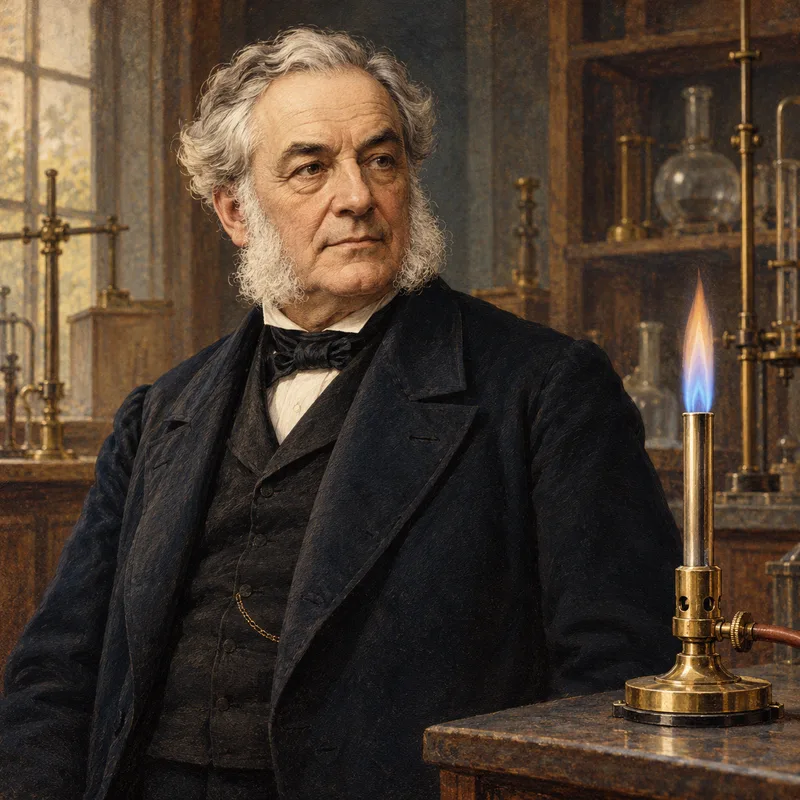
Robert Bunsen
1811-1899 · Germany
Bunsen burner; spectroscopy; discovered Cs and Rb