Biography · Chemist no. 55 of 350
Robert Burns Woodward: The Life of the Master of Organic Synthesis
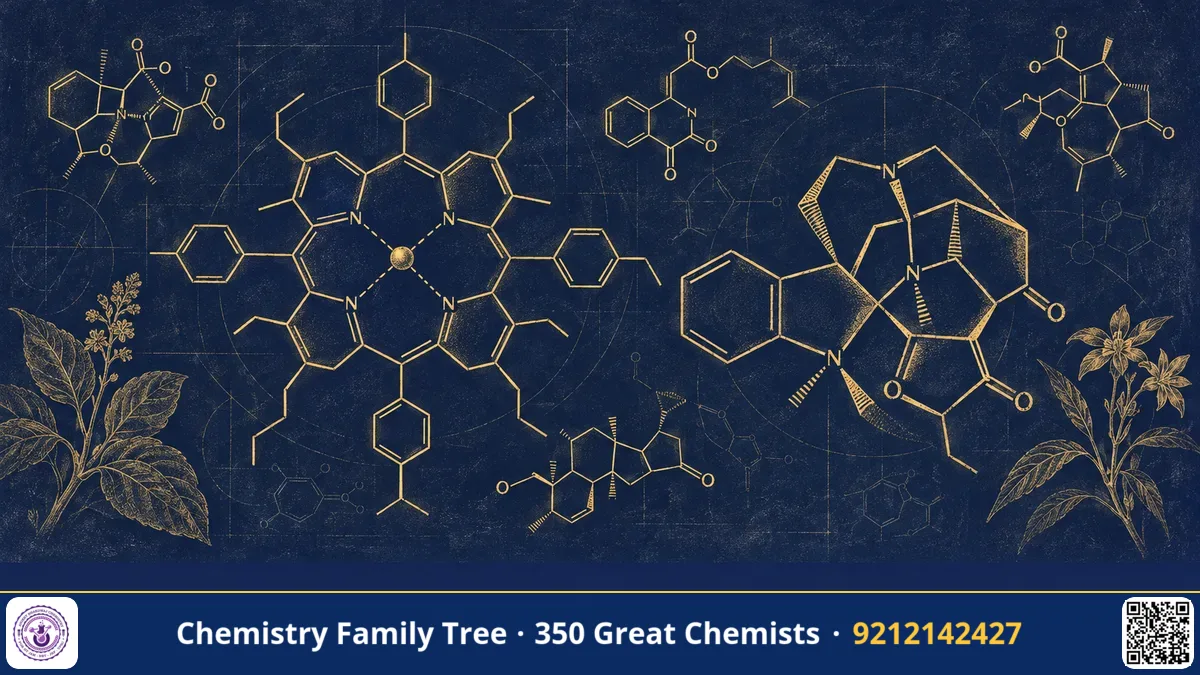
Robert Burns Woodward (1917-1979) is often called the greatest organic chemist of the twentieth century. He made complex natural products in the laboratory at a time when many people thought this was almost impossible, and he did it with logic, planning and an exceptional memory. Quinine, cholesterol, cortisone, strychnine, reserpine, chlorophyll and vitamin B12 are among his famous targets. He received the Nobel Prize in Chemistry in 1965, and together with Roald Hoffmann he formulated the Woodward-Hoffmann rules. This biography describes his life, work and personality, and what students can learn from him.
Early Life and Family
Woodward was born on 10 April 1917 in Boston, Massachusetts, USA. His father died when he was very young, and he was raised mainly by his mother in the Boston area. From childhood he was fascinated by chemistry. As a boy he did experiments at home, read advanced chemistry books and wrote to chemical companies to obtain samples and information. His love for the subject was visible well before college.
Education and Mentors
Woodward entered the Massachusetts Institute of Technology (MIT) in 1933. He was so far ahead of his classmates that he skipped much routine coursework and was, at one stage, asked to leave for neglecting classes he found unnecessary, but he was readmitted. He completed his Bachelor's degree in 1936 and his PhD in 1937, at the age of twenty, an extraordinary achievement. His doctoral work was done in the MIT department under James Flack Norris. He then went to Harvard University, first as a junior fellow, and stayed there for the rest of his career. At Harvard he mentored a remarkable group of students and postdoctoral fellows, many of whom became leaders of chemistry themselves. Roald Hoffmann, a Nobel laureate, worked closely with him in the 1960s.
Career Timeline
| Year | Event |
|---|---|
| 1917 | Born in Boston, Massachusetts (10 April) |
| 1936-1937 | Bachelor's and PhD at MIT |
| 1937 | Joined Harvard University |
| 1944 | Formal synthesis of quinine with William Doering |
| 1951 | Total synthesis of cholesterol and cortisone |
| 1952 | Proposed the sandwich structure of ferrocene with Wilkinson and co-workers |
| 1954 | Synthesis of strychnine and lysergic acid |
| 1956 | Synthesis of reserpine |
| 1960 | Synthesis of chlorophyll a |
| 1963 | Woodward Research Institute set up in Basel, Switzerland |
| 1965 | Nobel Prize in Chemistry; Woodward-Hoffmann rules begin |
| 1972 | Vitamin B12 completed with Albert Eschenmoser's group |
| 1979 | Died in Cambridge, Massachusetts (8 July) |
Major Scientific Contributions
1. Total synthesis as an art and a science
Woodward showed that very complicated molecules could be made rationally, step by step, if each step was planned using a deep understanding of mechanism and stereochemistry. His syntheses included quinine (a malaria drug), cholesterol and cortisone (steroids), strychnine, lysergic acid, reserpine (used in treatment of high blood pressure), colchicine, chlorophyll a, cephalosporin C and vitamin B12, one of the most complex molecules synthesised at that time.
2. Structure determination
Before modern spectroscopy was routine, Woodward worked out structures of natural products like strychnine and terramycin by reasoning and degradation. He also correctly proposed the sandwich structure of ferrocene, Fe(C5H5)2, with Geoffrey Wilkinson and others, which began modern organometallic chemistry. He suggested the name "ferrocene".
3. Woodward rules for UV spectra
The empirical Woodward (and later Woodward-Fieser) rules calculate the λmax of conjugated dienes and enones from a base value plus increments for substituents. They are a standard exam topic:
Diene: base value (heteroannular) 214 nm, (homoannular) 253 nm
+ 5 nm per alkyl substituent, + 5 nm per exocyclic double bond, + 30 nm per extended conjugation
4. Woodward-Hoffmann rules
With Hoffmann, he explained the stereochemistry of electrocyclic reactions, cycloadditions and sigmatropic shifts through conservation of orbital symmetry. See our companion post for tables and examples.
Awards, Honours and Nobel Prize
Woodward received the Nobel Prize in Chemistry in 1965 "for his outstanding achievements in the art of organic synthesis". He also received many other honours, including the Davy Medal of the Royal Society (1959), the US National Medal of Science (1964), the Copley Medal (1978) and the Wolf Prize in Chemistry (1978), and he was a foreign member of the Royal Society. After his death in 1979 the prize for that work, awarded in 1981, went to Hoffmann and Kenichi Fukui, since Nobel Prizes are not awarded after death.
Personality, Struggles and Lesser-Known Facts
- PhD at twenty: He finished MIT's doctoral requirements at 20, an age at which most students are still in undergraduate classes.
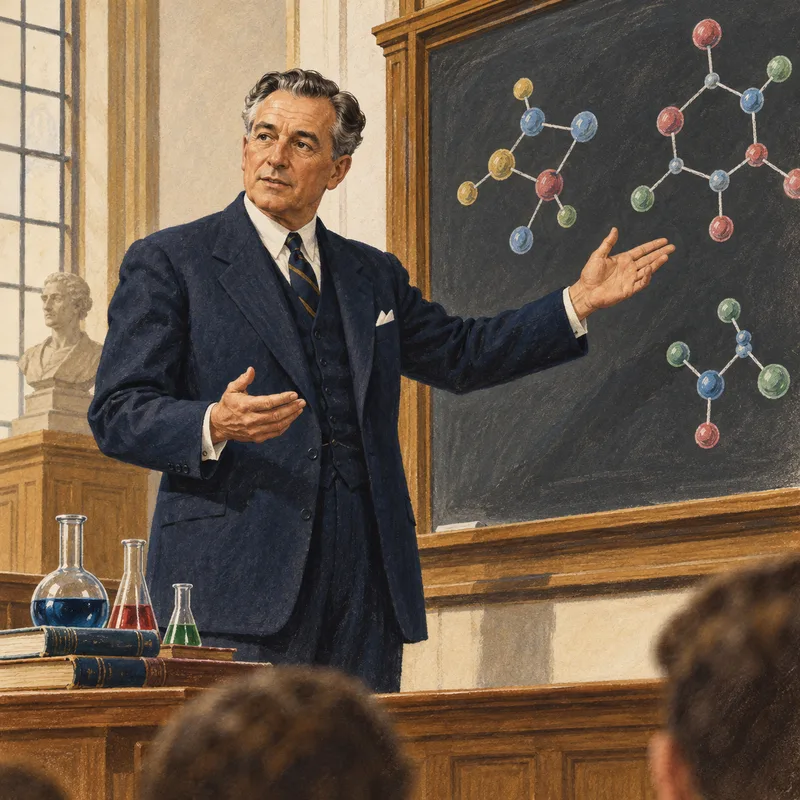
- Famous lectures: His lectures at Harvard were legendary. He often spoke for three hours or more with coloured chalk, drawing complex structures from memory without notes.
- Blue suits and cigarettes: He was known for wearing blue and for being a heavy smoker, a habit common among scientists of that time but one that today's students should not imitate.
- Industry connections: He worked as a consultant for companies such as Pfizer and used industrial support to fund large projects. The B12 project involved dozens of co-workers over about a decade.
- International institute: The Woodward Research Institute in Basel was established with support from Ciba, giving him a European base for his research.
- Demanding but inspiring: Former students describe him as demanding in the laboratory and very generous with ideas. His group worked long hours, and his standards of purity and proof were extremely high.
Legacy and Influence on Modern Chemistry
Woodward changed the culture of organic chemistry. Before him, synthesis of a complex natural product was seen as an almost heroic act; after him it became a field based on logic. His students and "academic grandchildren" fill the faculty lists of universities across the world, including India, where his name is familiar in every organic chemistry class through the Woodward rules of UV spectroscopy and the Woodward-Hoffmann rules. Later chemists such as E. J. Corey took synthesis further with retrosynthetic analysis. The 21st-century approach to synthesis, stressing efficiency and green chemistry, is built on the foundation Woodward laid.
Lessons for Students
- Master the fundamentals: Woodward's success came from deep knowledge of mechanisms and stereochemistry, the same topics you study for JAM and NET.
- Be curious early: He began experimenting as a child. Start your own small projects.
- Plan before you act: His syntheses were planned in detail before the first flask was taken out.
- Share credit and learn from observations: The Woodward-Hoffmann rules came from the partnership of an experimentalist and a theoretician, with a surprising observation in a B12 intermediate as the spark.
Quick Facts Box
- Born: 10 April 1917, Boston, Massachusetts, USA
- Died: 8 July 1979, Cambridge, Massachusetts, USA
- Nationality: American
- Field: Organic chemistry, total synthesis
- Famous for: Synthesis of quinine, cholesterol, cortisone, strychnine, chlorophyll, vitamin B12; Woodward-Hoffmann rules; Woodward rules for UV
- Nobel Prize: Chemistry 1965
FAQ
Why did R. B. Woodward win the Nobel Prize?
The 1965 prize was awarded for his outstanding achievements in the art of organic synthesis, including steroids, alkaloids, chlorophyll and other complex natural products.
Did Woodward synthesise vitamin B12?
Yes. Vitamin B12 was completed in 1972 through a joint effort between Woodward's group at Harvard and Albert Eschenmoser's group at ETH Zurich.
What are Woodward's rules in spectroscopy?
They are empirical rules that predict the UV absorption maximum of conjugated dienes and α,β-unsaturated carbonyl compounds using a base value plus substituent increments.
Which famous students worked with Woodward?
Roald Hoffmann, who won the 1981 Nobel Prize, collaborated closely with him on the orbital symmetry rules, and many other leading chemists trained in his group.
Published by ABC Chemistry — IIT-JAM | CSIR-NET | GATE Chemistry Coaching. Visit abcchemistry.com
About the chemist
Robert Burns Woodward
1917-1979 · United States · Nobel Chemistry 1965
Total synthesis; Woodward-Hoffmann rules