The discovery, explained · Chemist no. 55 of 350
The Woodward-Hoffmann Rules: Why Some Reactions Go One Way and Not the Other
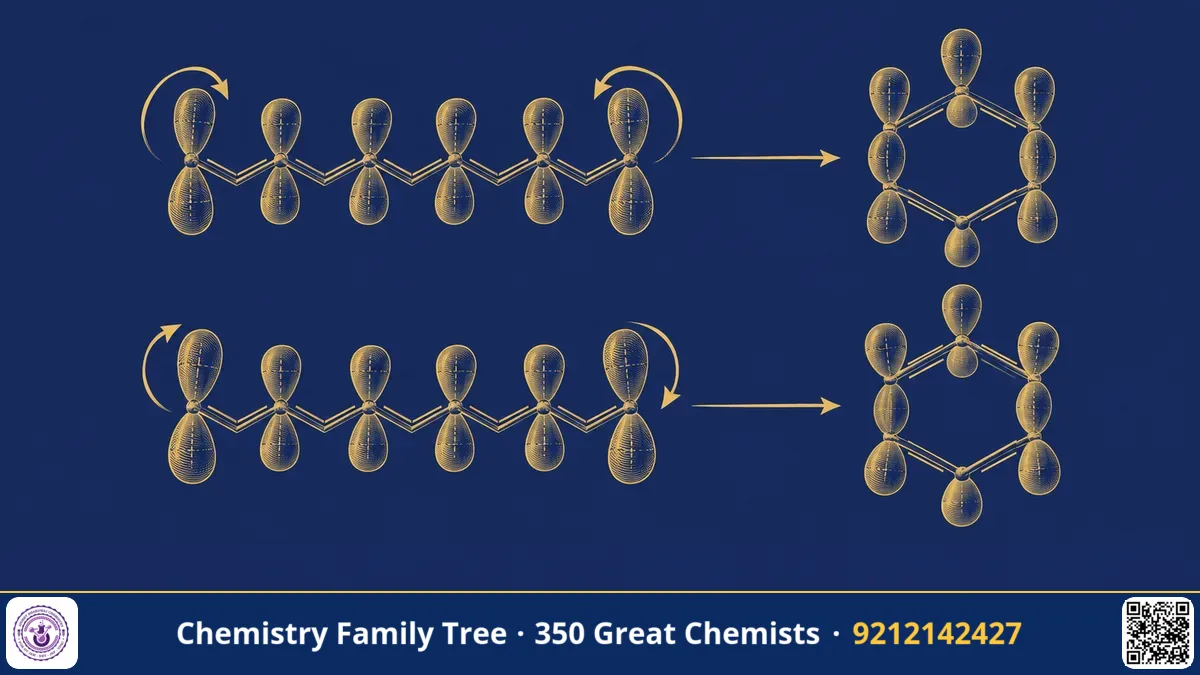
Why does cis-3,4-dimethylcyclobutene open on heating to give only one particular diene, and a different one when exposed to light? For decades organic chemists observed such stereochemical results without any general explanation. In the mid-1960s, Robert Burns Woodward and Roald Hoffmann at Harvard put forward a simple and powerful idea: in concerted reactions, the symmetry of the molecular orbitals must be conserved. These are the Woodward-Hoffmann rules. They explain electrocyclic reactions, cycloadditions and sigmatropic rearrangements, and they are a core topic for IIT-JAM, CSIR-NET and GATE. Woodward had already won the Nobel Prize in 1965 for synthesis; Hoffmann shared the 1981 Nobel Prize with Kenichi Fukui for these theories.
The Scientific Problem Before the Discovery
By the early 1960s chemists knew many pericyclic reactions: reactions in which bonds break and form in a single, concerted step through a cyclic transition state, with no ionic or radical intermediate. The Diels-Alder reaction, the Cope rearrangement and the Claisen rearrangement are examples. The puzzle was their stereochemistry. For instance, heating a cyclobutene gives a butadiene stereospecifically, but why one geometry and not the other? And why do the same molecules behave differently under light? Existing theories of reactivity based on charges or radicals could not answer these questions.
The Discovery: Step by Step
- Observation during vitamin B12 synthesis: While working on the total synthesis of vitamin B12, Woodward noticed that the stereochemistry of a ring-opening of a cyclobutene could not be explained by usual ideas. He later described this as the starting point for the new theory.
- Analysis with orbitals: Woodward and Hoffmann, who was a theoretical chemist, used extended Hückel calculations and orbital symmetry arguments. They looked at the highest occupied molecular orbital (HOMO) of the open-chain polyene.
- The key idea: A concerted reaction proceeds smoothly only if the symmetry of the occupied orbitals of the reactant is maintained all the way to the product. If not, the reaction has a high barrier and is "forbidden".
- Publication: They published a series of papers in 1965, and a detailed monograph The Conservation of Orbital Symmetry in 1970.
The Chemistry Behind It
1. Electrocyclic reactions
An electrocyclic reaction is the ring closure of a conjugated polyene (or the reverse ring opening). The ends of the π system rotate to form a σ bond. They can rotate in the same direction (conrotatory) or in opposite directions (disrotatory).
| Number of π electrons | Thermal (heat) | Photochemical (light) |
|---|---|---|
| 4n (e.g. 4, 8) | Conrotatory | Disrotatory |
| 4n + 2 (e.g. 2, 6, 10) | Disrotatory | Conrotatory |
Examples:
cis-3,4-dimethylcyclobutene --heat--> (E,Z)-2,4-hexadiene   (4 e-, conrotatory)
cis-3,4-dimethylcyclobutene --light--> (E,E)-2,4-hexadiene  (4 e-, disrotatory)
(E,Z,E)-2,4,6-octatriene --heat--> cis-5,6-dimethylcyclohexa-1,3-diene (6 e-, disrotatory)
The reason: in thermal reactions, the HOMO of the ground state controls the rotation. For butadiene the HOMO (ψ2) has opposite phases at the two terminals, so a bonding σ interaction forms only if the ends rotate in the same direction (conrotatory). For hexatriene the HOMO (ψ3) has the same phase at the two ends, so disrotatory motion is needed. Under light, an electron is promoted, so the new HOMO is the next orbital and the rule reverses.
2. Cycloaddition reactions
| Type | Electrons | Thermal | Photochemical |
|---|---|---|---|
| [4+2] (Diels-Alder) | 6 | Allowed (suprafacial-suprafacial) | Forbidden |
| [2+2] | 4 | Forbidden (s,s) | Allowed (s,s) |
This is why the Diels-Alder reaction goes simply on warming, while the [2+2] dimerisation of alkenes needs UV light. The general rule: a thermal cycloaddition with 4n+2 electrons is allowed when all components are suprafacial.
3. Sigmatropic rearrangements
In a [i,j] sigmatropic shift a σ bond migrates across a π system. A thermal [1,5] hydrogen shift in a cyclopentadiene or a pentadiene is suprafacial and allowed (6 electrons). A thermal [1,3] hydrogen shift is forbidden for suprafacial migration. The Cope and Claisen rearrangements are [3,3] shifts, allowed thermally through a chair-like transition state.
The general selection rule
A ground-state pericyclic change is symmetry-allowed when the total number of (4q+2)s and (4r)a components is odd. Photochemical changes follow the opposite rule. For exam purposes, most students use the simplified tables above together with frontier orbital (HOMO-LUMO) arguments, which are Fukui's contribution.
Applications Today
- Predicting stereochemistry: Synthetic chemists use the rules to plan ring closures and cycloadditions in natural product synthesis.
- Vitamin D chemistry: Previtamin D converts to vitamin D3 by a thermal [1,7] sigmatropic hydrogen shift; ring opening of 7-dehydrocholesterol under UV light is an electrocyclic process. This links the rules to biology and sunlight.
- Drug synthesis: Diels-Alder, Cope and Claisen reactions are routinely used to make intermediates.
- Photochromic materials: Spiropyrans and diarylethenes used in smart lenses and switches work by photochemical electrocyclic ring opening and closing.
- Computational chemistry: The rules inspired later work on reaction pathways and are built into modern teaching of mechanisms.
Exam Corner
- Thermal 4n electrons: conrotatory. Thermal 4n+2 electrons: disrotatory. Photochemical: opposite.
- Thermal [4+2] is allowed; thermal [2+2] is forbidden; photochemical [2+2] is allowed.
- Thermal [1,5] H shift is suprafacial; thermal [1,3] H shift is forbidden suprafacially; [3,3] shifts (Cope, Claisen) are allowed.
- Thermal ring opening of cis-3,4-dimethylcyclobutene gives (E,Z)-hexa-2,4-diene; of trans gives (E,E).
- Woodward-Hoffmann rules are based on conservation of orbital symmetry; Fukui's approach is based on the HOMO-LUMO interaction.
Common Misconceptions
- "Forbidden means impossible." Forbidden reactions have a high energy barrier and may happen by other (stepwise) routes at higher temperatures.
- "The rules apply to all reactions." They apply to concerted pericyclic reactions only, not to ionic or radical stepwise reactions.
- "Woodward alone got the Nobel for this." Woodward died in 1979. The 1981 Nobel Prize for the theory went to Hoffmann and Fukui; Woodward's own prize (1965) was for synthesis.
Quick Revision Box
- Woodward-Hoffmann rules: conservation of orbital symmetry in concerted pericyclic reactions (1965).
- Electrocyclic: 4n thermal = con; 4n+2 thermal = dis; light reverses.
- Cycloaddition: thermal [4+2] allowed, thermal [2+2] forbidden.
- Sigmatropic: thermal suprafacial [1,5] H shift allowed; [1,3] forbidden.
- Hoffmann and Fukui shared the 1981 Nobel Prize in Chemistry.
- Woodward won the 1965 Nobel Prize for the art of organic synthesis.
FAQ
What are the Woodward-Hoffmann rules?
They are rules that predict whether a concerted pericyclic reaction is allowed or forbidden, and its stereochemistry, using the symmetry of molecular orbitals.
What is the difference between conrotatory and disrotatory?
In conrotatory motion both terminal groups rotate in the same direction (both clockwise or both anticlockwise); in disrotatory motion they rotate in opposite directions.
Why is the Diels-Alder reaction thermally allowed?
It involves six electrons in a suprafacial-suprafacial arrangement, and the HOMO of the diene overlaps in phase with the LUMO of the dienophile.
Why did Woodward not get the Nobel Prize for the rules?
He died in July 1979, before the 1981 prize was awarded. Nobel Prizes are not given posthumously. Hoffmann and Fukui received it, and Hoffmann said publicly that Woodward would have shared it had he been alive.
Published by ABC Chemistry — IIT-JAM | CSIR-NET | GATE Chemistry Coaching. Visit abcchemistry.com
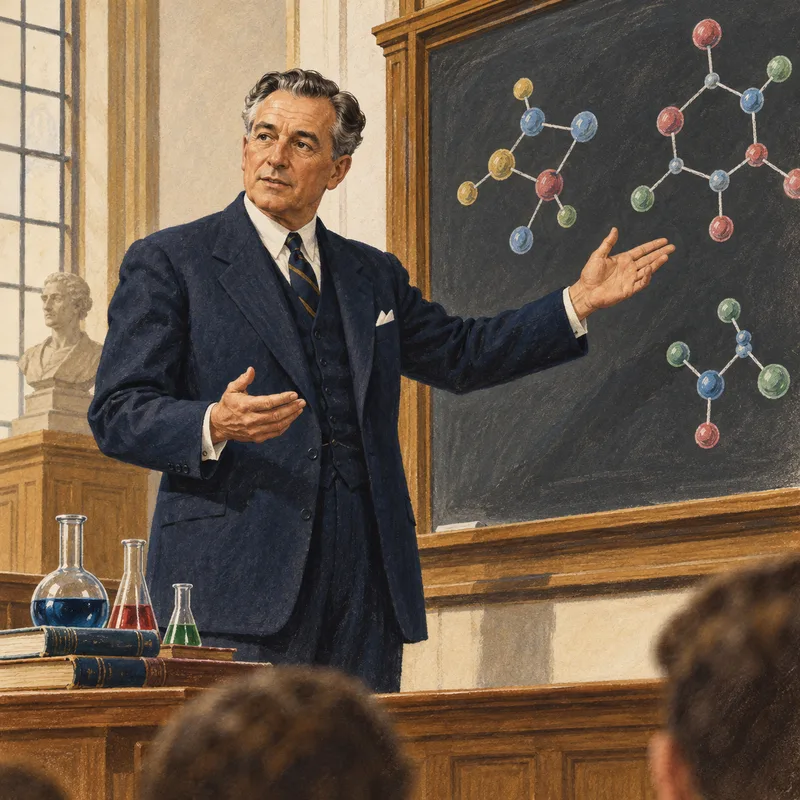
About the chemist
Robert Burns Woodward
1917-1979 · United States · Nobel Chemistry 1965
Total synthesis; Woodward-Hoffmann rules