Biography · Chemist no. 92 of 350
Robert H. Grubbs: The Farm Boy Who Taught Carbon Bonds to Swap Partners
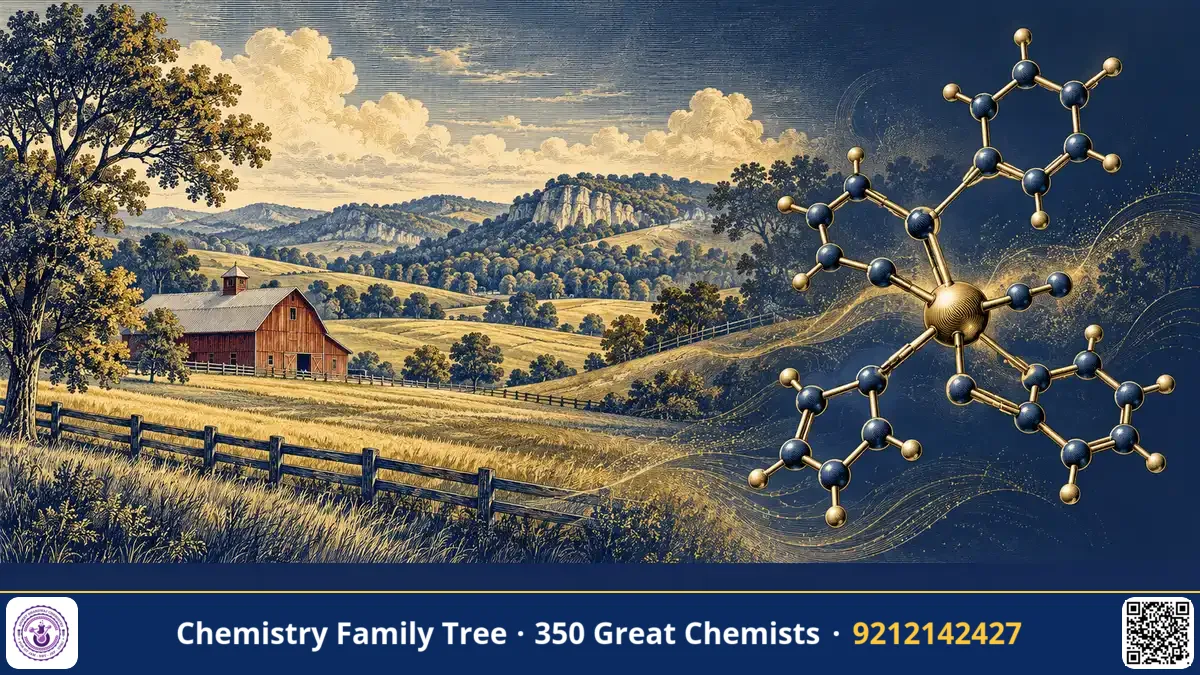
Robert Howard Grubbs (1942-2021) was an American chemist at the California Institute of Technology (Caltech). He is remembered for the ruthenium catalysts that bear his name, which made olefin metathesis a routine tool in laboratories and factories. He shared the 2005 Nobel Prize in Chemistry with Yves Chauvin and Richard Schrock. His legacy in one line: he turned a delicate, specialist reaction into a robust method that any synthetic chemist can use.
Early Life and Family
Grubbs was born on 27 February 1942 in rural Kentucky, in the United States, and grew up on a farm in the Calvert City area of Marshall County. Farm life meant practical work, and he later spoke about the value of learning by doing. Like many scientists of his generation, he came from a family with no tradition of research. His path from a small Kentucky community to a Caltech chair shows how curiosity and good teachers can open doors. Later in life he lived in California with his wife and family, and he stayed active in teaching and research until the last years of his life.
Education and Mentors
Grubbs studied chemistry at the University of Florida, where he completed his bachelor's degree in 1963 and his master's degree in 1965 with Merle Battiste. He then moved to Columbia University in New York for his PhD, which he finished in 1968 under Ronald Breslow, a leading physical organic chemist. After that he did postdoctoral work at Stanford University with James Collman, a pioneer in organometallic and bioinorganic chemistry. This combination was important. Breslow gave him a rigorous grounding in mechanism, and Collman introduced him to transition-metal chemistry. His later career lives in the overlap of those two areas.
Career Timeline
| Year | Event |
|---|---|
| 1942 | Born in Kentucky, USA |
| 1963 / 1965 | BSc and MSc, University of Florida |
| 1968 | PhD, Columbia University (Ronald Breslow) |
| 1968-1969 | Postdoctoral research at Stanford (James Collman) |
| 1969-1978 | Faculty member at Michigan State University |
| 1978 | Joined Caltech as Professor of Chemistry |
| Late 1970s-1980s | Studied titanacyclobutanes and mechanism of metathesis |
| 1990s | Developed ruthenium carbene catalysts (first-generation Grubbs catalyst) |
| 1998 | Co-founded the company Materia to commercialise metathesis |
| Around 1999 | Second-generation catalyst with N-heterocyclic carbene |
| 2005 | Nobel Prize in Chemistry (with Chauvin and Schrock) |
| 2021 | Died on 19 December |
Major Scientific Contributions
Mechanism studies. At Michigan State and early Caltech years, Grubbs studied metallacycles. Working with titanium compounds made from Tebbe's reagent, his group isolated and studied titanacyclobutanes, the four-membered rings that Chauvin's mechanism predicted. This work gave experimental support to the idea that metathesis goes through metal carbenes and metallacyclobutanes:
[M]=CHR + CH₂=CHR' ⇌ [M]-metallacyclobutane ⇌ [M]=CHR' + CH₂=CHR
Ruthenium catalysts. Grubbs's group found that ruthenium compounds could polymerise strained alkenes, even in water. This led to well-defined ruthenium alkylidenes. The first-generation catalyst, RuCl₂(=CHPh)(PCy₃)₂, was stable enough to handle in air for short periods and tolerated alcohols, acids and aldehydes. The second-generation catalyst replaced one phosphine with an N-heterocyclic carbene and became the workhorse of the field.
Living ROMP and polymer chemistry. His group also developed living ring-opening metathesis polymerisation, which gives polymers with controlled length and narrow dispersity. For the underlying chemistry, read our discovery post on the Grubbs catalyst.
Awards, Honours and Nobel Prize
The most important honour was the 2005 Nobel Prize in Chemistry, shared equally among Yves Chauvin, Robert Grubbs and Richard Schrock "for the development of the metathesis method in organic synthesis". Chauvin explained how it works, Schrock produced the first efficient defined catalysts, and Grubbs delivered catalysts that tolerate functional groups. Grubbs also held the Victor and Elizabeth Atkins Professorship at Caltech and was a member of the US National Academy of Sciences. He received many other prizes from chemical societies; if you need an exact list for an exam or article, check the official Nobel biography rather than relying on memory.
Personality, Struggles and Lesser-Known Facts
- Rural roots: He often credited his early farm life for a practical, problem-solving attitude in the lab.
- Collaboration over rivalry: The metathesis story has three laureates. Colleagues described Grubbs as generous in acknowledging Chauvin's and Schrock's work.
- Not an overnight success: The ruthenium catalysts came after years of work on titanium and other metals. Several early systems were not stable enough to be useful.
- Industry link: He co-founded Materia, showing his interest in turning laboratory chemistry into products, such as tough polymers.
- Teacher and mentor: Dozens of students and postdocs from his group went on to professorships and industry roles worldwide, spreading metathesis.
Legacy and Influence on Modern Chemistry
Because of the Grubbs catalysts, ring-closing metathesis is now a standard step in drug discovery, natural product synthesis and materials science. Medium and large rings, once very difficult to make, can be closed in one step with the loss of ethene. Metathesis also supports greener manufacturing because it is catalytic, selective and produces little waste. Textbooks in organometallic chemistry now devote a whole section to it, and the Chauvin-Grubbs-Schrock story is a standard example of how a mechanism idea, a defined catalyst and a practical catalyst combine to make a technology.
Lessons for Students
- Mechanism first. Understanding how a reaction works lets you improve it. Grubbs built on Chauvin's mechanism.
- Be patient with failures. Years of work on unstable catalysts led to a stable one.
- Cross disciplines. Organic mechanism plus inorganic metal chemistry gave a new tool. Do not treat chemistry branches as separate worlds.
- Share credit. Great discoveries usually have many contributors.
Quick Facts Box
- Born: 27 February 1942, Kentucky, USA
- Died: 19 December 2021
- Nationality: American
- Field: Organometallic and organic chemistry
- Famous for: Ruthenium-based Grubbs catalysts for olefin metathesis
- Nobel: Chemistry 2005 (shared with Chauvin and Schrock)
FAQ
Where did Robert Grubbs work?
He spent most of his career at the California Institute of Technology (Caltech) from 1978 onwards, after nearly a decade at Michigan State University.
Who was Grubbs's PhD supervisor?
Ronald Breslow at Columbia University. His postdoctoral mentor was James Collman at Stanford.
Did Grubbs discover olefin metathesis?
No. Metathesis was seen in industry earlier and Chauvin explained the mechanism. Grubbs developed practical ruthenium catalysts that made the reaction widely useful.
Why is the Grubbs catalyst important for exams?
It is the standard example of a metal carbene catalyst and appears in questions on organometallic chemistry, organic synthesis, polymer chemistry and the Nobel Prizes.
Published by ABC Chemistry — IIT-JAM | CSIR-NET | GATE Chemistry Coaching. Visit abcchemistry.com
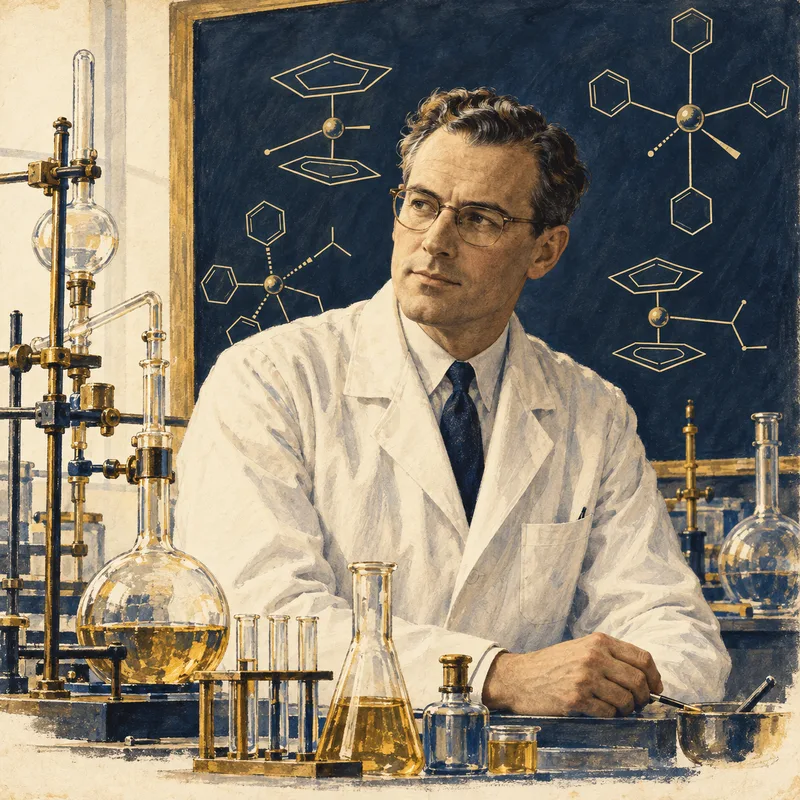
About the chemist
Robert H. Grubbs
1942-2021 · United States · Nobel Chemistry 2005
Olefin metathesis catalysts