The discovery, explained · Chemist no. 92 of 350
Robert Grubbs and the Catalyst That Lets Carbon Double Bonds Swap Partners
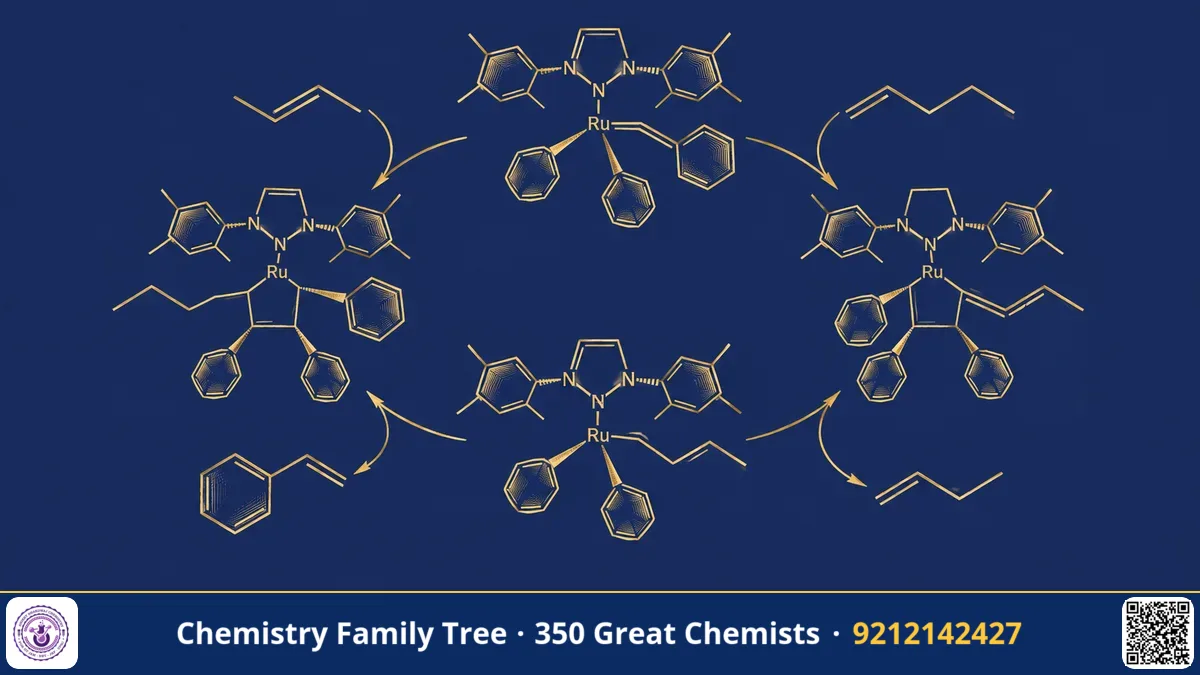
Imagine two couples dancing, and at a signal they swap partners. That, in one picture, is olefin metathesis. Two carbon-carbon double bonds break and re-form, and the pieces on each side exchange places. The reaction was known in industry for decades, but it needed fussy, air-sensitive catalysts that destroyed most functional groups. Robert H. Grubbs changed this by developing ruthenium carbene catalysts that work in the presence of air, moisture, alcohols, amides and acids. Today chemists use them to build drug molecules, plastics and fine chemicals. In 2005 Grubbs shared the Nobel Prize in Chemistry with Yves Chauvin and Richard Schrock "for the development of the metathesis method in organic synthesis". This post explains the idea, the mechanism and the exam points you need.
The Scientific Problem Before the Discovery
The word "metathesis" comes from Greek roots meaning "change of position". In the 1950s and 1960s, industrial chemists noticed that propene, passed over certain metal oxide catalysts, gave ethene and 2-butene:
2 CH₃–CH=CH₂ ⇌ CH₂=CH₂ + CH₃–CH=CH–CH₃
This was useful, but nobody knew how it happened. Early proposals suggested that two alkenes joined into a four-carbon ring (cyclobutane) and then split in a different direction. That idea had a problem: such a concerted [2+2] reaction between two simple alkenes is thermally forbidden by the Woodward-Hoffmann rules. A second problem was practical. The early catalysts, based on tungsten, molybdenum or rhenium, were poorly defined mixtures. They were also destroyed by water, oxygen and most polar groups, so they could not be used on complex molecules containing -OH, -COOH or -NH₂ groups. Organic chemists wanted a tool that would form C=C bonds in the middle of a delicate molecule, but metathesis was not yet that tool.
The Discovery: From Mechanism to Practical Catalyst
Two steps made the difference.
- The mechanism (Chauvin, 1971). Yves Chauvin, with his student Jean-Louis Hérisson, proposed that the true catalyst is a metal carbene (M=CHR). The carbene adds to an alkene in a [2+2] fashion to give a four-membered ring containing the metal, called a metallacyclobutane. This ring then opens the other way and releases a new alkene and a new metal carbene. This is the Chauvin mechanism.
- Well-defined catalysts (Schrock and Grubbs). Richard Schrock made molybdenum and tungsten alkylidene complexes that worked as single-component, defined catalysts. Grubbs, working at Caltech, then developed ruthenium-based carbenes. In the early 1990s his group reported ruthenium alkylidene complexes, and by the mid-1990s the now famous first-generation Grubbs catalyst appeared: RuCl₂(=CHPh)(PCy₃)₂, where PCy₃ is tricyclohexylphosphine.
Around 1999 the group improved it. One phosphine ligand was replaced by an N-heterocyclic carbene (NHC), giving the second-generation Grubbs catalyst. It is more active and more stable, and it handles hindered and electron-poor alkenes. A later variant, the Hoveyda-Grubbs catalyst, carries a chelating isopropoxy-benzylidene group, which makes the catalyst recoverable and very robust.
The Chemistry Behind It
The catalytic cycle can be written in four simple stages:
[Ru]=CHR  +  R'CH=CH₂   →   metallacyclobutane   →   [Ru]=CH₂ + R'CH=CHR
[Ru]=CH₂  +  R'CH=CH₂   →   metallacyclobutane   →   [Ru]=CHR' + CH₂=CH₂
Every step is reversible, so the product mixture is governed by thermodynamics unless something drives the reaction forward. In practice, chemists often remove a volatile alkene such as ethene (gas) to shift the equilibrium. This is Le Chatelier's principle in action.
Why is the [2+2] step allowed for a metal carbene when it is forbidden for two alkenes? The metal contributes d orbitals, which change the orbital symmetry picture, so the pathway has a low barrier. That is a favourite conceptual question.
Types of metathesis reactions
| Type | Short form | What happens |
|---|---|---|
| Ring-closing metathesis | RCM | A diene closes to a cycloalkene and releases ethene |
| Ring-opening metathesis polymerisation | ROMP | Strained cycloalkene opens and links into a polymer |
| Cross metathesis | CM | Two different alkenes swap fragments |
| Acyclic diene metathesis polymerisation | ADMET | Dienes join step-wise, losing ethene |
| Ethenolysis | - | Alkene cleaved with ethene to give terminal alkenes |
A typical RCM example: diethyl diallylmalonate, with two terminal alkenes, closes to a five-membered cyclopentene ring and ethene escapes:
CH₂=CH–CH₂–C(CO₂Et)₂–CH₂–CH=CH₂ → cyclopentene diester + CH₂=CH₂
ROMP is driven by release of ring strain. Norbornene, for example, opens and links up to give polynorbornene with C=C bonds in the chain.
Applications Today
- Pharmaceuticals: RCM is used to build macrocyclic rings in drug candidates, such as hepatitis C protease inhibitors. Making medium and large rings was once very hard.
- Petrochemicals: Metathesis is part of industrial processes such as the Shell Higher Olefin Process, and the conversion of propene with butenes in the olefin conversion technology.
- Polymers: ROMP of dicyclopentadiene gives tough, impact-resistant materials used in moulded parts.
- Green chemistry: Because reactions are catalytic and release only small molecules like ethene, they have high atom economy and produce less waste. The Nobel committee called metathesis a great step forward for "green chemistry".
- India context: Indian pharma and research groups use RCM in total synthesis of natural products, so metathesis questions appear in organic synthesis papers.
Exam Corner
- Nobel Prize in Chemistry 2005: Chauvin, Grubbs, Schrock. Chauvin proposed the mechanism, Schrock made Mo/W catalysts, Grubbs made Ru catalysts.
- First-generation Grubbs catalyst: RuCl₂(=CHPh)(PCy₃)₂. Second generation replaces one PCy₃ with an N-heterocyclic carbene. Expect to identify the oxidation state of Ru (+2) and its 16-electron count.
- Mechanism: metal carbene + alkene → metallacyclobutane → new alkene + new carbene, a series of [2+2] cycloadditions and cycloreversions.
- RCM of a terminal diene releases ethene; the loss of gas drives the equilibrium forward. Ring size 5 to 7 forms easily.
- ROMP is driven by relief of ring strain (norbornene, cyclobutene, cyclooctene) and gives polymers whose repeat unit contains C=C.
Common Misconceptions
- "Metathesis is the same as a Wittig reaction." No. Wittig makes C=C from a carbonyl and a phosphorus ylide with a stoichiometric by-product. Metathesis rearranges existing C=C bonds catalytically.
- "Grubbs invented metathesis." Metathesis was observed in industry earlier, and the mechanism was Chauvin's. Grubbs made it practical for functional molecules.
- "The catalyst is consumed." It is regenerated in each cycle; only a small percentage is needed.
Quick Revision Box
- Olefin metathesis = exchange of alkylidene fragments between C=C bonds.
- Mechanism: Chauvin (1971), via metallacyclobutane intermediate.
- Grubbs catalysts are Ru-carbenes, tolerant to air, water and functional groups.
- Main types: RCM, CM, ROMP, ADMET.
- Nobel Prize in Chemistry 2005 shared by Chauvin, Grubbs and Schrock.
- Driving force: release of ethene gas or relief of ring strain.
FAQ
What is a Grubbs catalyst?
It is a ruthenium complex containing a metal-carbon double bond (a carbene or alkylidene) that catalyses olefin metathesis. It works in ordinary solvents and tolerates many functional groups.
What is the difference between Grubbs and Schrock catalysts?
Schrock catalysts use molybdenum or tungsten and are very active but sensitive to air, water and polar groups. Grubbs catalysts use ruthenium and are far more tolerant, though sometimes less active with hindered alkenes.
Why is the catalyst important for green chemistry?
It is highly selective, works under mild conditions and generates little waste, so fewer steps and fewer hazardous reagents are needed to make complex molecules.
Is this topic in the IIT-JAM or CSIR-NET syllabus?
Olefin metathesis, the Grubbs catalyst and the Chauvin mechanism appear in organometallic chemistry and organic synthesis sections, and they are a good topic for short-answer and MCQ questions.
Published by ABC Chemistry — IIT-JAM | CSIR-NET | GATE Chemistry Coaching. Visit abcchemistry.com
About the chemist
Robert H. Grubbs
1942-2021 · United States · Nobel Chemistry 2005
Olefin metathesis catalysts