Biography · Chemist no. 158 of 350
Robert Huber: Complete Life and Legacy of a Protein Crystallographer
Robert Huber, born in 1937 in Munich, is a German biochemist and one of the leading protein crystallographers of the twentieth century. He directed a department at the Max Planck Institute of Biochemistry in Martinsried for many years and led his team to solve the structures of enzymes, inhibitors, antibodies and the photosynthetic reaction centre. For the last, he shared the 1988 Nobel Prize in Chemistry with Johann Deisenhofer and Hartmut Michel. His legacy: he taught chemists that to understand a protein, you must see it in three dimensions.
Early Life and Family
Robert Huber was born on 20 February 1937 in Munich, Germany. He was the son of a bank clerk, and he grew up in the city during the Second World War years and the difficult period after the war. The family had no tradition of science, but he developed an early interest in chemistry and went on to study it at university.
Education and Mentors
Huber studied chemistry at the Technical University of Munich (TUM). He completed his diploma in 1960 and then did his doctoral work on X-ray crystallography under Walter Hoppe, completing his PhD in 1963. Hoppe was a pioneer of crystallographic methods in Germany, and from him Huber learned the methods and the value of rigorous computation. After the doctorate he remained in the field, working on structural problems of organic molecules and then increasingly on proteins. In 1971 he became a director at the Max Planck Institute of Biochemistry in Martinsried, where he built a world-leading group.
Career Timeline
| Year | Event |
|---|---|
| 1937 | Born in Munich, Germany |
| 1960 | Diploma in chemistry, Technical University of Munich |
| 1963 | PhD under Walter Hoppe |
| 1971 | Director at the Max Planck Institute of Biochemistry, Martinsried |
| 1970s | Structures of trypsin inhibitor complexes and antibody fragments |
| 1984–1985 | Structure of the photosynthetic reaction centre from Rh. viridis published |
| 1988 | Shared the Nobel Prize in Chemistry |
| 1990s | Structure of the proteasome and work on protein degradation |
Major Scientific Contributions
Huber's most celebrated contribution is the three-dimensional structure of the photosynthetic reaction centre, solved together with Johann Deisenhofer after Hartmut Michel produced the crystals. Beyond that, his group worked on many biological problems:
- Enzyme–inhibitor complexes: trypsin with BPTI, showing how inhibitors bind serine proteases.
- Antibody structure: early structures of immunoglobulin fragments, revealing the domain organisation of antibodies.
- Complement and blood-clotting proteins: structures that gave insight into proteolysis cascades in blood.
- Proteasome: structure of this large cellular protein-degradation machine.
- Methods: improvement of data collection and refinement techniques for large proteins.
Awards, Honours and Nobel Prize
In 1988, the Nobel Prize in Chemistry was awarded jointly to Johann Deisenhofer, Robert Huber and Hartmut Michel "for the determination of the three-dimensional structure of a photosynthetic reaction centre." This was a Chemistry prize. Huber received many further honours and memberships of academies, and he held professorships both at TUM and at other institutions. He also held a position at Cardiff University in the United Kingdom as a visiting professor late in his career.
Personality, Struggles and Lesser-Known Facts
- Mentor to many: His department trained a large number of structural biologists who now lead groups around the world.
- Methodical approach: Colleagues describe his insistence on accuracy and on careful checking of electron density maps.
- Recognising others' contributions: He emphasised that Michel's crystals made the reaction centre project possible and that Deisenhofer did much of the structure determination.
- Long scientific career: He continued active research long after his Nobel Prize, moving from structure into questions of protein degradation and drug targets.
Legacy and Influence on Modern Chemistry
Huber's influence is visible in the way modern drug discovery works. Structure-based design uses the three-dimensional structure of a target protein to design molecules that fit the active site, an idea supported by early inhibitor complexes studied in his group. Proteasome inhibitors are now used in cancer treatment. The reaction centre structure helped create the field of membrane protein crystallography and inspired research on solar energy conversion. For Indian students, his work illustrates topics in bioinorganic chemistry, enzyme catalysis and instrumental methods such as X-ray diffraction.
How the Reaction Centre Project Worked
It is useful for students to see how the Nobel-winning project was divided. First, Hartmut Michel and Dieter Oesterhelt's group prepared the reaction centre from Rhodopseudomonas viridis and obtained crystals in 1982. Second, Huber's department collected X-ray diffraction data from these crystals. Third, heavy-atom derivatives were prepared to supply phase information, and Johann Deisenhofer computed electron density maps. Fourth, the team built the atomic model using computer graphics and refined it. The result showed four protein subunits with a precise arrangement of pigments and quinones. Such a project needs patience, because each step can fail for months. Huber's role was to lead the department, supply the crystallographic experience built up on earlier protein structures, and make sure that the final model was reliable and carefully checked.
Why His Earlier Work Mattered
Before the reaction centre, Huber's group had already solved enzyme–inhibitor complexes such as trypsin with a protein inhibitor, and the structure of antibody fragments. These projects trained the group in data collection, phasing and refinement, and in understanding how proteins recognise other molecules. The same skills were needed for the much harder reaction centre. In science, a famous result is often the visible tip of years of quieter, well-done work.
Lessons for Students
- Be rigorous. A structure is only as good as its data and the care taken in refinement.
- Ask big biological questions. Choose problems whose answer will help many other scientists.
- Build a team. Great laboratories bring different skills together.
- Stay curious for decades. Huber moved from small molecules to proteins to molecular machines.
Quick Facts Box
- Born: 20 February 1937, Munich, Germany
- Died: Not covered here
- Nationality: German
- Field: Biochemistry, protein crystallography
- Famous for: Structure of the photosynthetic reaction centre; trypsin inhibitor and proteasome structures
- Nobel: 1988, Chemistry (shared with Deisenhofer and Michel)
FAQ
Who supervised Robert Huber's PhD?
Walter Hoppe at the Technical University of Munich.
Where did Huber mainly work?
At the Max Planck Institute of Biochemistry in Martinsried near Munich.
Was Huber's Nobel in Chemistry or in Medicine?
Chemistry, in 1988.
Why do chemistry students study his work?
It links X-ray diffraction, enzyme mechanisms, bioinorganic cofactors and electron transfer, topics that appear throughout the advanced chemistry syllabus.
Published by ABC Chemistry — IIT-JAM | CSIR-NET | GATE Chemistry Coaching. Visit abcchemistry.com
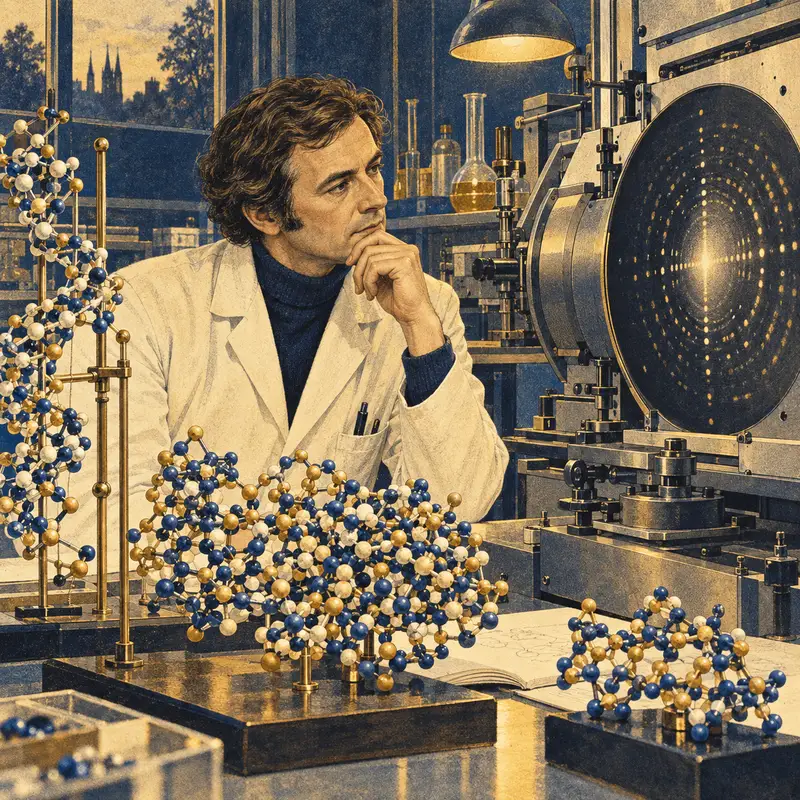
About the chemist
Robert Huber
1937- · Germany · Nobel Chemistry 1988
Structure of photosynthetic reaction centre