The discovery, explained · Chemist no. 195 of 350
Robert Lefkowitz and the Hunt for the Hormone Receptor
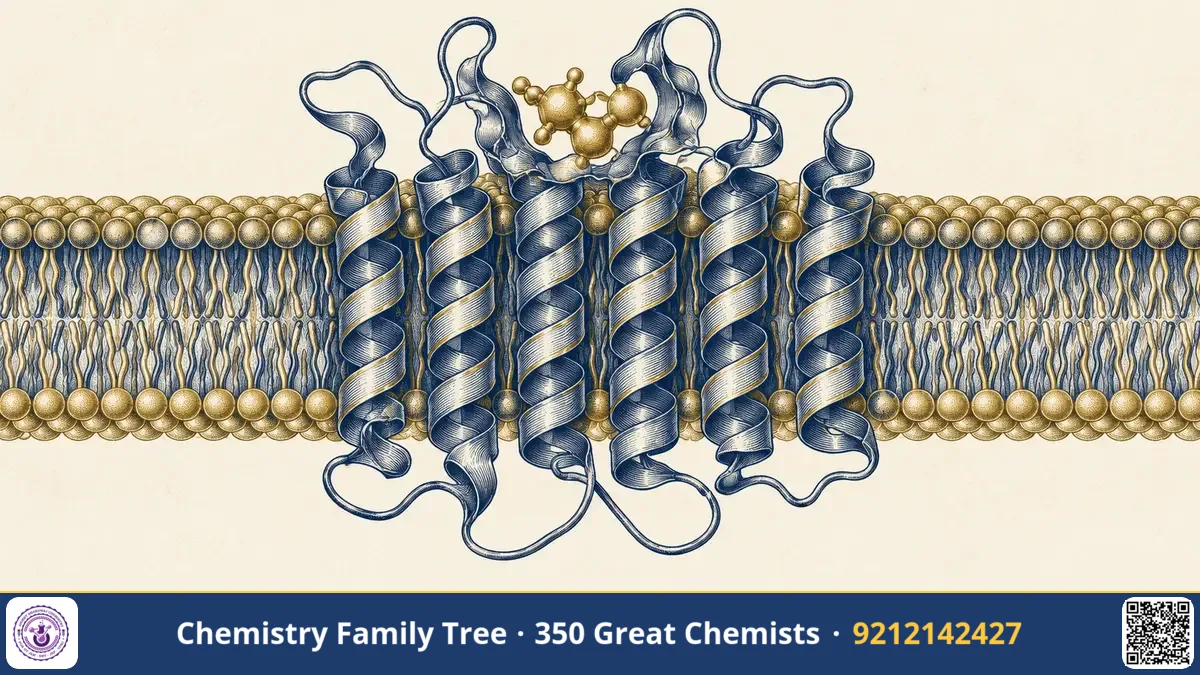
When you feel your heart pound after a scare, adrenaline has bound to a receptor on your heart cells and triggered a chain of chemical events. For most of the twentieth century, "receptors" were only a convenient idea. Nobody had isolated one or measured it. Robert J. Lefkowitz, a physician-scientist at Duke University, turned the idea into molecules, first by tagging hormones with radioactive iodine to track them, then by purifying and cloning the receptor genes. He found that the beta-adrenergic receptor belongs to a huge family, now called G protein-coupled receptors (GPCRs). In 2012 he shared the Nobel Prize in Chemistry with Brian Kobilka for studies of GPCRs. This post tells that story, step by step, with the chemistry you need.
The Scientific Problem Before the Discovery
The idea of a "receptive substance" goes back to John Langley and Paul Ehrlich in the late nineteenth and early twentieth centuries. In 1948 Raymond Ahlquist proposed that adrenaline acts through two types of receptors, alpha and beta, based on how different compounds affected tissues. Earl Sutherland found that adrenaline raises the level of cyclic AMP (cAMP) inside cells, and called cAMP a "second messenger" (Nobel Prize in Physiology or Medicine, 1971). Alfred Gilman and Martin Rodbell later showed that G proteins link receptors to adenylyl cyclase (Nobel Prize in Physiology or Medicine, 1994).
Yet the receptor itself was a black box. Many doubted that a distinct protein existed; some thought hormones acted by disturbing the membrane in a general way. Receptors are present in tiny amounts, a few thousand per cell, embedded in lipid membranes, and they are hard to dissolve and purify. There was no direct way to count or characterise them.
The Discovery: Step by Step
- Radioligand binding (1970s). Lefkowitz and colleagues attached the radioactive isotope iodine-125 to hormones, such as ACTH and later adrenergic ligands, producing high-specific-activity "radioligands". They incubated these with membrane fragments and measured how much stuck to the membranes.
- Proving specificity. True receptor binding is saturable and reversible, and can be competed by unlabelled ligands. Binding that met these criteria showed that real, specific receptors exist, and it allowed the first direct measurements of affinity and receptor number.
- Dissecting the system. Using these assays, his group showed that agonists and antagonists bind differently, and that receptors can exist in states with high or low affinity, depending on interaction with G proteins. This supported the ternary complex idea: hormone, receptor and G protein.
- Purification. In the early 1980s, his group purified the beta-adrenergic receptor from tissue using affinity chromatography, with a ligand attached to a solid column to catch the receptor.
- Cloning (1986). Working with Brian Kobilka, then a postdoctoral fellow, the group obtained part of the protein sequence and cloned the gene for the beta₂-adrenergic receptor. When they read the sequence they saw seven stretches of hydrophobic amino acids, each long enough to span a membrane as an α-helix.
- A family emerges. The sequence resembled rhodopsin, the light receptor of the eye, which also couples to a G protein. This suggested a large family of receptors with a common seven-transmembrane design. Today humans are known to have around 800 GPCR genes.
The Chemistry Behind It
A GPCR is a single polypeptide chain threading the membrane seven times. The outside part binds the ligand; the inside part contacts a heterotrimeric G protein (α, β, γ subunits). The signalling cycle is:
Ligand + GPCR → active GPCR*
GPCR* + Gα(GDP)βγ → GPCR* + Gα(GTP) + βγ   (GDP–GTP exchange)
Gα(GTP) + adenylyl cyclase → ATP → cAMP + PPi
cAMP + protein kinase A → phosphorylation of target proteins
Gα(GTP) → Gα(GDP) + Pi   (GTPase, signal off)
Binding follows the law of mass action. For a ligand L and receptor R:
R + L ⇌ RL Kd = [R][L] / [RL]
The dissociation constant Kd is a measure of affinity: a smaller Kd means tighter binding. In saturation experiments the bound ligand B follows B = Bmax[L] / (Kd + [L]), where Bmax gives the number of receptor sites. Competition experiments with unlabelled drugs give IC₅₀ values, which can be converted to inhibition constants Ki.
Lefkowitz's lab also discovered how signalling is turned off. After a receptor is activated, G protein-coupled receptor kinases (GRKs) phosphorylate it, and proteins called arrestins bind and block further G protein coupling. Later work showed that arrestins also start their own signals, leading to the idea of "biased agonism", where a drug favours one pathway over another.
Applications Today
- Drugs. About a third to a half of all approved medicines act on GPCRs. Examples are beta-blockers (propranolol, atenolol, metoprolol) for hypertension and heart disease, salbutamol (albuterol) for asthma, antihistamines, many antipsychotics and opioids.
- Everyday senses. Vision (rhodopsin), smell (olfactory receptors) and parts of taste depend on GPCRs.
- Structure-based design. Following Kobilka's crystal structures, drug companies design molecules to fit receptor pockets.
- Safer drugs. Biased agonists that activate beneficial pathways while avoiding side effects are under development, for example for pain relief.
- In India, beta-blockers and salbutamol inhalers are among the commonly used medicines for heart disease and asthma.
Exam Corner
- Nobel Prize in Chemistry 2012: Robert Lefkowitz and Brian Kobilka, for studies of G protein-coupled receptors.
- GPCRs have seven transmembrane α-helices and couple to heterotrimeric G proteins that exchange GDP for GTP.
- Gs stimulates adenylyl cyclase (↑cAMP); Gi inhibits it; Gq activates phospholipase C, producing IP₃ and DAG.
- Kd = [R][L]/[RL]; a lower Kd means a higher affinity. Bmax indicates receptor density.
- Arrestins block the G protein signal after receptor phosphorylation by GRKs.
Common Misconceptions
- "A receptor is a vague concept." Receptors are real proteins with defined structures and binding sites, as Lefkowitz demonstrated.
- "Lefkowitz won a Medicine prize." His prize was in Chemistry (2012), though the topic overlaps with physiology. Sutherland (1971) and Gilman and Rodbell (1994) won in Physiology or Medicine for earlier signalling work.
- "All hormones enter the cell." Steroid hormones do, but adrenaline and peptide hormones act from outside through membrane receptors.
Quick Revision Box
- Method: ¹²⁵I-labelled radioligand binding on membranes.
- 1986: cloning of the β₂-adrenergic receptor with Kobilka.
- GPCR = seven transmembrane helices + G protein.
- cAMP is the classic second messenger of Gs-coupled receptors.
- GRKs and arrestins desensitise receptors.
- Nobel Prize in Chemistry 2012.
FAQ
Why use iodine-125?
It emits gamma rays that are easy to detect, has a convenient half-life of about 60 days, and can be attached to tyrosine residues of proteins and peptide hormones without destroying their function.
What does "G protein-coupled" mean?
The receptor passes its signal to a guanine-nucleotide-binding protein inside the cell, rather than acting as an enzyme or ion channel itself.
How many GPCRs do humans have?
Roughly 800 genes encode GPCRs, forming the largest family of membrane receptors in the human genome.
How does this connect to pharmacology questions in exams?
Agonists, antagonists, Kd, IC₅₀ and second messengers come directly from this work and appear in medicinal chemistry and biochemistry questions.
Published by ABC Chemistry — IIT-JAM | CSIR-NET | GATE Chemistry Coaching. Visit abcchemistry.com
About the chemist
Robert Lefkowitz
1943- · United States · Nobel Chemistry 2012
G-protein-coupled receptors