The discovery, explained · Chemist no. 124 of 350
Robert Robinson: The Tropinone Synthesis, the Robinson Annulation and the Curved Arrow
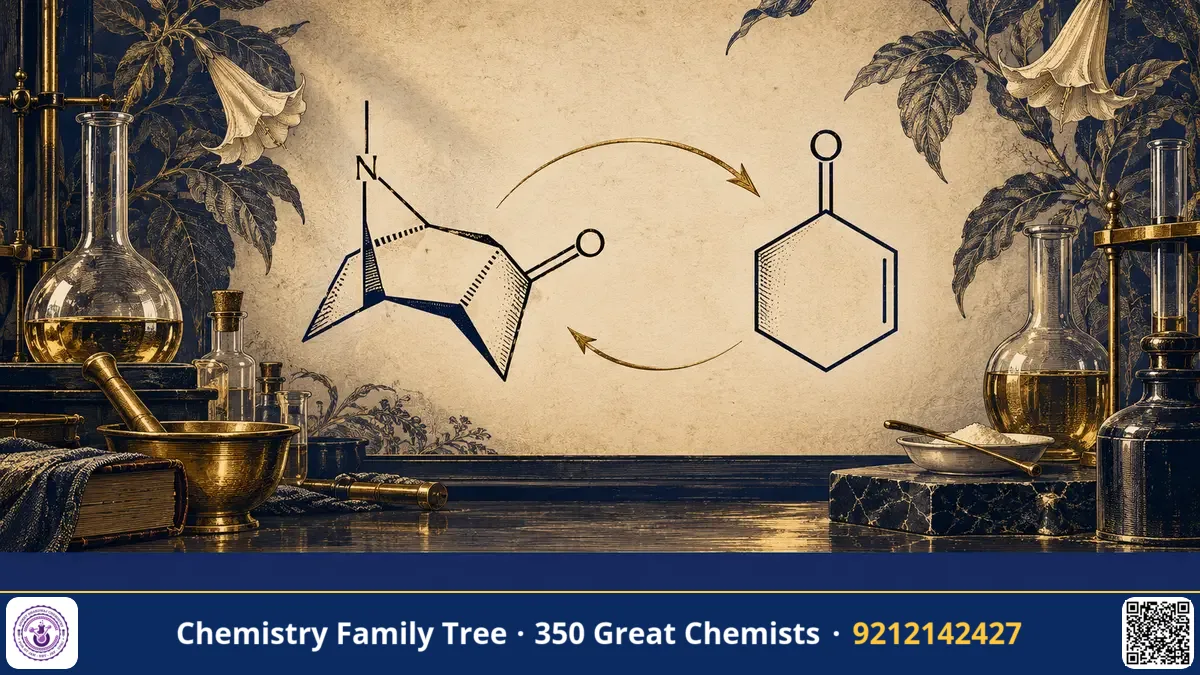
If you have ever drawn curved arrows to show the movement of electrons in a mechanism, you have used an idea that Sir Robert Robinson helped to create. If you have built a six-membered ring by a Michael addition followed by an aldol condensation, you have used the Robinson annulation. And if you have studied alkaloids, you will have met his elegant one-pot synthesis of tropinone in 1917. Robinson was one of the greatest organic chemists of the twentieth century, and he received the Nobel Prize in Chemistry for 1947 "for his investigations on plant products of biological importance, especially the alkaloids". This post covers the main ideas and mechanisms, with a focus on what appears in exams.
The Scientific Problem Before the Discovery
Alkaloids are nitrogen-containing natural products from plants, such as morphine, quinine, atropine, strychnine and nicotine. Many are powerful drugs or poisons. In 1900 the way to prove the structure of such a molecule was to break it into smaller pieces and identify them, and then confirm the structure by building the molecule from simple parts. Synthesis was a stern test, and complex molecules were usually made by long routes with low yields.
- Tropinone, the core of atropine and cocaine, had been synthesised by Richard Willstätter in 1901, but in about 15 steps and with a very low overall yield (under 1%).
- Chemists believed that nature builds such molecules in a simple way, but laboratory routes did not reflect this.
- There was no common language to describe how electrons move in a reaction. Mechanisms were written as sketches of atoms and bonds.
The Discovery: Step by Step
The 1917 tropinone synthesis
Robinson looked at the structure of tropinone, a bicyclic amino ketone (8-methyl-8-azabicyclo[3.2.1]octan-3-one), and asked how a plant might form it. He saw that it could be cut into three simple parts: a dialdehyde (succinaldehyde, OHC–CH₂–CH₂–CHO), a primary amine (methylamine, CH₃NH₂) and a ketone with two acidic CH₂ groups (acetone, or better, acetonedicarboxylic acid). He mixed these three in water at room temperature, and tropinone formed in one step.
OHC–CH₂CH₂–CHO + CH₃NH₂ + CO(CH₂COOH)₂ → tropinone + 2CO₂ + 2H₂O
- Imine/iminium formation. Methylamine adds to one aldehyde group of succinaldehyde and loses water to give an iminium ion.
- First Mannich reaction. The enol of acetonedicarboxylate attacks the iminium carbon, making a new C–C bond.
- Second ring closure. The remaining aldehyde reacts with the secondary amine nitrogen to form another iminium ion, and a second intramolecular Mannich reaction closes the second ring.
- Decarboxylation. The two carboxyl groups, which are β to the ketone, are lost as CO₂ on warming or acidification to give tropinone.
The yield in Robinson's first experiment was only about 17%. Clemens Schöpf in 1935 found that working at near physiological pH (about 5 to 7) with a buffer, the yield rose above 90%. This supports the idea that the reaction resembles the pathway in the plant. It is called the Robinson-Schöpf reaction, and it is a classical example of biomimetic synthesis and of a tandem reaction, where several bonds are made in a single operation.
The Robinson annulation
An annulation is a reaction that builds a new ring onto an existing molecule. In 1935 Robinson and Rapson published a method of building a six-membered ring with a cyclic enone, which is now so widely used that it carries his name. It has two stages:
- Michael addition. The enolate of a ketone (for example, 2-methylcyclohexanone) adds in a conjugate (1,4) manner to methyl vinyl ketone (MVK, CH₂=CH–CO–CH₃), giving a 1,5-diketone.
- Intramolecular aldol condensation. Under base, an enolate formed from the methyl ketone end attacks the ring carbonyl, closing a six-membered ring and giving a β-hydroxy ketone.
- Dehydration. Loss of water gives the conjugated cyclohexenone.
ketone + CH₂=CH–CO–CH₃ →(base)→ 1,5-diketone →(aldol)→ β-hydroxy ketone →(–H₂O)→ cyclohexenone (new six-membered ring)
When 2-methylcyclohexane-1,3-dione reacts with MVK in this way, the bicyclic product is the Wieland-Miescher ketone. Such bicyclic enones form the A/B rings of steroids and terpenes, and it is used in numerous total syntheses, including those of steroid hormones.
Curved arrows and electronic theory
In the 1920s, Robinson and Christopher Ingold independently developed the electronic theory of organic reactions. Robinson used curved arrows to show how pairs of electrons shift from one atom to another. He proposed the idea of the "aromatic sextet" in 1925 in work with J. W. Armit, which explained the special stability of benzene as a closed group of six π electrons. His arrows made it possible to write mechanisms simply, and today they are the standard notation in every textbook.
The Chemistry Behind It
Mannich reaction. An amine, an aldehyde and a compound with an acidic α-hydrogen combine to give a β-amino carbonyl compound (a Mannich base). The electrophile is an iminium ion, R₂N⁺=CH₂, and the nucleophile is an enol or enolate.
Michael addition. A soft nucleophile (an enolate) adds to the β-carbon of an α,β-unsaturated carbonyl compound. The driving force is the formation of a strong C–C σ bond at the expense of a weaker C=C π bond.
Aldol condensation. The enolate attacks a carbonyl carbon to give a β-hydroxy carbonyl compound, which loses water easily when this leads to a conjugated enone. Six-membered ring closures are favoured because of low ring strain, so the intramolecular aldol gives cyclohexenone rather than a four- or eight-membered ring.
Retrosynthesis. Robinson thought backward from product to simple starting materials, "disconnecting" the target at logical bonds, which is the idea that E. J. Corey formalised decades later as retrosynthetic analysis.
Applications Today
- Steroid and terpene synthesis. The Robinson annulation forms ring systems in cortisone, progesterone, testosterone analogues and many terpenoids.
- Drug discovery. Tropane alkaloids include atropine (used in eye examination and as an antidote for organophosphate poisoning), scopolamine (for motion sickness) and cocaine (a local anaesthetic, now rarely used).
- Green chemistry. Tandem and biomimetic reactions that build complex molecules in one pot in water use less solvent and energy.
- Education. The curved-arrow formalism is taught throughout the world and is the basic language of organic chemistry.
- Dyes. His work on anthocyanins explained the flower pigments, which are related to natural colourants for food.
Exam Corner
- Robinson annulation = Michael addition + intramolecular aldol condensation (+ dehydration) to give a cyclohexenone.
- Typical reagents: a ketone enolate and methyl vinyl ketone (or its equivalent); base such as NaOEt or KOH.
- Tropinone synthesis (1917): succinaldehyde + methylamine + acetonedicarboxylic acid (double Mannich reaction), a biomimetic one-pot reaction.
- Willstätter's tropinone synthesis (1901) took about 15 steps; Robinson's took one operation.
- Robinson was awarded the 1947 Nobel Prize in Chemistry for work on alkaloids; he is also known for the curved-arrow notation and the aromatic sextet.
Common Misconceptions
- "Robinson annulation is a single reaction step." It is a sequence of Michael addition, aldol addition and dehydration, often carried out in one pot.
- "Curved arrows show the movement of atoms." They show the movement of electron pairs (full-headed) or single electrons (fish-hook arrows).
- "Alkaloids are always basic and toxic." Most are basic because of the amine group, but many are valuable medicines at the right dose.
Quick Revision Box
- Tropinone: 8-methyl-8-azabicyclo[3.2.1]octan-3-one, made in 1917.
- Reaction type: double intramolecular Mannich, then decarboxylation.
- Robinson annulation published 1935 (with Rapson).
- Aromatic sextet idea, 1925 (with Armit).
- Nobel Prize in Chemistry 1947.
- Curved arrows = electron-pair movement.
FAQ
Why is Robinson's tropinone synthesis called biomimetic?
Because the reaction takes place in water at mild pH from simple building blocks, in a way that resembles what happens in plants.
What is the role of methyl vinyl ketone in the Robinson annulation?
It is the Michael acceptor. It supplies four carbons that form part of the new six-membered ring.
Why is the product of annulation an enone?
Because the β-hydroxy ketone from the aldol step loses water to give a conjugated C=C–C=O system, which is stable.
Did Robinson win the prize in Medicine?
No. He received the Nobel Prize in Chemistry for 1947.
Published by ABC Chemistry — IIT-JAM | CSIR-NET | GATE Chemistry Coaching. Visit abcchemistry.com
About the chemist
Robert Robinson
1886-1975 · United Kingdom · Nobel Chemistry 1947
Alkaloid structure and synthesis