Biography · Chemist no. 124 of 350
Sir Robert Robinson: Master of Natural Product Synthesis and the Curved Arrow
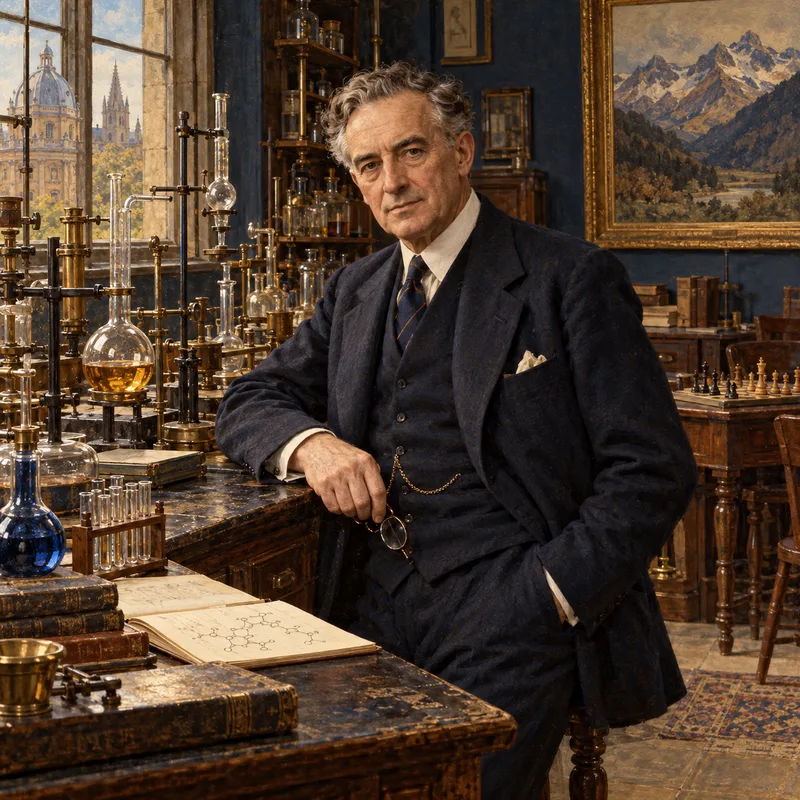
Sir Robert Robinson (1886-1975) was an English organic chemist who worked out the structures and syntheses of many natural products, especially alkaloids, and who helped to create the electronic theory of organic reactions. He gave chemistry the Robinson annulation and the one-pot tropinone synthesis, and he was a pioneer of the use of curved arrows. He won the Nobel Prize in Chemistry for 1947, served as President of the Royal Society and received the Order of Merit. He was also a skilled mountaineer and a strong chess player.
Early Life & Family
Robert Robinson was born on 13 September 1886 at Rufford, near Chesterfield in Derbyshire, England. His father, William Bradbury Robinson, was a manufacturer of surgical dressings, and the business involved cotton and bandages. As a boy, he saw the family business and the machinery of the works, which may have helped him to think in practical terms. He had a happy childhood in the English countryside, and his love for the hills of Derbyshire stayed with him all his life.
He was educated at Fulneck School, a Moravian school near Leeds, and at the Chesterfield Grammar School, and he showed ability in both science and mathematics. He was first inclined toward mathematics, but his father's interest in chemicals and a strong chemistry teacher directed him to chemistry. In 1912 he married Gertrude Maud Walsh, who was also a chemist and his lifelong partner in research until her death in 1954. They had a son and a daughter. Later he married Stearn Sylvia Hillstrom in 1957.
Education & Mentors
Robinson went to the University of Manchester in 1902, where he studied chemistry under William Henry Perkin Jr., one of the leading British organic chemists and a son of the discoverer of the first synthetic dye, mauve. Under Perkin, Robinson worked on the synthesis of natural products, and he took his degree there and a doctorate (D.Sc.) in 1910. Perkin's laboratory taught him to combine rigorous experiments with ambition to tackle the structures of complex compounds.
Career Timeline
| Year | Event |
|---|---|
| 1886 | Born at Rufford, near Chesterfield, Derbyshire |
| 1902 | Enters the University of Manchester to study under W. H. Perkin Jr. |
| 1912 | Professor of Pure and Applied Organic Chemistry at the University of Sydney |
| 1915 | Professor at the University of Liverpool |
| 1917 | Publishes the tropinone synthesis |
| 1920 | Joins the British Dyestuffs Corporation for a short period as research director |
| 1921 | Professor at the University of St Andrews |
| 1922 | Professor at the University of Manchester |
| 1928 | Professor at University College London |
| 1930 | Waynflete Professor of Chemistry at Oxford, a post he held until 1955 |
| 1935 | Publishes the Robinson annulation with Rapson |
| 1939 | Knighted |
| 1945-1950 | President of the Royal Society |
| 1947 | Nobel Prize in Chemistry |
| 1949 | Order of Merit |
| 1957 | Helps to found the journal Tetrahedron |
| 1975 | Dies at Great Missenden, Buckinghamshire |
Major Scientific Contributions
Robinson's output was enormous, and he published hundreds of papers. The most important parts are summarised here; the key reactions are explained in our discovery post.
- Tropinone synthesis (1917). A one-pot, biomimetic reaction giving a bicyclic alkaloid skeleton.
- Robinson annulation (1935). A Michael addition and aldol condensation sequence to make a cyclohexenone ring.
- Alkaloid structures. He proposed structures for morphine (with John Masson Gulland, 1925), and strychnine, which he worked out around 1946 along with others, and many more. The morphine structure was later confirmed by X-ray crystallography and by total synthesis.
- Plant pigments. Synthesis and structure of anthocyanins, which are the red, blue and purple pigments of flowers and fruits, and of flavones.
- Electronic theory. The curved arrow and the idea of electron displacement; the "aromatic sextet" in 1925.
- Steroids and penicillin. He took part in the British wartime work on the structure of penicillin and studied sex hormones such as equilenin and synthetic oestrogens.
Awards, Honours & Nobel Prize
Robinson received the Nobel Prize in Chemistry for 1947 "for his investigations on plant products of biological importance, especially the alkaloids". He was elected a Fellow of the Royal Society in 1920 and served as its President from 1945 to 1950. He received its Davy Medal (1930), Royal Medal (1932) and Copley Medal (1942). He was knighted in 1939 and appointed to the Order of Merit in 1949. He received numerous honorary degrees and foreign memberships.
Personality, Struggles & Lesser-Known Facts
- Mountaineer. He loved climbing and walking in the mountains in Britain and in the Alps and Pyrenees, and he spent many holidays at it. Climbing and chemistry were two passions that continued through his life.
- Chess master. He was a keen chess player and was President of the British Chess Problem Society. He promoted the game and chess problems, and he was good enough to play at a high level.
- A colleague and a rival. He had friendly but sharp debates with Christopher Ingold about the electronic theory and the way to name the concepts. Their disagreement about terms and priority was known across the field, and the vocabulary used today comes mostly from Ingold, while the curved arrows are Robinson's.
- Industrial work. He worked for some time in the dyestuffs industry and consulted for industrial groups, and he was one of the founders of the journal Tetrahedron.
- Stubborn about methods. He often relied on structural intuition and on elegant proposals for the biosynthesis of natural products, and many of his guesses proved to be right.
Legacy & Influence on Modern Chemistry
The curved arrow is possibly his greatest legacy, since students in every country use it every day. The Robinson annulation and the Mannich-based tropinone synthesis are part of the toolbox of synthetic chemists, and they are standard topics in organic chemistry courses. His idea that nature builds complex molecules from simple units by simple reactions led to the field of biomimetic synthesis and to the study of biosynthesis. His students at Oxford, including John Cornforth (Nobel Prize in Chemistry 1975) and Arthur Birch, spread his influence in Australia and the world. For Indian candidates preparing for JAM, NET and GATE, his name appears in connection with annulation, Mannich reactions, alkaloid synthesis and the aromatic sextet.
Lessons for Students
- Learn mechanisms, not only reactions. Curved arrows show how and why a reaction happens.
- Look to nature for ideas. Simple building blocks and mild conditions can give complex molecules.
- Keep a life outside the laboratory. Climbing and chess gave Robinson fresh energy and new ways of thinking.
- Give credit and accept debate. Healthy scientific rivalry improved the field.
Quick Facts Box
- Born: 13 September 1886, Rufford, near Chesterfield, England
- Died: 8 February 1975, Great Missenden, England
- Nationality: British
- Field: Organic chemistry, natural products
- Famous for: Tropinone synthesis, Robinson annulation, curved arrows, alkaloid structures
- Nobel: Chemistry, 1947
FAQ
Where did Robinson hold professorships?
Sydney, Liverpool, St Andrews, Manchester, University College London, and Oxford, where he was Waynflete Professor from 1930 to 1955.
Who were Robinson's famous Nobel-winning students?
John Warcup Cornforth shared the 1975 Nobel Prize in Chemistry. Robinson also taught Arthur Birch, a leading organic chemist.
What is the connection of Robinson with chess?
He was a gifted chess player and served as President of the British Chess Problem Society.
What was the Nobel Prize awarded for?
For his investigations on plant products of biological importance, especially the alkaloids, in the Chemistry prize of 1947.
Published by ABC Chemistry — IIT-JAM | CSIR-NET | GATE Chemistry Coaching. Visit abcchemistry.com
About the chemist
Robert Robinson
1886-1975 · United Kingdom · Nobel Chemistry 1947
Alkaloid structure and synthesis