Biography · Chemist no. 182 of 350
Roderick MacKinnon: From Medicine to the Atomic Structure of Ion Channels
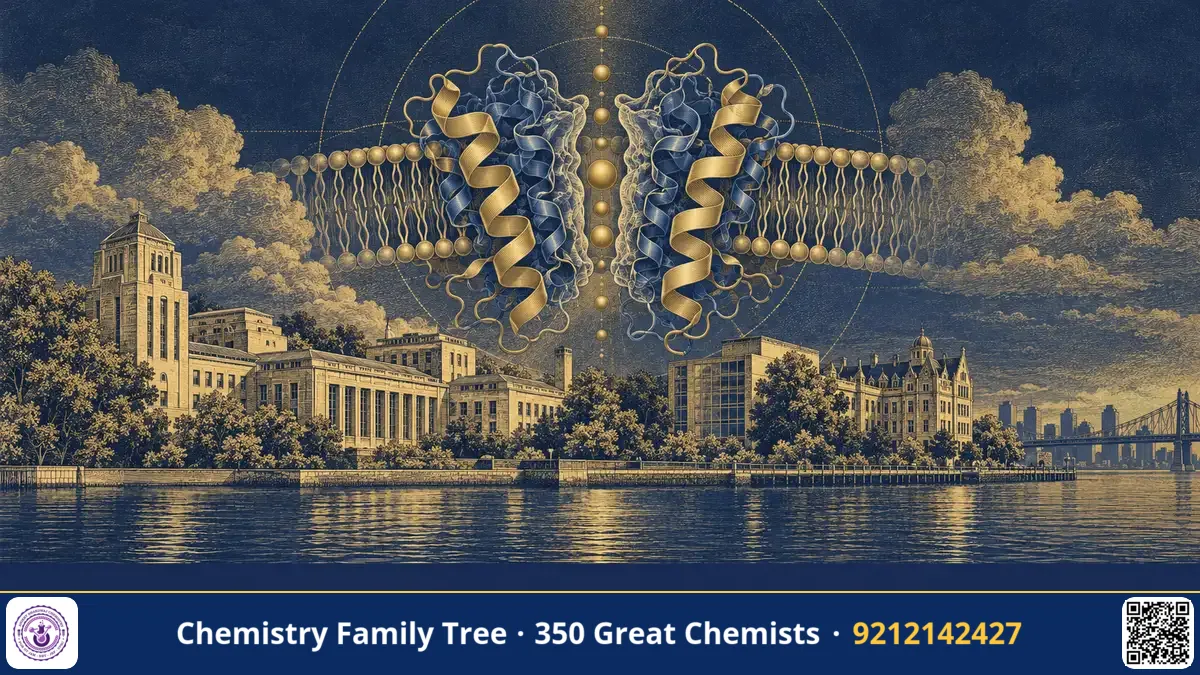
Roderick (Rod) MacKinnon (born 19 February 1956) is an American biophysicist and structural biologist at Rockefeller University in New York. He is best known for determining the first atomic structure of a potassium channel, which explained how nerve and muscle cells control their electrical signals. He received half of the 2003 Nobel Prize in Chemistry. His life story is a reminder that a scientific career can change direction late and still reach the top.
Early Life and Family
MacKinnon was born in Burlington, Massachusetts, in the United States. He grew up in the Boston area in a family with no famous scientific background. As a boy and teenager he was not an obvious future laureate: he has said in interviews that he was an indifferent student in school and found his interest only when he reached university.
Education and Mentors
He studied biochemistry at Brandeis University, graduating in 1978. He then went to Tufts University School of Medicine and received his MD in 1982. He did his medical internship and residency at Beth Israel Hospital in Boston and worked as a physician for some years. During this time he became fascinated by the physiology of the heart and by how ion channels create electrical activity. He decided to go back to basic research and joined the laboratory of Christopher Miller at Brandeis University, who studied ion channels using purified channel proteins in artificial membranes. In Miller's laboratory he learned molecular biology and biophysics, and he later moved to Harvard Medical School as a faculty member. A decisive change came when he turned to X-ray crystallography, because he felt that only a structure would explain how channels select ions.
Career Timeline
| Year | Event |
|---|---|
| 1956 | Born in Burlington, Massachusetts |
| 1978 | BA in biochemistry, Brandeis University |
| 1982 | MD, Tufts University School of Medicine |
| 1980s | Medical residency; postdoctoral research with Christopher Miller at Brandeis |
| 1989 | Joined Harvard Medical School faculty |
| 1996 | Moved to Rockefeller University, New York; Howard Hughes Medical Institute investigator |
| 1998 | Published the crystal structure of the KcsA potassium channel |
| 2003 | Published the KvAP voltage-gated channel structure; Nobel Prize in Chemistry (half share) |
Major Scientific Contributions
MacKinnon's major contribution is the structure of the KcsA potassium channel. The channel is a tetramer with a central pore and a narrow selectivity filter lined with the sequence TVGYG. Carbonyl oxygen atoms replace the water shell of a dehydrated K⁺ ion, giving it a perfect fit, while the smaller Na⁺ ion is excluded by the rigid geometry. Two K⁺ ions in the filter repel each other and speed up flow to about 10⁸ ions per second. The details are in our discovery article.
Later he and his group explained how channels open and close (gating) in response to voltage, calcium and other signals, determined structures of calcium-activated, voltage-gated and chloride channels, and studied how toxins and drugs interact with them. This created the molecular basis for the field of ion-channel pharmacology.
Awards, Honours and Nobel Prize
- Nobel Prize in Chemistry 2003: awarded half "for structural and mechanistic studies of ion channels"; Peter Agre received the other half for the discovery of water channels. This was a Chemistry prize although MacKinnon is a medical doctor.
- Member of the US National Academy of Sciences and other national academies.
- Other major awards for ion-channel research, including prizes before the Nobel
- Honorary degrees from several universities.
Personality, Struggles and Lesser-Known Facts
- A late bloomer: He changed from clinical medicine to basic research after his medical training, and later added crystallography to his skills.
- Learning a new craft: He moved into crystallography without a classical training in it, working with experts and using synchrotron beamlines to collect data.
- Years of failure: Membrane proteins are notoriously reluctant to crystallise. His group tried many channels and many detergent conditions before KcsA gave good crystals.
- A bold choice: Skeptics believed that a bacterial channel would teach little about human channels. The conserved filter sequence proved otherwise.
- Teaching style: He is known for clear explanations, using physical analogies, and for mentoring many young scientists.
Legacy and Influence on Modern Chemistry
Because of MacKinnon's structures, textbooks can now show exactly why a potassium channel prefers K⁺ over Na⁺. His work launched the structural era of electrophysiology, and today structures of human channels are used for rational drug design for epilepsy, arrhythmia, pain and diabetes. In India, researchers and pharmaceutical companies use these concepts in screening for heart-safe drugs. In chemistry courses, his results are a perfect illustration of ion solvation, coordination chemistry, electrostatics and thermodynamics working together inside a protein.
Lessons for Students
- It is never too late to change direction if your curiosity points elsewhere.
- Learn the tools that your question needs, even if they are outside your original training.
- Choose model systems wisely: a humble bacterial protein solved a human problem.
- Patience is a research skill; crystals take time.
- Understand principles from physics and chemistry; biology is built on them.
Quick Facts Box
- Born: 19 February 1956, Burlington, Massachusetts, USA
- Died: Living
- Nationality: American
- Field: Structural biology, biophysics
- Famous for: Atomic structure of the potassium channel (KcsA, 1998)
- Nobel: Chemistry 2003 (half, shared with Peter Agre)
FAQ
Is Roderick MacKinnon a medical doctor?
Yes, he earned an MD at Tufts, but his Nobel Prize was in Chemistry.
Where does he work?
At Rockefeller University in New York, where he is a professor and Howard Hughes Medical Institute investigator.
What method did he use to solve the channel?
X-ray crystallography of crystals of the KcsA channel, with data collected using synchrotron radiation.
How is his work linked to the heart?
Potassium channels control the repolarisation of cardiac cells, so understanding their structure helps explain arrhythmias and drug side effects.
Published by ABC Chemistry — IIT-JAM | CSIR-NET | GATE Chemistry Coaching. Visit abcchemistry.com
About the chemist
Roderick MacKinnon
1956- · United States · Nobel Chemistry 2003
Structure of potassium ion channels