The discovery, explained · Chemist no. 182 of 350
Roderick MacKinnon and the Potassium Channel: Seeing How an Ion Is Chosen
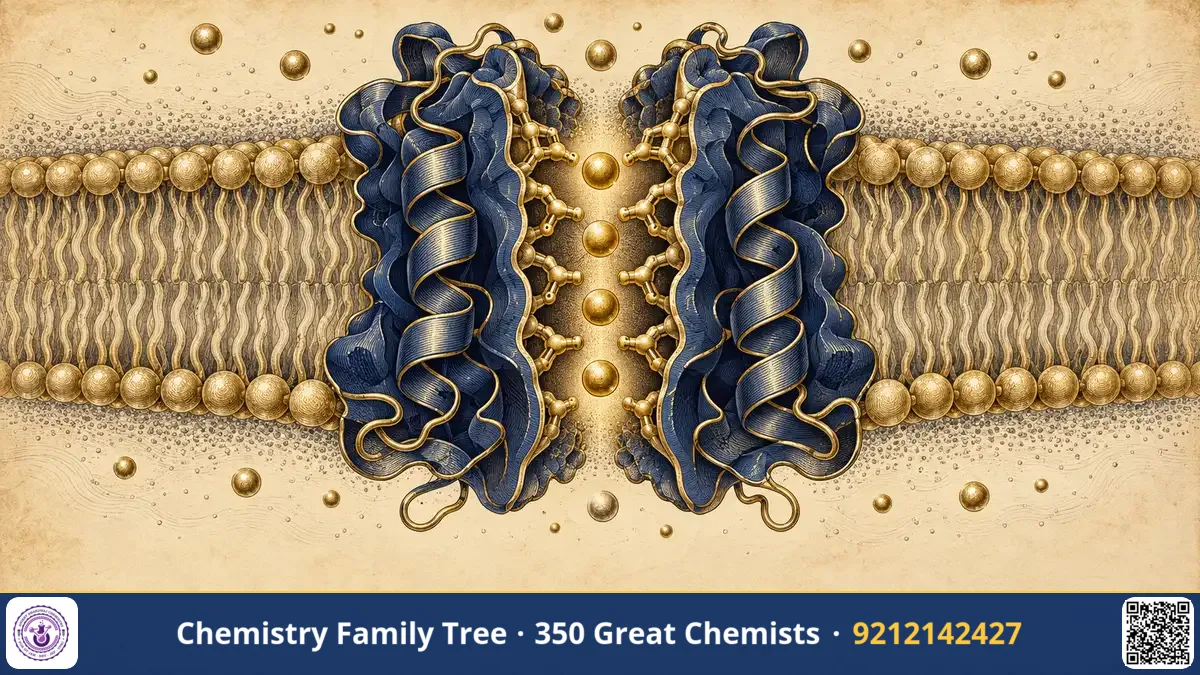
Your heartbeat, your thoughts and the twitch of your finger all depend on tiny electrical signals. These signals are produced when ions such as K⁺ and Na⁺ cross cell membranes through protein channels. Physiologists had measured the currents for half a century, but nobody had seen a channel. In 1998 Roderick MacKinnon and his colleagues at Rockefeller University solved the three-dimensional structure of a potassium channel by X-ray crystallography and showed, atom by atom, how it passes K⁺ ions at nearly the speed of diffusion while rejecting the smaller Na⁺ ion.
For this work MacKinnon received half of the 2003 Nobel Prize in Chemistry (Peter Agre received the other half for aquaporins). MacKinnon trained as a physician, but the prize was in Chemistry, because it was awarded for structural and mechanistic studies of ion channels.
The Scientific Problem Before the Discovery
In the 1950s Alan Hodgkin and Andrew Huxley described nerve impulses with mathematical equations, assuming that membranes contain gated pores for sodium and potassium. Later, electrophysiologists, using the patch-clamp method, could record the current of single channel molecules. The mystery was chemical:
- K⁺ (ionic radius about 1.33 Å) is larger than Na⁺ (about 0.95 Å). A pore that lets K⁺ pass should easily allow the smaller Na⁺ as well. Yet potassium channels are around 10,000 times more selective for K⁺ over Na⁺.
- Ions in water are surrounded by a shell of water molecules (hydration). To enter a narrow pore the ion must lose most of this shell, which costs a lot of energy. How could the channel be selective and fast?
Without a structure these questions had only speculative answers. Membrane proteins are hard to crystallise because they are embedded in lipid and are unstable in detergent.
The Discovery: Step by Step
- Choose a good target: MacKinnon selected KcsA, a small potassium channel from the bacterium Streptomyces lividans. Its sequence resembled that of eukaryotic K⁺ channels, but it was easy to make in large amounts.
- Purify and crystallise: The protein was expressed in E. coli, solubilised with detergent and purified. Crystals were improved by binding an antibody Fab fragment, which provided surfaces for crystal contacts.
- Collect X-ray data: Crystals were diffracted with synchrotron radiation, giving a structure at 3.2 Å resolution (published in Science in 1998).
- Interpret the structure: The channel is a tetramer of four identical subunits around a central pore, shaped like an inverted teepee: a wide water-filled cavity near the cell interior and a narrow selectivity filter at the outer end.
- Later work: With higher-resolution data and ion soaking experiments, his group located K⁺ ions inside the filter. In 2003 they also reported the structure of a voltage-gated channel (KvAP), showing how a voltage sensor can open the gate.
The Chemistry Behind It
The heart of the structure is the selectivity filter, a stretch of about 12 Å lined by the conserved amino-acid sequence T-V-G-Y-G (threonine, valine, glycine, tyrosine, glycine) from each of the four subunits. The backbone carbonyl oxygens (C=O) of this sequence point into the pore. They form four rings of oxygen atoms, creating a series of binding sites.
The trick is that the carbonyl oxygens mimic the water shell:
[K(H₂O)₈]⁺ → K⁺ surrounded by 8 carbonyl oxygens in the filter
Each K⁺ loses its hydration water, but is immediately coordinated by eight oxygen atoms of the protein, so the energy cost of dehydration is paid back. The geometry fits K⁺ perfectly. The smaller Na⁺ ion cannot reach all the oxygens at the same time because the filter is rigid; it is not compensated for the loss of water, so it is rejected by a high energetic cost.
Moreover, two K⁺ ions occupy the filter at once, separated by a water molecule. Their mutual electrostatic repulsion pushes the ions through, so the passage is extremely fast, about 10⁸ ions per second per channel. In thermodynamic terms the selectivity comes from the difference in free energy of binding:
ΔΔG = ΔG(Na⁺) − ΔG(K⁺) > 0 (K⁺ favoured by roughly 5 kcal/mol)
Also noteworthy: the four helices lining the cavity produce a helix dipole that stabilises a K⁺ ion in the water-filled cavity, helping it to approach the filter.
Applications Today
- Cardiology: The hERG potassium channel controls the heart's repolarisation. Many drugs are screened against hERG to avoid arrhythmia.
- Diabetes: ATP-sensitive K⁺ channels in pancreatic cells are the targets of sulfonylurea drugs such as glibenclamide, widely used in India.
- Neurology: Channel mutations cause epilepsy and episodic ataxia; channel-blocking drugs treat several disorders.
- Toxins: Scorpion and snake toxins block channels, and the structures help design pain-relief medicines.
- Bioelectronics: Artificial ion-selective membranes and sensors take hints from the filter.
Exam Corner
- MacKinnon shared half of the Nobel Prize in Chemistry 2003 for structure and mechanism of ion channels.
- KcsA: tetrameric K⁺ channel from Streptomyces lividans, solved by X-ray crystallography (1998).
- Signature selectivity-filter sequence: TVGYG; carbonyl oxygens replace the hydration shell.
- Ionic radius: Na⁺ 0.95 Å < K⁺ 1.33 Å, yet K⁺ is preferred, as the filter is rigid.
- Multiple K⁺ ions in the filter repel each other, giving high conductance.
Common Misconceptions
- "A smaller ion should pass more easily." In a channel, the match between the ion and the coordinating oxygens matters more than size alone.
- "The filter is a simple hole." It is a precisely arranged chemical environment that substitutes for water.
- "Selectivity makes the channel slow." Potassium channels are both highly selective and very fast.
Quick Revision Box
- Roderick MacKinnon, Rockefeller University; Chemistry Nobel 2003 (half).
- KcsA structure published 1998 at 3.2 Å resolution.
- Four subunits form a central pore: cavity plus selectivity filter.
- TVGYG carbonyl oxygens coordinate dehydrated K⁺.
- Na⁺ rejected because it is too small for the rigid oxygen cage.
- Conductance about 10⁸ ions s⁻¹ via ion-ion repulsion.
FAQ
Why was a bacterial channel used?
It was stable, produced in large amounts and had a sequence similar to human channels, so the findings apply widely.
How does the channel discriminate between K⁺ and Na⁺?
Carbonyl oxygens form a rigid cage that fits K⁺ and compensates for its dehydration; Na⁺ cannot be properly coordinated, so it is energetically disfavoured.
What did MacKinnon show about voltage gating?
His group's structure of the KvAP channel in 2003 showed a paddle-like voltage sensor that moves in the membrane to open the pore, although this model was debated and refined later.
Why is the discovery in Chemistry and not Medicine?
The Nobel committee awarded the structural and mechanistic analysis of the channels, which is chemical in nature: atomic structures and ion energetics.
Published by ABC Chemistry — IIT-JAM | CSIR-NET | GATE Chemistry Coaching. Visit abcchemistry.com
About the chemist
Roderick MacKinnon
1956- · United States · Nobel Chemistry 2003
Structure of potassium ion channels