Biography · Chemist no. 186 of 350
Roger D. Kornberg: A Nobel Family and the Machinery of Genes
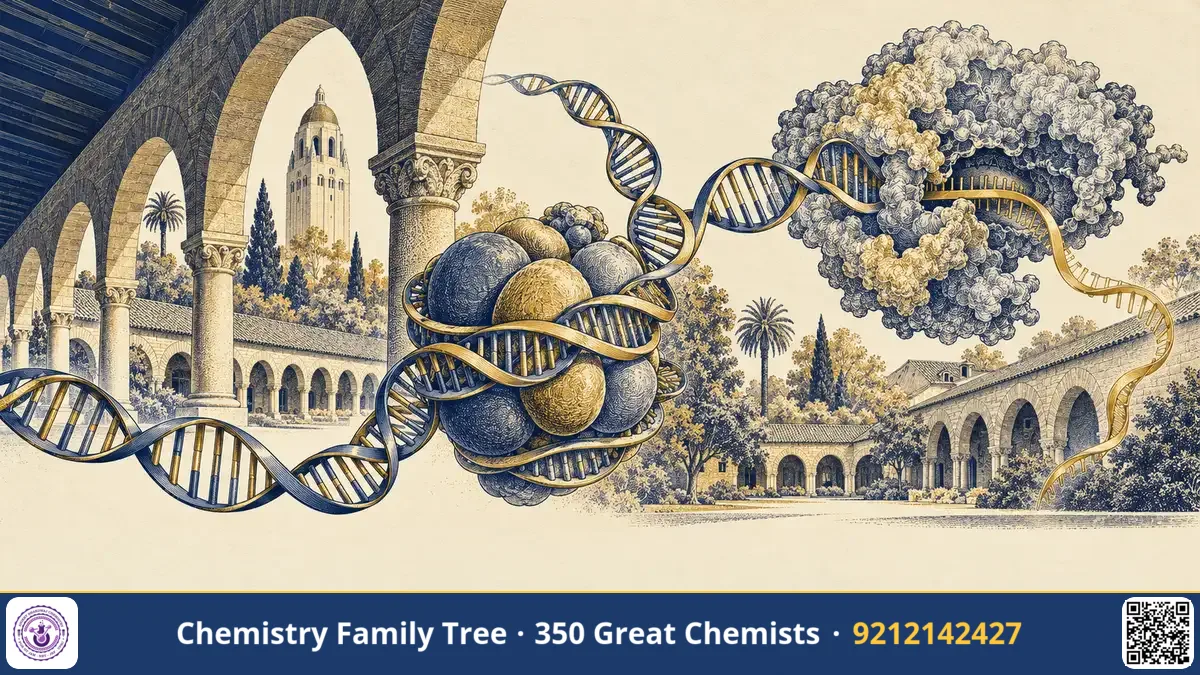
Roger David Kornberg (born 24 April 1947) is an American biochemist and structural biologist at Stanford University. He discovered the nucleosome as a young researcher, and later determined the structure of RNA polymerase II, the enzyme that copies genes in human and yeast cells. In 2006 he won the Nobel Prize in Chemistry, alone. He is also part of a famous scientific family: his father, Arthur Kornberg, received the 1959 Nobel Prize in Physiology or Medicine.
Early Life and Family
Roger Kornberg was born in St. Louis, Missouri, where his father was a professor of microbiology at Washington University. The family later moved to Stanford, California, in 1959, when Arthur Kornberg became head of the new biochemistry department there. Roger thus grew up in a house where conversation about enzymes and DNA was routine. His brothers, Thomas and Kenneth, also became scientists: Thomas Kornberg is a biologist at the University of California, San Francisco and discovered DNA polymerases II and III, while Kenneth is an architect. His mother, Sylvy Kornberg, was a biochemist too. Roger has said that he saw the pleasures of scientific life at home but also made his own path.
Education and Mentors
He earned a BS in chemistry at Harvard University (1967) and a PhD in chemistry at Stanford University (1972), under the physical chemist Harden McConnell, a pioneer of membrane biophysics and spin-labelling. In McConnell's group he studied the movement of lipid molecules in membranes, discovering "flip-flop" (the movement of lipids between the two layers of a bilayer) and measuring that it is very slow compared with lateral diffusion. For postdoctoral research he moved to the MRC Laboratory of Molecular Biology in Cambridge, England, working with Aaron Klug (Nobel Prize in Chemistry 1982) and with Francis Crick (Nobel Prize in Physiology or Medicine 1962). There he turned from membranes to chromatin, which led to his greatest early discovery.
Career Timeline
| Year | Event |
|---|---|
| 1947 | Born in St. Louis, Missouri |
| 1967 | BS in chemistry, Harvard University |
| 1972 | PhD in chemistry, Stanford University |
| 1972–1975 | Postdoctoral research at the MRC Laboratory of Molecular Biology, Cambridge |
| 1974 | Proposed the nucleosome model of chromatin |
| 1976 | Assistant professor, Harvard Medical School |
| 1978 | Professor of structural biology at Stanford University School of Medicine |
| 2000–2001 | Solved the structure of yeast RNA polymerase II and of transcribing complexes |
| 2006 | Nobel Prize in Chemistry |
Major Scientific Contributions
Kornberg's first major result was the nucleosome: the discovery that chromatin consists of repeating units with about 200 base pairs of DNA associated with a histone octamer (two copies each of H2A, H2B, H3 and H4). The DNA is wrapped about 1.7 times around the octamer. This explains how the long DNA molecule is compacted about seven-fold at the first level and why genes must be unwrapped to be read.
His second great achievement was understanding eukaryotic transcription. His laboratory built a faithful yeast transcription system in a test tube, discovered the Mediator complex, and determined the structure of RNA polymerase II in 2000–2001, followed by structures of the enzyme with DNA, RNA and nucleotides, revealing how it makes RNA. The chemical reaction RNAₙ + NTP → RNAₙ₊₁ + PPi, with two Mg²⁺ ions, is described in the discovery article.
Awards, Honours and Nobel Prize
- Nobel Prize in Chemistry 2006: awarded to Roger D. Kornberg alone "for his studies of the molecular basis of eukaryotic transcription". This was in Chemistry.
- Member of the US National Academy of Sciences and other academies.
- Several scientific awards for his work on chromatin and transcription before and after the Nobel Prize.
- He and his father, Arthur Kornberg, became one of the few father-son pairs of Nobel laureates in science.
Personality, Struggles and Lesser-Known Facts
- Family of laureates: The Kornbergs joke that science was the family business. However, Roger's Nobel Prize is in Chemistry, whereas his father's was in Physiology or Medicine.
- Long project: Crystallising a 12-subunit enzyme complex took many years of trial and error, and for a time other scientists doubted that it could be done.
- From physical chemistry to biology: His PhD was on lipid dynamics in membranes, a field of physical chemistry rather than molecular biology.
- Entrepreneur: He co-founded a biotechnology company, Cytokinetics, in the late 1990s, and has been involved in other ventures.
- Family: He is married to Yahli Lorch, a structural biologist who has also worked on chromatin and transcription.
Legacy and Influence on Modern Chemistry
Every student who learns "beads on a string" for chromatin or the steps of transcription initiation is using the ideas of Kornberg. The structures of RNA polymerase II underpin research on gene regulation, cancer and viral infection. The principles of nucleosome positioning and histone modification form the foundation of epigenetics. In India, research groups at institutes such as the Indian Institute of Science and the Tata Institute of Fundamental Research study chromatin and transcription using concepts and methods that flow directly from his work.
Lessons for Students
- Move across fields: his move from physical chemistry to molecular biology made him unique.
- Take on long, difficult projects when the payoff is fundamental.
- Build reconstituted systems, simple test-tube versions of life processes, to understand them.
- Learn from great mentors, but find your own path.
- Combine structure and function: seeing the molecule explains the mechanism.
Quick Facts Box
- Born: 24 April 1947, St. Louis, Missouri, USA
- Died: Living
- Nationality: American
- Field: Structural biology, biochemistry
- Famous for: Nucleosome model; structure of RNA polymerase II
- Nobel: Chemistry 2006 (sole recipient)
FAQ
Is Roger Kornberg related to Arthur Kornberg?
Yes, Arthur was his father. Arthur won the 1959 Nobel Prize in Physiology or Medicine; Roger won the 2006 Nobel Prize in Chemistry.
Where does he work?
At Stanford University School of Medicine, where he has been a professor since 1978.
What is RNA polymerase II?
The enzyme that copies protein-coding genes into messenger RNA in eukaryotic cells.
Did he win the prize alone?
Yes. The 2006 Nobel Prize in Chemistry was given to him alone.
Published by ABC Chemistry — IIT-JAM | CSIR-NET | GATE Chemistry Coaching. Visit abcchemistry.com
About the chemist
Roger D. Kornberg
1947- · United States · Nobel Chemistry 2006
Molecular basis of eukaryotic transcription