The discovery, explained · Chemist no. 186 of 350
Roger Kornberg: From the Nucleosome to the Structure of RNA Polymerase II
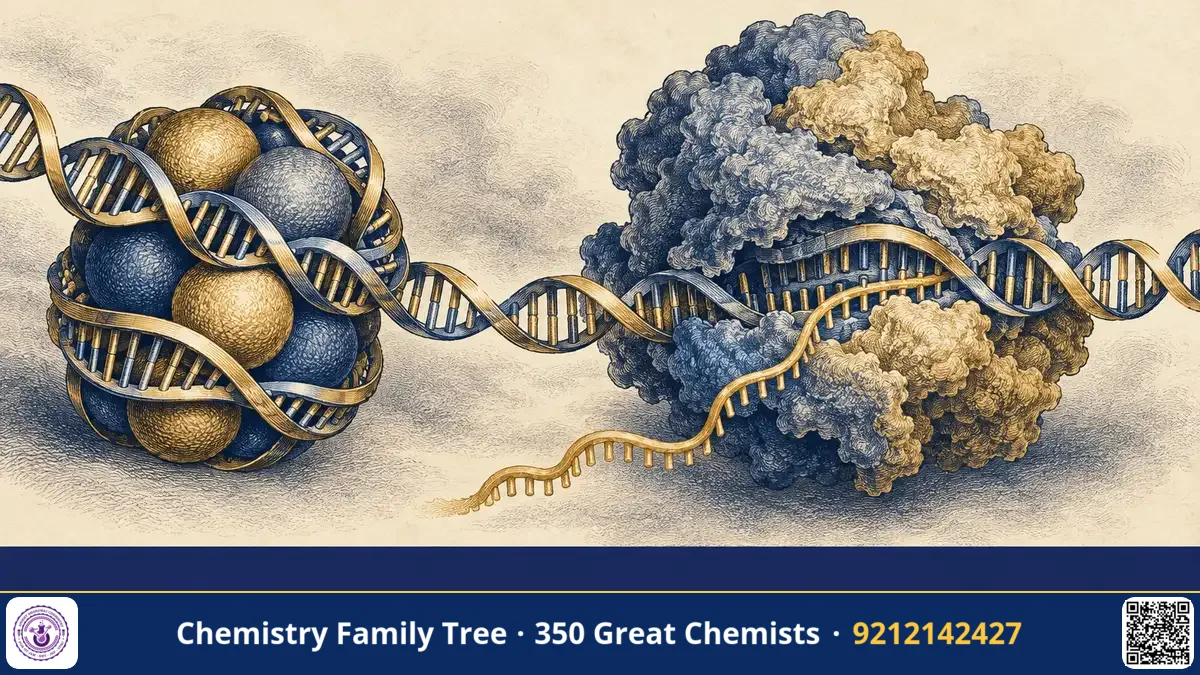
Each of your cells contains about two metres of DNA packed into a nucleus a few micrometres wide. Yet, whenever the cell needs a protein, it must open the right stretch of DNA and copy it into messenger RNA. In the early 1970s Roger D. Kornberg discovered how DNA is packaged into a repeating unit called the nucleosome. Decades later his laboratory at Stanford solved the atomic structure of RNA polymerase II, the enzyme that copies genes in eukaryotic cells, and captured it at work.
For these studies he received the 2006 Nobel Prize in Chemistry "for his studies of the molecular basis of eukaryotic transcription". He is the son of Arthur Kornberg, who won the 1959 Nobel Prize in Physiology or Medicine for DNA synthesis. Roger's prize, however, was in Chemistry.
The Scientific Problem Before the Discovery
The 1960s saw the central dogma and the genetic code worked out. Bacterial transcription was well understood: Jacques Monod and François Jacob described the lac operon, and bacterial RNA polymerase had been purified. But eukaryotic cells (yeast, plants, humans) posed two new puzzles.
- Packaging: Eukaryotic DNA is complexed with histone proteins (H2A, H2B, H3, H4 and H1) forming chromatin. Was chromatin just a random coating, or did it have a regular structure?
- Machinery: Eukaryotes have three RNA polymerases (I, II and III). RNA polymerase II makes mRNA, but alone it cannot start transcription at a promoter. Many extra protein factors were required, and nobody knew how they worked together.
The Discovery: Step by Step
Part 1: the nucleosome (1974)
- Digestion experiments with micrococcal nuclease, which cuts DNA between nucleosomes, had shown a ladder of DNA fragments in multiples of about 200 base pairs. This regular pattern suggested a repeating organisation.
- Kornberg, then a postdoctoral researcher at the MRC Laboratory of Molecular Biology in Cambridge, UK, studied histone interactions. Biochemical work by him and Jean Thomas showed that the histones H3 and H4 form a tetramer, and H2A and H2B form dimers, in solution.
- Combining his data with X-ray diffraction and the nuclease results, Kornberg proposed in 1974 that chromatin is built of repeating units. Each unit has about 200 bp of DNA and a core of eight histone molecules (two each of H2A, H2B, H3, H4), the histone octamer.
- Later structural work showed that 146–147 bp of DNA is wrapped around the octamer in about 1.7 left-handed superhelical turns, with the rest as "linker" DNA, bound by H1.
Part 2: RNA polymerase II (2001)
- Kornberg's group developed a cell-free system from yeast that could reproduce regulated transcription in a test tube, allowing the identification of general transcription factors and the Mediator complex.
- They purified the 12-subunit yeast RNA polymerase II, grew crystals, and in 2000 obtained an atomic-resolution structure by X-ray crystallography (about 2.8 Å).
- In 2001, they solved the structure of polymerase II with DNA template and RNA product, a complex captured in the act of transcribing. Later structures showed incoming nucleotides, and the changes in structure when nucleotides are added.
The Chemistry Behind It
The nucleosome is a case study in electrostatic chemistry. DNA carries a negative charge on each phosphate (one per nucleotide). Histones are rich in lysine and arginine, so they are strongly positive at physiological pH. The octamer has a positively charged surface that binds the phosphate backbone. Chemical modifications, such as acetylation of lysine (–NH₃⁺ → –NH–CO–CH₃), neutralise the charge, loosen the DNA and make genes more accessible. This is the basis of epigenetic regulation.
RNA polymerase II synthesises RNA by repeated nucleotidyl transfer, in the 5′→3′ direction, using the DNA template:
(RNA)ₙ–3′OH + NTP → (RNA)ₙ₊₁ + PPi
The 3′-OH of the growing chain attacks the α-phosphate of the incoming nucleoside triphosphate. The reaction is helped by two Mg²⁺ ions at the active site, and the release of pyrophosphate (then hydrolysed to 2 Pi) makes the process effectively irreversible. Base pairing with the template ensures fidelity (A–U, T–A, G–C, C–G). The structure shows a clamp that grips the DNA, a "bridge helix", a "trigger loop" that closes over the correct nucleotide, and exit channels for the RNA transcript and the DNA.
Applications Today
- Epigenetic drugs: Inhibitors of histone deacetylases (HDAC) and other chromatin enzymes treat some cancers.
- Antibiotics and antivirals: Understanding polymerase structures helps design inhibitors, such as rifampicin for bacterial RNA polymerase, a key anti-tuberculosis drug used in India.
- Toxins: The death-cap mushroom toxin α-amanitin blocks RNA polymerase II; the structure shows how it binds.
- Synthetic biology: Engineering gene expression in yeast, plants and human cells.
- Stem cell biology: Control of chromatin states is important for reprogramming cells.
Exam Corner
- Kornberg won the 2006 Nobel Prize in Chemistry, alone, for studies of the molecular basis of eukaryotic transcription.
- Nucleosome core: histone octamer (H2A, H2B, H3, H4) × 2; about 146 bp of DNA wrapped 1.7 turns.
- Histone H1 binds linker DNA; chromatin is the "beads on a string" structure.
- RNA polymerase II synthesises mRNA; its structure was solved by X-ray crystallography in yeast.
- Transcription chemistry: 3′-OH attack on the α-phosphate of NTP, Mg²⁺ catalysed, PPi released.
Common Misconceptions
- "Roger Kornberg won the Medicine Nobel like his father." His father, Arthur, won Physiology or Medicine (1959, shared with Severo Ochoa). Roger won Chemistry (2006).
- "Histones are negatively charged." They are positively charged, which is why they bind DNA.
- "RNA polymerase copies DNA to DNA." It makes RNA, using the DNA as a template.
Quick Revision Box
- 1974: nucleosome model (about 200 bp DNA per histone octamer).
- 2001: crystal structure of yeast RNA polymerase II, including transcribing complexes.
- Nobel Prize in Chemistry 2006, awarded to Kornberg alone.
- Histones are basic proteins rich in Lys and Arg.
- Reaction: RNAₙ + NTP → RNAₙ₊₁ + PPi, with two Mg²⁺ ions.
- Mediator links regulators to the polymerase.
FAQ
What is a nucleosome?
A unit of chromatin consisting of about 146 base pairs of DNA wrapped around a core of eight histone proteins.
Why was yeast used?
Yeast is a simple eukaryote that is easy to grow in bulk and to study genetically, yet its transcription machinery closely resembles that of humans.
What is the Mediator complex?
A large multi-protein assembly that transmits signals from gene-specific activators to RNA polymerase II.
Why is the structure important for drug design?
It shows exactly where inhibitors and toxins bind, so scientists can design more specific drugs.
Published by ABC Chemistry — IIT-JAM | CSIR-NET | GATE Chemistry Coaching. Visit abcchemistry.com
About the chemist
Roger D. Kornberg
1947- · United States · Nobel Chemistry 2006
Molecular basis of eukaryotic transcription