Biography · Chemist no. 190 of 350
Roger Tsien: The Chemist Who Gave Cells Their Colours
Roger Yonchien Tsien (1 February 1952 – 24 August 2016) was an American biochemist and chemist of Chinese descent, a professor at the University of California, San Diego. He designed molecules that let scientists see calcium in living cells, and he turned jellyfish GFP into a toolbox of fluorescent proteins in many colours. He shared the 2008 Nobel Prize in Chemistry with Osamu Shimomura and Martin Chalfie. He is often described as a chemist who thought like a physiologist.
Early Life and Family
Tsien was born in New York City, and grew up in Livingston, New Jersey. His father was an engineer and his family had emigrated from China; he came from an academically gifted family. His older brother Richard Tsien became a well-known neuroscientist. As a child, Roger had asthma and spent a lot of time indoors, where he developed a passion for chemistry. He did experiments with a home chemistry set, and at the age of sixteen he won a prize in the Westinghouse Science Talent Search (a national competition for high-school students in the United States) for a project on how metal ions bind thiocyanate.
Education and Mentors
Tsien received a scholarship to Harvard University, where he studied chemistry and physics and graduated in 1972. He then won a Marshall Scholarship and went to the University of Cambridge in England, where he completed a PhD in physiology in 1977. At Cambridge he worked in the physiological laboratory with Richard Adrian, and while there he developed his first calcium chelators. This mixing of organic chemistry with physiology determined his whole career. In 1982 he moved to the United States as a faculty member of the University of California, Berkeley.
Career Timeline
| Year | Event |
|---|---|
| 1952 | Born in New York City |
| 1972 | Graduated from Harvard in chemistry and physics |
| 1977 | PhD in physiology, University of Cambridge (Marshall Scholar) |
| 1980 | Designed the calcium chelator BAPTA |
| 1982 | Joined the University of California, Berkeley |
| 1985 | Fura-2 and Indo-1 calcium dyes published |
| 1989 | Moved to the University of California, San Diego; Howard Hughes Medical Institute investigator |
| 1990s | Studied GFP mechanism and engineered colour variants (S65T, BFP, CFP, YFP) |
| 2002 | Reported monomeric red fluorescent proteins derived from DsRed |
| 2008 | Nobel Prize in Chemistry (shared) |
| 2016 | Died in Eugene, Oregon, on 24 August |
Major Scientific Contributions
Tsien's earliest breakthrough was designing the chelator BAPTA and fluorescent dyes Quin-2, Fura-2 and Indo-1, which measure free calcium inside cells. His second great contribution was to understand and re-engineer GFP: he showed that chromophore formation requires oxygen, created brighter and differently coloured variants (S65T, blue, cyan and yellow proteins), and re-engineered coral red fluorescent proteins into monomeric forms such as mCherry. These allowed multi-colour imaging and FRET sensors for calcium, cAMP and kinases. The equations for FRET and ratiometric calcium measurement are in our discovery article.
In his later years, he developed molecules to light up tumours during surgery (activatable cell-penetrating peptides) and worked on molecular probes for brain imaging and for specific cell types.
Awards, Honours and Nobel Prize
- Nobel Prize in Chemistry 2008: shared by Osamu Shimomura, Martin Chalfie and Roger Y. Tsien "for the discovery and development of the green fluorescent protein, GFP". It was a Chemistry prize.
- Member of the US National Academy of Sciences and of the National Academy of Medicine (Institute of Medicine).
- Many scientific awards for his work on calcium indicators and fluorescent proteins, before and after the Nobel Prize.
- Howard Hughes Medical Institute investigator.
Personality, Struggles and Lesser-Known Facts
- Childhood chemist: Asthma kept him indoors as a boy, and he turned to his home chemistry set.
- Persistent about oxygen: He showed that GFP's chromophore needs oxygen, a surprise to many who expected enzymes to be needed.
- Family of scientists: His brother Richard is a neuroscientist; Roger often discussed calcium signalling in neurons with him.
- Chemist for biologists: He believed that chemists should design tools for biologists, and he spent much of his time making molecules that others could use.
- Generosity: He supported and shared materials with other scientists, and he shared the story of Douglas Prasher, trying to help his colleague after his career fell on hard times.
Legacy and Influence on Modern Chemistry
The molecules from his laboratory appear in thousands of research papers every year. The AM-ester loading method is a standard laboratory technique, Fura-2 is used all over the world for calcium imaging, and fluorescent proteins in all colours are routine tools for cell biologists. Modern neuroscience relies on genetically encoded calcium indicators such as GCaMP, which are descendants of his ideas. In India, laboratories in universities, the IISERs and NCBS use these tools, and chemistry students learn FRET and fluorescence in photochemistry courses.
Lessons for Students
- Combine chemistry with biology: the best tools come from knowing both.
- Start young; a home chemistry set is a good start.
- Design molecules for a purpose, not just for curiosity.
- Share materials and credit generously.
- Use simple physical principles (equilibrium, ratio measurement, energy transfer) to solve hard problems.
Quick Facts Box
- Born: 1 February 1952, New York City, USA
- Died: 24 August 2016, Eugene, Oregon, USA
- Nationality: American
- Field: Chemical biology, physiology
- Famous for: Calcium indicators (BAPTA, Fura-2); GFP variants; mCherry
- Nobel: Chemistry 2008 (shared with Shimomura and Chalfie)
FAQ
Where did Tsien work?
At the University of California, Berkeley, and from 1989 at the University of California, San Diego.
Was his PhD in chemistry?
No, it was in physiology, from Cambridge, although he trained in chemistry and physics at Harvard.
What is mCherry?
A bright, monomeric red fluorescent protein developed in Tsien's laboratory from a coral protein.
Which Nobel Prize did he win?
The Nobel Prize in Chemistry in 2008.
Published by ABC Chemistry — IIT-JAM | CSIR-NET | GATE Chemistry Coaching. Visit abcchemistry.com
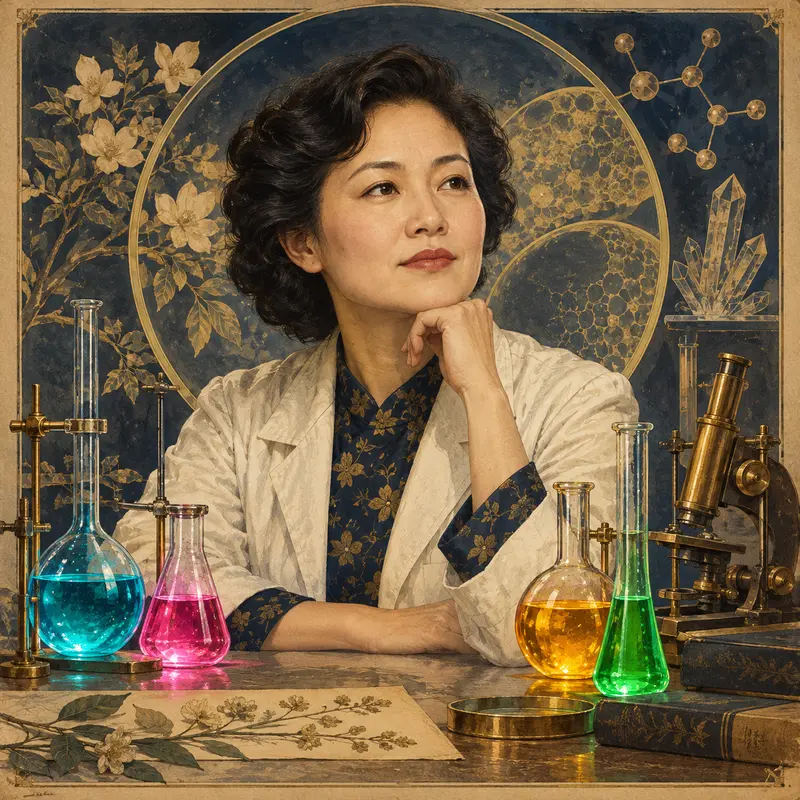
About the chemist
Roger Tsien
1952-2016 · United States · Nobel Chemistry 2008
Engineered fluorescent proteins and calcium probes