The discovery, explained · Chemist no. 296 of 350
1,3-Dipolar Cycloaddition: Rolf Huisgen and the Five-Membered Ring Revolution
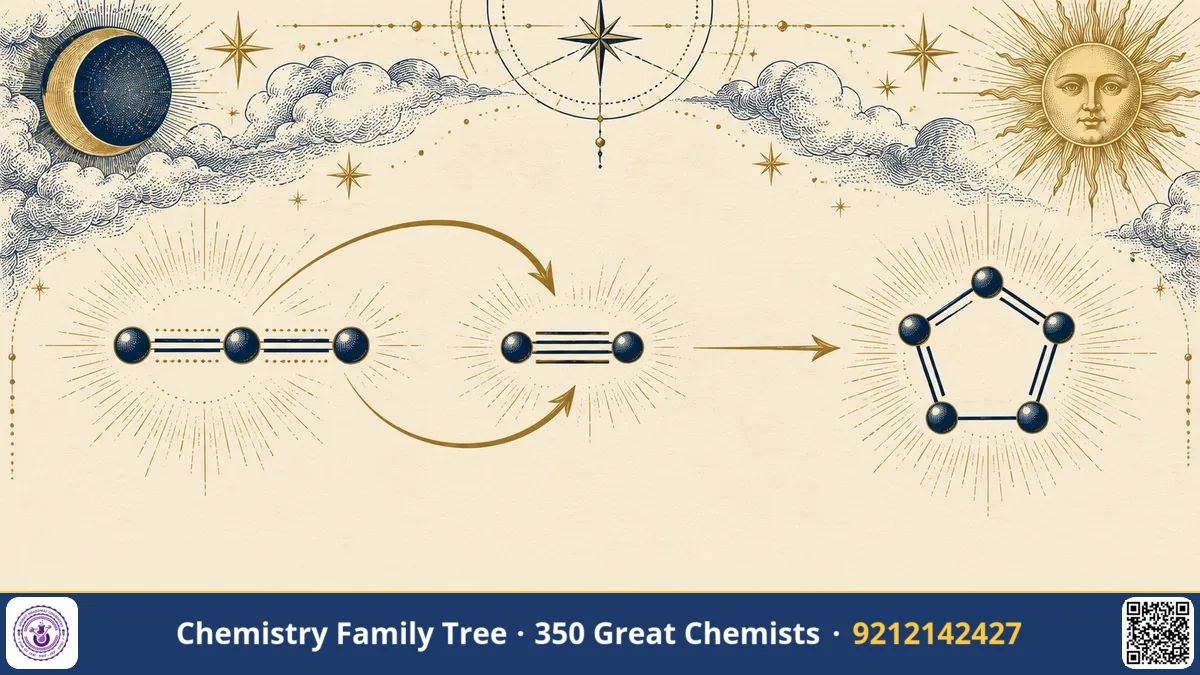
Five-membered heterocycles such as pyrazolines, isoxazoles, triazoles and pyrrolidines are everywhere in drugs, dyes and agrochemicals. How can they be made quickly, cleanly and with predictable regiochemistry? In the early 1960s the German chemist Rolf Huisgen gave a general answer. He recognised that a large family of molecules called 1,3-dipoles react with double or triple bonds in a single concerted step to form five-membered rings. This idea, now called the Huisgen 1,3-dipolar cycloaddition, unified many scattered reactions and became a central part of heterocyclic chemistry. Decades later, a variant of his azide-alkyne reaction became the model "click reaction", leading to the 2022 Nobel Prize in Chemistry.
The Scientific Problem Before the Discovery
By the 1950s, chemists knew many isolated reactions that produced five-membered rings: diazomethane adding to alkenes to give pyrazolines, azides adding to alkynes to give triazoles, nitrile oxides adding to alkenes to give isoxazolines, and ozone adding to alkenes to form primary ozonides. But these were treated as unrelated curiosities. Nobody had a common framework or a clear picture of the mechanism. Were they stepwise, with zwitterions or diradicals, or concerted, like the Diels-Alder reaction? Without an answer, predicting regiochemistry and stereochemistry was difficult.
The Discovery: Step-by-Step
Huisgen's group in Munich systematically studied reaction rates, solvent effects and stereochemistry across many dipole and dipolarophile combinations. Three key observations led to the general scheme:
- Common electronic structure. The reactive partners (1,3-dipoles) are three-atom species with four π electrons spread over the three atoms, a-b-c, with a formal charge separation, such as nitrile oxide R-C≡N⁺-O⁻ or azide R-N=N⁺=N⁻.
- Stereospecificity. A cis alkene gives a cis-substituted ring, and a trans alkene gives a trans ring. This showed that the new bonds form in a single step, with retention of the alkene geometry.
- Small solvent effect. Rates change very little when solvent polarity changes. A stepwise zwitterionic route would be very sensitive to polarity, so a concerted mechanism with little charge separation is favoured.
The general reaction is written as:
a=b⁺-c⁻ (1,3-dipole, 4π electrons) + d=e (dipolarophile, 2π electrons) → five-membered ring
Some typical examples are listed below.
| 1,3-Dipole | Dipolarophile | Product |
|---|---|---|
| Azide R-N₃ | Alkyne | 1,2,3-Triazole |
| Nitrile oxide R-CNO | Alkene | Isoxazoline |
| Nitrone R-CH=N⁺(R)-O⁻ | Alkene | Isoxazolidine |
| Diazomethane CH₂N₂ | Alkene | Pyrazoline |
| Ozone O₃ | Alkene | Primary ozonide (1,2,3-trioxolane) |
The Chemistry Behind It
Orbital description. The reaction is a [π4s + π2s] cycloaddition, thermally allowed by the Woodward-Hoffmann rules, just like the Diels-Alder [4+2] reaction. Six electrons take part in a cyclic transition state (four from the dipole, two from the dipolarophile), which is an aromatic-type, low-energy arrangement.
Frontier molecular orbitals. Rates and regioselectivity depend on the HOMO-LUMO gap between the two partners. There are three types:
- HOMO(dipole)-controlled (Type I): electron-rich dipoles such as diazomethane react fastest with electron-poor alkenes (acrylates).
- LUMO(dipole)-controlled (Type III): electron-poor dipoles such as ozone or nitrile oxides react faster with electron-rich alkenes.
- Both-controlled (Type II): azides and nitrones react with both electron-rich and electron-poor partners.
Regiochemistry. With azides and terminal alkynes, the thermal reaction usually gives a mixture of 1,4- and 1,5-disubstituted triazoles, because the orbital coefficients and sterics are similar. This was a limitation. In 2002, Morten Meldal and, independently, Valery Fokin and K. Barry Sharpless showed that Cu(I) catalysis gives only the 1,4-isomer (the CuAAC reaction), and later Ru catalysis was shown to give the 1,5-isomer. The thermal reaction is now often called the Huisgen cycloaddition, and the copper version the "click" reaction.
R-N₃ + HC≡C-R' --Cu(I), RT--> 1,4-disubstituted 1,2,3-triazole
The strain-promoted version, developed by Carolyn Bertozzi using cyclooctynes, works without copper and can label molecules in living cells. Meldal, Sharpless and Bertozzi shared the 2022 Nobel Prize in Chemistry (Sharpless for the second time).
Debate about the mechanism. The American chemist Richard Firestone proposed a stepwise diradical pathway, and a long scientific debate followed. Huisgen defended the concerted view using careful kinetic and stereochemical evidence. Modern computations support a concerted but often asynchronous pathway in most cases.
Applications Today
- Drug discovery: Triazole and isoxazoline rings appear in antifungal, antibacterial, antiviral and anticancer drugs. Click reactions help build compound libraries quickly.
- Bioconjugation: Azides and alkynes are small and stable in biology, so they are used to label proteins, sugars and DNA in cells.
- Materials: Click chemistry builds polymers, dendrimers, hydrogels and surface coatings.
- Total synthesis: Nitrone and nitrile oxide cycloadditions create several stereocentres in a single step.
- Environmental chemistry: The ozonolysis of alkenes in the atmosphere starts with a 1,3-dipolar cycloaddition of ozone, which makes the reaction relevant to air quality.
Exam Corner
- 1,3-Dipole + dipolarophile → five-membered ring via a concerted [3+2] (π4s + π2s) process, thermally allowed.
- The reaction is stereospecific (syn addition; the alkene geometry is retained) and shows little solvent effect.
- Azide + alkyne gives 1,2,3-triazole; CuAAC gives the 1,4-isomer selectively, RuAAC the 1,5-isomer.
- Nitrile oxide + alkene gives isoxazoline; nitrone + alkene gives isoxazolidine; diazomethane + alkene gives pyrazoline.
- Ozonolysis begins with ozone acting as a 1,3-dipole on the alkene to give a primary ozonide (molozonide).
Common Misconceptions
- "Huisgen cycloaddition and click chemistry are the same." Click chemistry is a broader concept; the copper-catalysed azide-alkyne reaction is one example, and it is a catalysed variant of Huisgen's thermal reaction.
- "1,3-dipoles are always ionic." They are neutral overall; the charges are formal and reflect resonance structures.
- "It is a Diels-Alder reaction." It is related, but the Diels-Alder reaction is a [4+2] giving a six-membered ring, while the 1,3-dipolar reaction is a [3+2] giving a five-membered ring.
Quick Revision Box
- Developed by Rolf Huisgen at Munich in the early 1960s.
- [3+2] cycloaddition; 4π electrons (dipole) + 2π electrons (dipolarophile).
- Concerted, stereospecific, little solvent effect.
- Common dipoles: azides, nitrile oxides, nitrones, diazoalkanes, ozone.
- Thermal azide-alkyne gives a 1,4/1,5 mixture; Cu(I) gives the 1,4-triazole.
- Click chemistry and bioorthogonal chemistry won the 2022 Nobel Prize.
FAQ
What is a 1,3-dipole?
It is a molecule with three adjacent atoms carrying four π electrons and zero net charge, but with resonance forms that show positive and negative charges at the ends or on the atoms, such as azides, nitrones and nitrile oxides.
Why is the Huisgen cycloaddition stereospecific?
Because both new σ bonds form in the same step on the same face of the dipolarophile, so cis substituents stay cis and trans stay trans.
Is Huisgen's name linked to a Nobel Prize?
Huisgen himself did not receive a Nobel Prize, but the 2022 Nobel Prize in Chemistry was awarded for click and bioorthogonal chemistry, which is built on his azide-alkyne cycloaddition.
How is it different from the Diels-Alder reaction?
The Diels-Alder reaction involves a 4π diene and gives a six-membered ring, while the 1,3-dipolar cycloaddition involves a 4π three-atom dipole and gives a five-membered ring.
Published by ABC Chemistry — IIT-JAM | CSIR-NET | GATE Chemistry Coaching. Visit abcchemistry.com
About the chemist
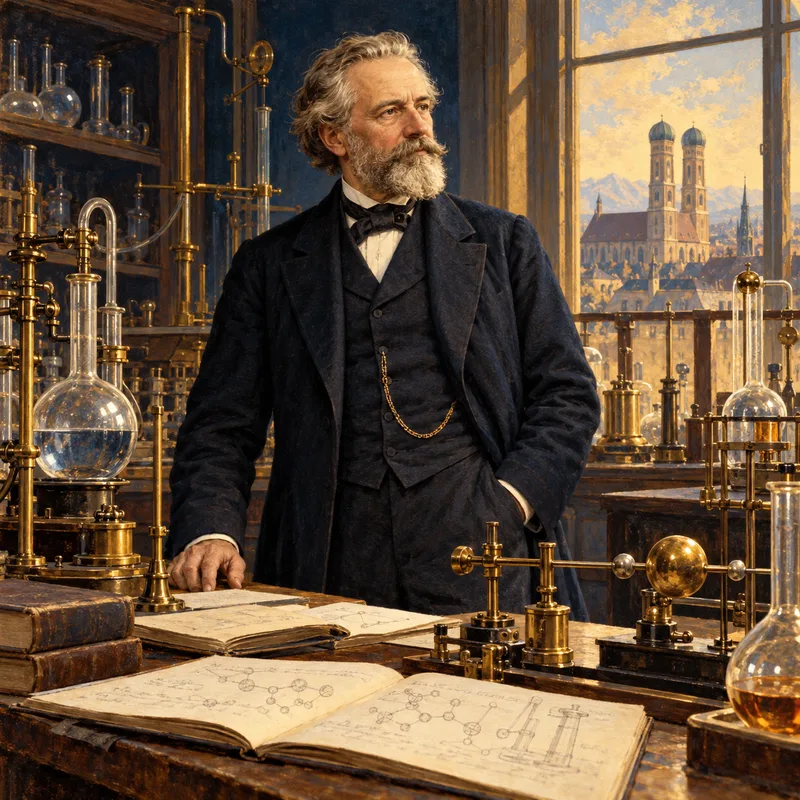
Rolf Huisgen
1920-2020 · Germany
1,3-dipolar cycloaddition