Biography · Chemist no. 296 of 350
Rolf Huisgen (1920-2020): A Century of Chemistry and a Lifetime of Cycloadditions
Introduction
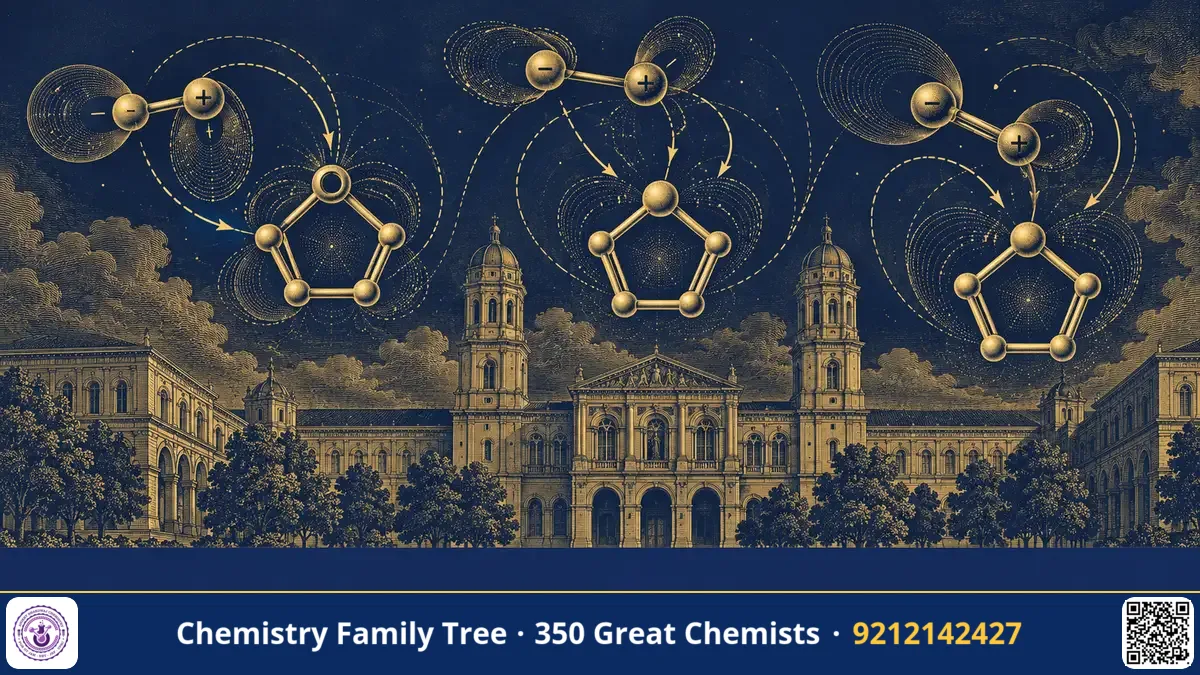
Rolf Huisgen was a German organic chemist who spent nearly his entire academic career in Munich. He is famous as the founder of the general theory of 1,3-dipolar cycloaddition, which explains how azides, nitrones, nitrile oxides and similar molecules form five-membered rings. A variant of his azide-alkyne reaction became the foundation of click chemistry, recognised by the Nobel Prize in 2022. His legacy in one line: he turned scattered reactions into a unified theory using careful kinetics and stereochemical logic. He lived to nearly 100 years of age and remained intellectually active almost until the end.
Early Life and Family
Huisgen was born on 14 June 1920 in Gerolstein, a small town in the Eifel region of western Germany. He grew up in the interwar years, and his early education was in Germany. He came of age as the Second World War began, and his student years in the 1940s were shaped by the war, when many universities worked under severe constraints. Few personal details about his family are widely documented, so this article focuses on his scientific path.
Education and Mentors
Huisgen studied chemistry at the University of Munich, where he worked under the Nobel Prize-winning chemist Heinrich Wieland, a master of natural products (bile acids, alkaloids, toad poisons). He completed his doctorate in 1943, during the war,. Wieland's emphasis on mechanism and on the careful interpretation of reactions had a lasting effect on him. After the war he qualified as a university lecturer (Habilitation) in Munich in the late 1940s and soon rose to a professorship.
Career Timeline
| Year | Event |
|---|---|
| 1920 | Born in Gerolstein, Germany |
| 1943 | Doctorate, University of Munich, under Heinrich Wieland |
| Late 1940s | Habilitation and early independent work in Munich |
| 1949 | Becomes professor at the University of Tübingen |
| 1952 | Returns to Munich as professor and director of the chemistry institute |
| 1950s | Studies ring-size effects on reaction rates, medium-ring lactones and arynes |
| 1960s | Formulates the general theory of 1,3-dipolar cycloaddition |
| 1988 | Retires but continues scientific and historical activity |
| 2020 | Dies in Munich, aged 99 |
Major Scientific Contributions
1. 1,3-Dipolar cycloaddition
Huisgen's systematic work showed that dipoles such as azides, diazoalkanes, nitrile oxides and nitrones add to double and triple bonds in a concerted [3+2] fashion. For the full discussion, see our companion discovery article.
2. Ring-size effects
He studied how the rate of ring closure and ring opening of lactones depends on ring size, showing the distinct strain features of medium rings (8 to 11 members). This is a classic topic in conformational analysis.
3. Arynes and nucleophilic aromatic substitution
Huisgen contributed to the proof of the benzyne intermediate in elimination-addition reactions of aryl halides with strong bases.
4. Mechanistic methodology
He developed a careful style of kinetic analysis, using solvent effects, activation parameters, and stereochemical probes to distinguish concerted from stepwise pathways. His work with the cycloaddition of thiocarbonyl ylides and carbonyl ylides further widened the family of dipoles.
Awards, Honours and Nobel Prize
Huisgen did not receive the Nobel Prize, although his work is regarded as foundational for the 2022 Nobel Prize in click and bioorthogonal chemistry. He was a member of the Bavarian Academy of Sciences, held many honorary doctorates and foreign memberships of academies, and received the awards of several chemical societies. Within chemistry, the term "Huisgen cycloaddition" is itself a lasting honour.
Personality, Struggles and Lesser-Known Facts
- Wartime student. He earned his doctorate in 1943, when Germany was at war, and rebuilt his research career in the post-war ruins.
- A very long career. He was publishing and advising well into his nineties, and was a celebrated figure at conferences when the click-chemistry revolution made his name widely known again.
- A late reward. He lived long enough to see the copper-catalysed azide-alkyne reaction grow out of his basic research and spread into biology and materials science.
- Strong mechanistic principles. He insisted that a mechanism must account for all the data: rates, stereochemistry and solvent effects.
- Scientific debate. His disagreement with Firestone over concerted versus diradical cycloaddition is a textbook example of how to resolve a mechanistic dispute with experiments.
Legacy and Influence on Modern Chemistry
The five-membered heterocycles produced by 1,3-dipolar cycloaddition appear in many pharmaceuticals. The concept of a dipole and a dipolarophile is now standard teaching, alongside the Diels-Alder reaction and the Woodward-Hoffmann rules. Click chemistry, bioorthogonal labelling in living cells and polymer synthesis all draw on his basic reaction. His students formed a large academic family in Germany and abroad, and his careful experimental style continues to influence physical organic chemists.
Lessons for Students
- Look for patterns across many reactions. A general principle is worth more than a single example.
- Use evidence: kinetics and stereochemistry can settle a debate about mechanism.
- Fundamental research can have a delayed pay-off. A reaction from the 1960s became a Nobel-winning tool 40 years later.
- Persist through difficult times; he built a career in the years of wartime and post-war reconstruction.
- Stay curious for life.
Quick Facts Box
- Born: 14 June 1920, Gerolstein, Germany
- Died: 26 March 2020, Munich, aged 99
- Nationality: German
- Field: Physical organic chemistry, heterocyclic chemistry
- Famous for: 1,3-Dipolar cycloaddition (Huisgen cycloaddition)
- Nobel Prize: None; his reaction underlies the 2022 Nobel Prize in click chemistry
FAQ
Who was Rolf Huisgen's doctoral supervisor?
He studied under Heinrich Wieland at the University of Munich, and completed his doctorate there in 1943.
What is Huisgen best known for?
He is best known for developing the concept and mechanism of 1,3-dipolar cycloaddition reactions that form five-membered rings.
How is his work connected to click chemistry?
The thermal azide-alkyne cycloaddition is Huisgen's reaction. Copper catalysis turned it into the efficient and selective click reaction developed by Meldal, Sharpless and colleagues.
Did Rolf Huisgen win a Nobel Prize?
No. He lived to 99, and saw the field he founded become central to modern chemistry, but the 2022 Nobel Prize in Chemistry was given to Bertozzi, Meldal and Sharpless.
Published by ABC Chemistry — IIT-JAM | CSIR-NET | GATE Chemistry Coaching. Visit abcchemistry.com
About the chemist
Rolf Huisgen
1920-2020 · Germany
1,3-dipolar cycloaddition