Biography · Chemist no. 137 of 350
Ronald George Wreyford Norrish (1897-1978): The Cambridge Chemist Who Photographed Fleeting Molecules
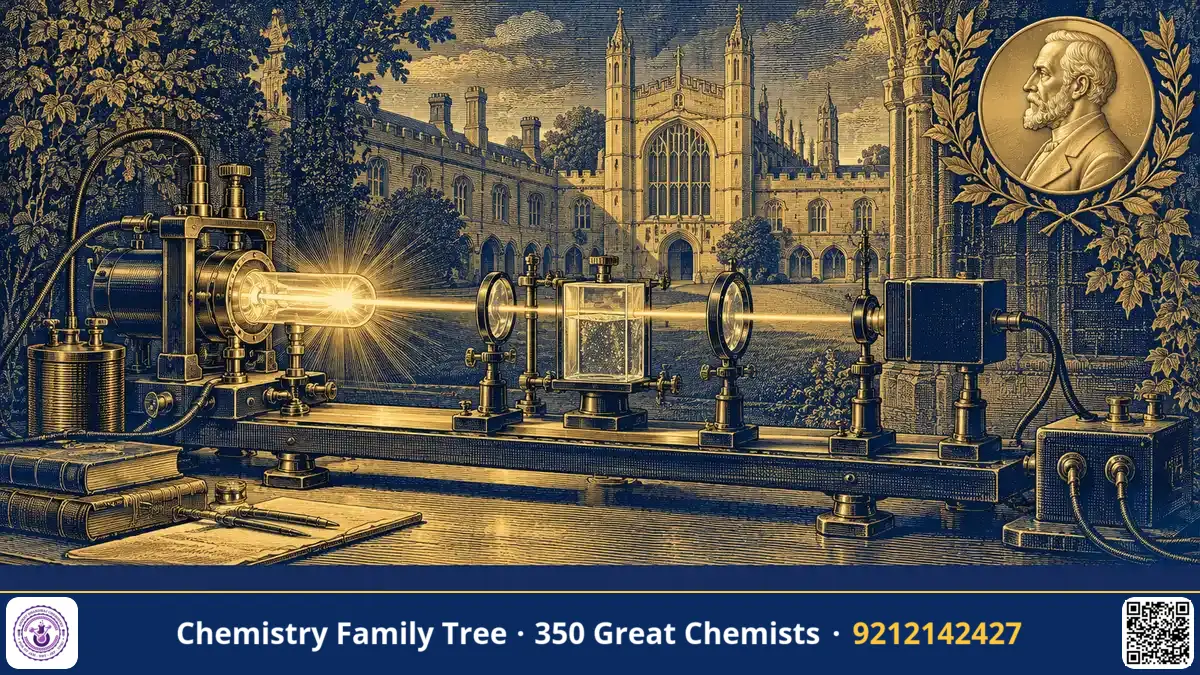
Ronald Norrish was a British physical chemist and a lifelong member of Cambridge University. With his student George Porter he invented flash photolysis, a technique that allowed scientists to see short-lived radicals and excited molecules for the first time. He also gave his name to the Norrish Type I and Type II photoreactions and the Trommsdorff-Norrish gel effect in polymerisation. In 1967 he shared the Nobel Prize in Chemistry with Porter and Manfred Eigen. His legacy in one line: he opened the microsecond world of reactive intermediates to direct observation.
Early Life and Family
Norrish was born on 9 November 1897 in Cambridge, England. He attended The Perse School in Cambridge, an old and respected school with a good record in science teaching. He grew up in the university town where he would spend almost all his scientific life.
Education and Mentors
In 1915 Norrish won a scholarship to Emmanuel College, Cambridge, but his studies were interrupted by the First World War. He served in the Royal Field Artillery in France, was wounded, and was taken prisoner in 1918. The experience of war and captivity stayed with him. He returned to Cambridge in 1919 and completed his studies in natural sciences, specialising in chemistry. His early research was in physical chemistry and photochemistry, including the reaction between hydrogen and chlorine and the combustion of hydrocarbons. Cambridge's chemistry department was rich in physical chemists, which shaped his approach.
Career Timeline
| Year | Event |
|---|---|
| 1897 | Born in Cambridge |
| 1915 | Enters Emmanuel College, Cambridge |
| 1917-1918 | Serves in the Royal Field Artillery; wounded and taken prisoner in 1918 |
| 1919-1925 | Returns to Cambridge, gains his degree and starts research |
| 1925 | Becomes a lecturer in physical chemistry, Cambridge |
| 1936 | Elected Fellow of the Royal Society |
| 1937 | Appointed Professor of Physical Chemistry, University of Cambridge |
| 1949-1950 | Develops flash photolysis with George Porter |
| 1965 | Retires from the chair |
| 1967 | Shares the Nobel Prize in Chemistry with Porter and Eigen |
| 1978 | Dies in Cambridge |
Major Scientific Contributions
Flash photolysis. An intense microsecond flash from a capacitor-discharge lamp produces a high concentration of transient species; a second delayed flash records their absorption spectrum. In this way radicals such as ClO and triplet states were seen directly. The technique is the ancestor of modern laser spectroscopy.
Photochemistry of carbonyl compounds. He studied the photolysis of aldehydes and ketones and identified two primary processes now named after him: the Norrish Type I reaction (α-cleavage to give acyl and alkyl radicals, R–CO–R′ → R–CO• + •R′) and the Norrish Type II reaction (intramolecular γ-hydrogen abstraction through a six-membered transition state to give a 1,4-biradical).
Polymerisation. With others, he studied the sudden acceleration of radical polymerisation in viscous media. This is known as the Trommsdorff-Norrish effect, or gel effect.
Combustion and explosions. His group studied the kinetics and the role of radical chains in combustion, building on photochemical methods.
The experimental method and reaction mechanisms are discussed in the companion discovery article.
Awards, Honours and Nobel Prize
Norrish received the 1967 Nobel Prize in Chemistry jointly with George Porter, sharing half of the prize, with the other half going to Manfred Eigen, "for their studies of extremely fast chemical reactions, effected by disturbing the equilibrium by means of very short pulses of energy". He was elected a Fellow of the Royal Society in 1936 and received other honours from British and international scientific societies, and was awarded honorary degrees.
Personality, Struggles and Lesser-Known Facts
- He was wounded and captured in the First World War, a hard start to adult life; he then returned to study chemistry.
- Almost his entire career was spent in Cambridge, the town where he was born, and he led the physical chemistry department for nearly three decades.
- His student George Porter, who joined Norrish after wartime naval service, became a co-inventor of flash photolysis and later a Nobel laureate himself. Porter later moved to Sheffield and then to the Royal Institution.
- The flash lamps of 1949 were built in the laboratory from large capacitors and quartz tubes, long before commercial lasers existed.
Legacy and Influence on Modern Chemistry
Flash photolysis opened the study of free radicals, triplet states and excited-state reactions, and led to the field of modern ultrafast chemistry. Femtosecond lasers, the subject of Ahmed Zewail's 1999 Nobel Prize in Chemistry, extend the same idea of pump and probe. The Norrish reactions are used by organic photochemists, polymer chemists and atmospheric scientists. Photoinitiators for UV-curable inks and coatings and photodegradation of plastics rely on Norrish-type cleavage. In India, photochemistry, Norrish Type I and II and the gel effect all appear in the organic and physical chemistry syllabi for IIT-JAM, CSIR-NET and GATE.
Lessons for Students
- To see something short-lived, make a lot of it quickly and look immediately.
- Mentor students generously; Norrish's best-known collaborator began as his research student.
- Do not be discouraged by early setbacks such as war; stay committed to the subject.
- Learn named reactions together with the mechanism behind the name.
Quick Facts Box
- Born: 9 November 1897, Cambridge, England
- Died: 7 June 1978, Cambridge, England
- Nationality: British
- Field: Physical chemistry, photochemistry, kinetics
- Famous for: Flash photolysis; Norrish Type I and II reactions
- Nobel Prize: Chemistry, 1967 (shared with George Porter and Manfred Eigen)
FAQ
Who were Norrish's co-laureates?
George Porter shared half of the prize with Norrish, and Manfred Eigen received the other half.
What is a Norrish Type II reaction?
The photochemical γ-hydrogen abstraction by an excited carbonyl group, giving a 1,4-biradical.
Was Norrish's Nobel Prize in Physics?
No, it was in Chemistry.
What is the gel effect?
The autoacceleration of free-radical polymerisation as viscosity increases and termination becomes slow.
Published by ABC Chemistry — IIT-JAM | CSIR-NET | GATE Chemistry Coaching. Visit abcchemistry.com
About the chemist
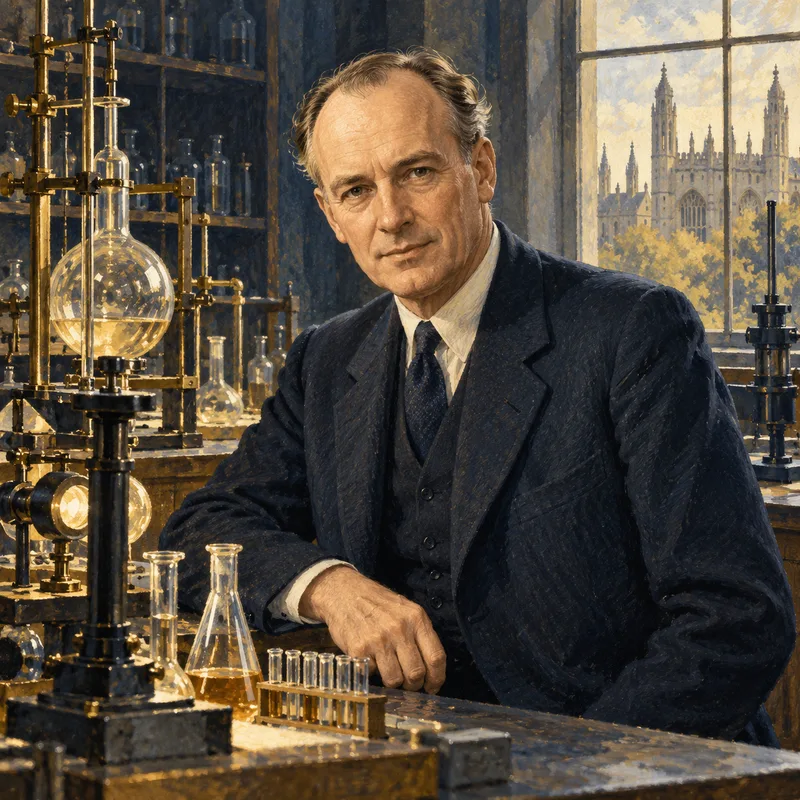
Ronald Norrish
1897-1978 · United Kingdom · Nobel Chemistry 1967
Flash photolysis, photochemical kinetics