The discovery, explained · Chemist no. 137 of 350
Ronald Norrish and Flash Photolysis: Catching Reactive Radicals in the Act
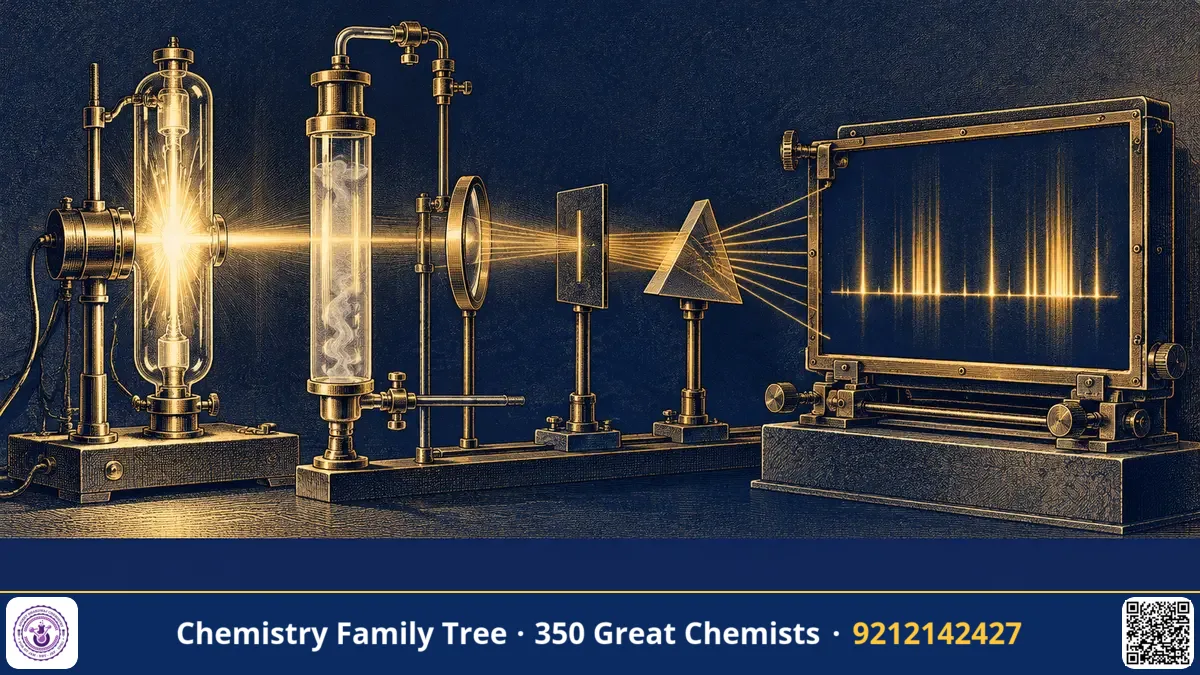
Free radicals and excited molecules control flames, polymerisation, the ozone layer and the photochemistry of every sunlit surface. But they live for only fractions of a second, so for decades chemists could only guess at their existence. In the late 1940s, at the University of Cambridge, Ronald George Wreyford Norrish and his research student George Porter invented flash photolysis: a method in which an intense flash of light creates a burst of reactive intermediates, and a second, weaker flash photographs their absorption spectrum before they disappear. Norrish also gave his name to two classic photochemical reactions of ketones, the Norrish Type I and Type II reactions. In 1967, Norrish and Porter shared half of the Nobel Prize in Chemistry (the other half went to Manfred Eigen).
The Scientific Problem Before the Discovery
Reaction mechanisms in the 1940s were deduced from final products and rate laws. Chemists proposed radicals such as CH₃•, OH• and ClO as intermediates, but direct proof was scarce. Spectroscopy of stable molecules was highly developed, but for transient species the concentration at any moment is tiny. To see them one needs to produce them in large enough concentration all at once, faster than they can react. Ordinary lamps give a weak, continuous light. Norrish and his group had studied photochemical reactions for years and had the needed instrumentation know-how, including the work on the photolysis of hydrogen-chlorine mixtures and on the combustion of hydrocarbons.
The Discovery: Step by Step
- The flash. A bank of capacitors was discharged through a long quartz tube filled with an inert gas such as argon or xenon. The result was an extremely intense flash of light lasting a few microseconds, with energy of thousands of joules.
- The reaction vessel. The tube was placed next to the reaction vessel containing the sample (gas or solution). Absorption of the flash produced a high concentration of excited molecules, atoms and radicals within microseconds.
- The probe flash. After a controlled delay, a second smaller flash of continuous light passed through the sample and into a spectrograph. The absorption spectrum was recorded on a photographic plate.
- Time resolution. By changing the delay between the two flashes, the rise and decay of each transient could be followed.
- First results. The first discoveries included the ClO radical in chlorine photolysis in the presence of oxygen, and spectra of many other radicals. Later work found triplet states of organic molecules, such as aromatic hydrocarbons.
The method was reported in 1949-1950 by Norrish and Porter and quickly became a standard tool in photochemistry. Today's laser flash photolysis works on the same plan with shorter pulses.
The Chemistry Behind It
A photochemical process starts when a molecule absorbs a photon of energy E = hν, giving an excited state. The excited state can lose energy by fluorescence, phosphorescence, internal conversion, intersystem crossing or chemical reaction. Flash photolysis detects transient species such as radicals, triplet states and ions.
Norrish Type I reaction (α-cleavage). An excited ketone breaks the bond between the carbonyl carbon and the α-carbon, giving an acyl radical and an alkyl radical:
R–CO–R′  →(hν)→  R–C•=O + •R′
R–C•=O  →  R• + CO      (decarbonylation)
The radicals can recombine, lose carbon monoxide, or disproportionate to give an aldehyde and an alkene. This is the main route in gas-phase photolysis of simple ketones such as acetone.
Norrish Type II reaction (γ-hydrogen abstraction). A ketone with a hydrogen on the γ-carbon undergoes intramolecular abstraction through a six-membered cyclic transition state, giving a 1,4-biradical:
R–CO–CH₂–CH₂–CH₂R′ →(hν)→ [1,4-biradical] → enol + alkene → ketone (methyl ketone)
The biradical either cleaves between the α and β carbons, giving an alkene and an enol that tautomerises to a ketone, or closes to form a cyclobutanol (the Norrish-Yang cyclisation, developed by Nelson Yang). Type II is common in solution and does not need radicals to leave the molecule.
Other Norrish contributions. Norrish also studied the effect of high viscosity on radical polymerisation. When polymerising methyl methacrylate becomes viscous, termination between large polymer radicals slows down, while propagation continues, so the rate suddenly increases. This autoacceleration is called the Trommsdorff-Norrish effect or gel effect.
Applications Today
- Atmospheric chemistry. Transient radicals such as OH, NO₃ and ClO, which drive smog and ozone depletion, are studied by flash photolysis and laser techniques.
- Polymer science. Photoinitiators in UV curing of coatings and dental fillings undergo Norrish Type I cleavage to produce radicals.
- Photodegradation. Norrish Type II reactions explain why some polymers (polyketones, certain plastics) break down in sunlight, a principle used in photodegradable plastic design.
- Organic synthesis. The Norrish-Yang cyclisation is used to make strained cyclobutanols and complex natural-product skeletons.
- Biology. Flash photolysis is used to study photosynthesis, vision and haemoglobin binding of CO and O₂ by flashing off bound ligands.
Exam Corner
- Flash photolysis: an intense flash creates transients; a delayed second flash records their absorption spectrum.
- Norrish Type I: α-cleavage of ketone gives acyl and alkyl radicals; may lose CO.
- Norrish Type II: intramolecular γ-H abstraction via a six-membered transition state, giving a 1,4-biradical, then alkene + enol or cyclobutanol.
- Trommsdorff-Norrish (gel) effect: autoacceleration of polymerisation due to reduced termination.
- Norrish and Porter shared half of the 1967 Nobel Prize in Chemistry; the other half went to Eigen.
Common Misconceptions
- "Type II needs no γ-hydrogen." It requires at least one γ-hydrogen; without it, only Type I is possible.
- "Flash photolysis measures slow reactions." It was invented for very fast processes, from microseconds down.
- "The gel effect slows polymerisation." It speeds it up, because termination is hindered.
Quick Revision Box
- Flash photolysis: Norrish and Porter, 1949-50, Cambridge.
- Type I: α-cleavage, radicals R–CO• + R′•, possible CO loss.
- Type II: γ-H transfer through 6-membered TS, 1,4-biradical.
- Norrish-Yang: biradical closes to cyclobutanol.
- Gel effect: Trommsdorff-Norrish autoacceleration.
- Nobel Prize in Chemistry 1967 with Porter (and Eigen).
FAQ
What is flash photolysis?
A technique in which a very short, intense light pulse produces reactive intermediates, which are detected by a time-delayed probe pulse.
What is the difference between Norrish Type I and II?
Type I is α-cleavage of the C–C bond next to the carbonyl; Type II is intramolecular abstraction of a γ-hydrogen by the excited carbonyl oxygen.
Who was George Porter?
Norrish's research student and co-inventor of flash photolysis, who shared the 1967 Nobel Prize with him.
Why is the gel effect important?
It explains sudden rate increases and heat release in bulk polymerisation, which are a safety concern in industry.
Published by ABC Chemistry — IIT-JAM | CSIR-NET | GATE Chemistry Coaching. Visit abcchemistry.com
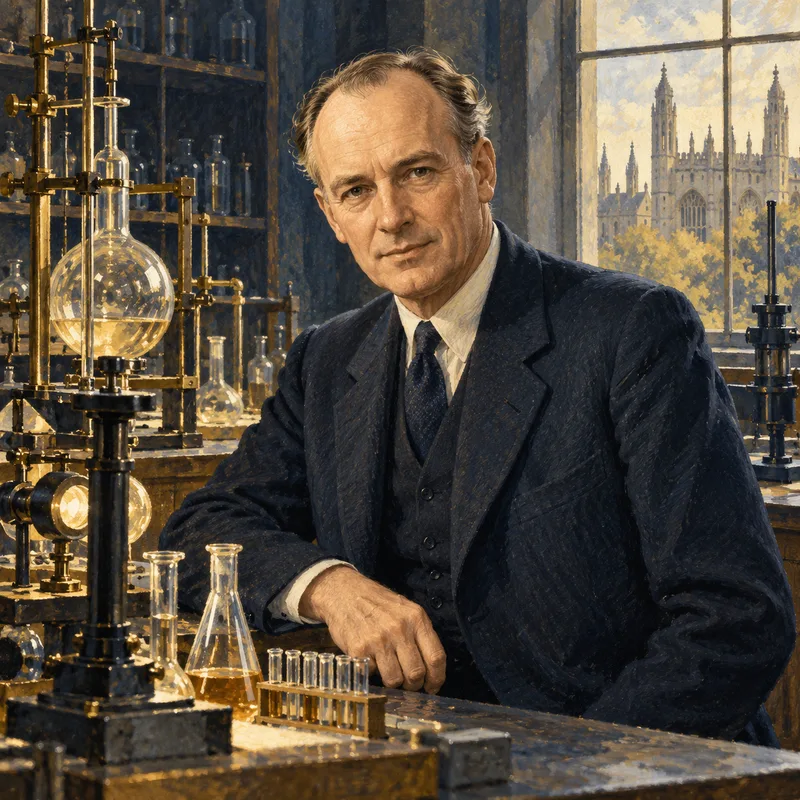
About the chemist
Ronald Norrish
1897-1978 · United Kingdom · Nobel Chemistry 1967
Flash photolysis, photochemical kinetics