Biography · Chemist no. 339 of 350
Roy Plunkett: The Chemist Who Found Teflon
Roy Joseph Plunkett (1910-1994) was an American organic chemist who worked for most of his career at the DuPont company. In April 1938, aged only 27, he found that a cylinder of tetrafluoroethylene gas had turned itself into a waxy white solid, polytetrafluoroethylene, which the world now knows as Teflon. His one-line legacy: he noticed the odd result that others might have ignored, and his curiosity gave us one of the most useful plastics ever made. This article tells the story of his life for students who want to see how an ordinary, hard-working chemist can change industry.
Early Life and Family
Roy Plunkett was born on 26 June 1910 in New Carlisle, Ohio, a small town in the American Midwest. He grew up in a modest family during a period when chemistry was transforming everyday life, from dyes and fertilisers to medicines and new fuels. The United States was then growing as an industrial power and many young people from small towns saw science as a route to a good career. Plunkett showed an early interest in practical problem-solving and in chemistry as a subject, and he did well enough at school to continue to college at a time when fewer people did so.
Education and Mentors
Plunkett studied chemistry at Manchester College in Indiana (now Manchester University), where he took his bachelor's degree in 1932. This was in the middle of the Great Depression, so jobs were scarce and further study was a sensible choice. He went on to Ohio State University, a major centre for chemistry, and completed his PhD in 1936. His doctoral work was in organic chemistry, giving him the skills in handling reactive compounds, gas-phase reactions and careful characterisation that would matter later. At Ohio State he gained a grounding in the methods of systematic research: plan the experiment, measure carefully, record everything, and trust the data even when it surprises you.
Career Timeline
| Year | Event |
|---|---|
| 1910 | Born in New Carlisle, Ohio, USA |
| 1932 | Bachelor's degree, Manchester College, Indiana |
| 1936 | PhD in chemistry, Ohio State University; joins DuPont's Jackson Laboratory, New Jersey |
| 1938 | Discovers PTFE (Teflon) on 6 April while working on refrigerants |
| 1940s | Moves into tetraethyl lead manufacture at DuPont; PTFE patented and developed commercially |
| 1945 | DuPont registers the Teflon trademark |
| 1950s to 1960s | Holds management roles in DuPont's chemicals business |
| 1975 | Retires from DuPont |
| 1994 | Dies in Corpus Christi, Texas |
Major Scientific Contributions
Plunkett's best-known contribution is the discovery of PTFE, the polymer of tetrafluoroethylene. For the chemistry in detail, see our companion article on the Teflon discovery. In summary:
- He recognised that a cylinder weighing the same as before, yet empty of gas, meant that the gas had polymerised:
n CF₂=CF₂ → –(CF₂–CF₂)ₙ– - He characterised the solid's remarkable properties: chemical inertness, high melting point and a slippery surface.
- His work led to the first fluoropolymer, opening a whole family of materials later including FEP and PFA.
- At DuPont he also worked on the large-scale production of tetraethyl lead,
Pb(C₂H₅)₄, the anti-knock additive used in petrol at the time.
He did not make Teflon into a commercial product alone. DuPont engineers had to solve the problem of how to make TFE safely in large quantity and how to shape a plastic that does not melt like others. Plunkett's contribution was the vital first step: seeing the new material, proving what it was and understanding that it was worth pursuing.
Awards, Honours and Nobel Prize
Plunkett did not win a Nobel Prize, and he should not be confused with Nobel laureates in fluorine chemistry. His recognition came from industrial and inventor communities:
- Induction into the National Inventors Hall of Fame (1985).
- Induction into the Plastics Hall of Fame.
- Recognition by chemical societies and by DuPont for his contribution to polymer science.
He did, however, enjoy the unusual honour of seeing a laboratory curiosity grow into a household name during his own lifetime.
Personality, Struggles and Lesser-Known Facts
- He refused to discard the odd cylinder. Many would have blamed a faulty valve. Plunkett and his assistant Jack Rebok weighed the cylinder, then sawed it open to look inside.
- Teflon was a side-track. He was not searching for a polymer at all, but for a refrigerant. The discovery happened only because he had made enough TFE to store.
- The Manhattan Project connection. PTFE resisted corrosive uranium hexafluoride and was used in gaskets and seals in the wartime atomic programme. For years its early use was largely hidden.
- Career moved on. After Teflon, he spent much of his working life in chemical manufacturing and management, including tetraethyl lead, rather than continuing as a bench researcher on fluoropolymers.
- Modest about fame. He often credited teamwork and the company's resources for turning an accident into a product.
Legacy and Influence on Modern Chemistry
The legacy of Plunkett's discovery is large. Fluoropolymers are a pillar of modern materials science. PTFE and its relatives line chemical reactors, insulate cables for computers and aircraft, protect fabrics, and serve in medicine as grafts and implants. The C–F bond, with its great strength (about 485 kJ/mol), became a classic example in textbooks to explain why fluorinated compounds are stable. At the same time, long-lived fluorinated chemicals have raised environmental questions in recent decades, so today's chemists work on safer alternatives. This ongoing debate is itself part of Plunkett's legacy, because it shows that a good discovery brings new responsibilities for later generations of scientists.
Lessons for Students
- Trust measurements. The cylinder's mass told the true story; the missing gas pressure was only a clue.
- Investigate surprises. Many discoveries begin as an "error" in an experiment. In your own practicals, do not hide odd results.
- Learn fundamentals. Knowing about addition polymerisation and radicals allowed Plunkett to explain the powder quickly.
- Persist after the discovery. A discovery needs engineers, patents and years of work before it benefits society.
- Be humble and collaborative. Science progresses by teams, not by lone geniuses.
Quick Facts Box
- Born: 26 June 1910, New Carlisle, Ohio, USA
- Died: 12 May 1994, Corpus Christi, Texas, USA
- Nationality: American
- Field: Organic and polymer chemistry
- Famous for: Discovery of PTFE (Teflon) in 1938
- Nobel Prize: None; inducted into the National Inventors Hall of Fame in 1985
FAQ
Who discovered Teflon?
Roy Plunkett, a young DuPont research chemist, discovered polytetrafluoroethylene on 6 April 1938 in New Jersey.
Did Plunkett win a Nobel Prize for Teflon?
No. He received major inventor and industry honours, including induction into the National Inventors Hall of Fame, but no Nobel Prize.
What was Plunkett trying to make when he found Teflon?
He was investigating new fluorine-containing refrigerant gases related to the Freon family, starting from tetrafluoroethylene.
Why should an Indian chemistry student learn about Plunkett?
His story links directly to the polymer chapter in Class 12 and to free-radical polymerisation in university syllabi, and it shows the value of careful observation in laboratory work.
Published by ABC Chemistry — IIT-JAM | CSIR-NET | GATE Chemistry Coaching. Visit abcchemistry.com
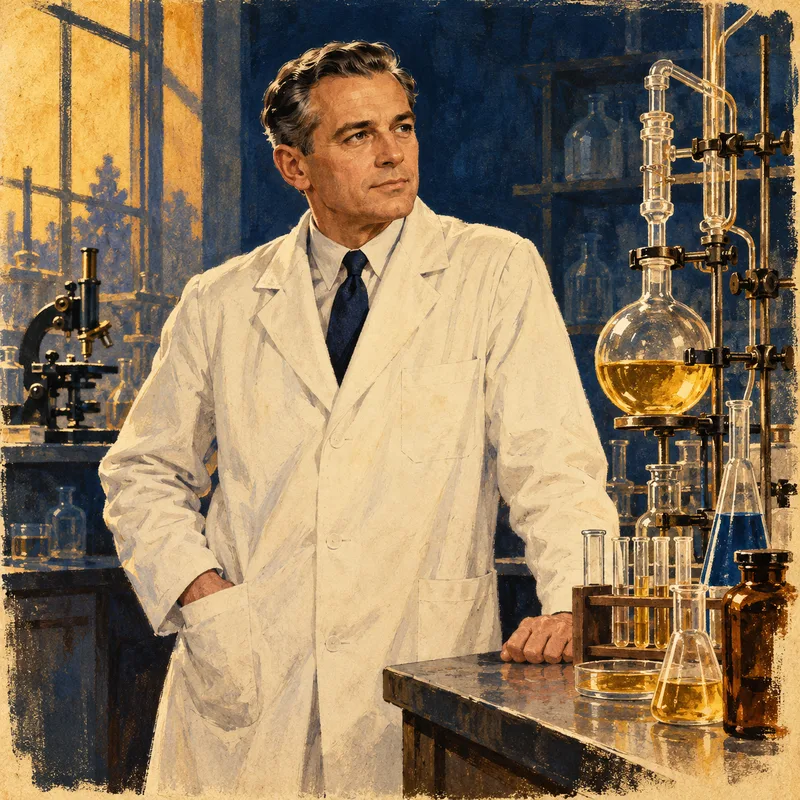
About the chemist
Roy Plunkett
1910-1994 · United States
Discovered PTFE (Teflon)