The discovery, explained · Chemist no. 339 of 350
Roy Plunkett and the Accidental Discovery of Teflon (PTFE)
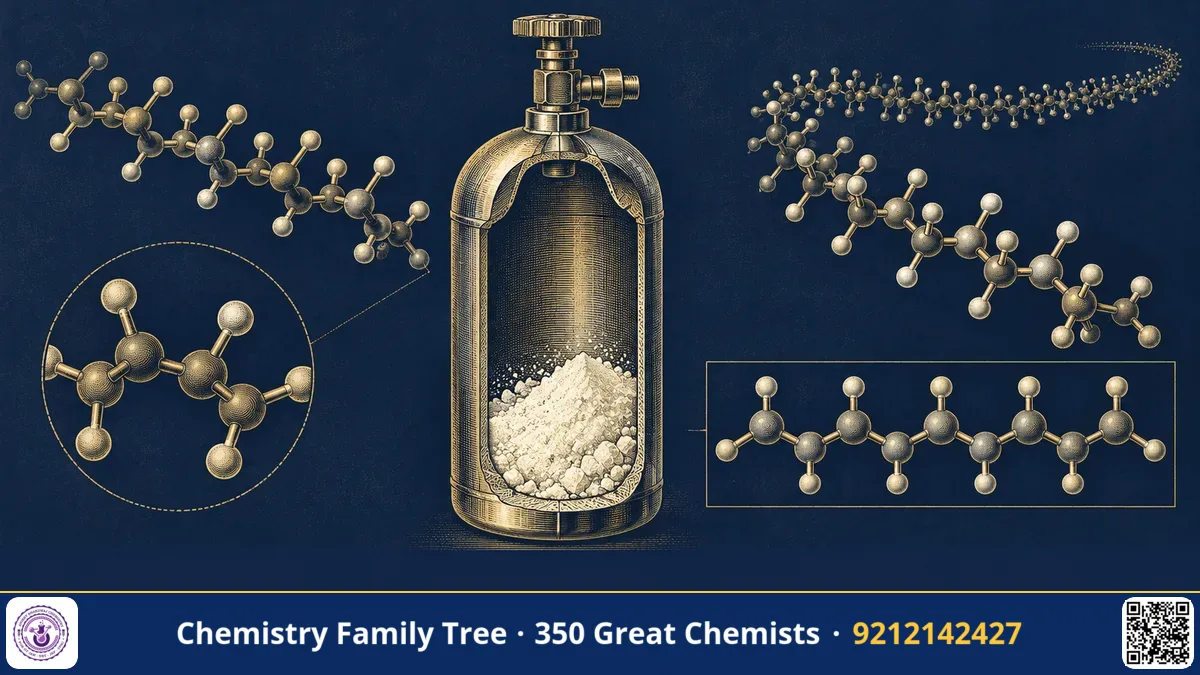
Every kitchen in India has at least one non-stick pan, and every chemistry laboratory has Teflon tape, Teflon stirrer bars and Teflon taps on burettes. All of these trace back to one surprising morning in April 1938, when a young DuPont chemist named Roy Plunkett opened a gas cylinder that should have been full of gas, and found it apparently empty. Inside was a slippery white powder that nothing seemed to dissolve, burn or corrode. That powder was polytetrafluoroethylene, or PTFE, now sold as Teflon. The story is a perfect example of how a careful scientist turns a puzzle into a major discovery, and it is also a rich source of exam questions on addition polymerisation, free radicals and the unusual strength of the carbon-fluorine bond.
The Scientific Problem Before the Discovery
In the 1930s, refrigerators used toxic or flammable gases such as ammonia, sulphur dioxide and methyl chloride. A leak in a kitchen could kill. Chemists at General Motors and DuPont had already developed the first chlorofluorocarbon (CFC) refrigerants, known commercially as Freon, which were non-toxic and non-flammable. DuPont and General Motors had formed a joint company, Kinetic Chemicals, to make them.
Plunkett, working at DuPont's Jackson Laboratory in New Jersey, was asked to look for new fluorinated refrigerants. One idea was to start from tetrafluoroethylene (TFE), CF₂=CF₂, and add hydrogen chloride to it to make a new chlorinated, fluorinated compound. He needed a good supply of TFE gas, so he prepared several hundred grams and stored it in small steel cylinders cooled with dry ice, because TFE is a gas at room temperature (boiling point about -76 °C) and is prone to react vigorously.
The Discovery: Step by Step
- The empty cylinder. On 6 April 1938, Plunkett and his assistant Jack Rebok set up a cylinder of TFE and opened the valve. No gas came out.
- The weight test. The cylinder weighed exactly what a full cylinder should weigh, so the gas had not leaked. Something inside had changed.
- Cutting it open. Rather than throwing the cylinder away, Plunkett sawed it open and found a white, waxy powder coating the inside.
- Testing the powder. The solid was extremely slippery. It did not dissolve in common solvents, acids or alkalis, and did not melt in the way a normal plastic does. It decomposed only at very high temperature.
- Reasoning it out. The mass of powder matched the mass of gas. The only sensible explanation was that thousands of TFE molecules had joined together: a polymerisation.
The reaction can be written simply as:
n CF₂=CF₂  →  –(CF₂–CF₂)ₙ–
tetrafluoroethylene        polytetrafluoroethylene (PTFE)
Later work showed that the polymerisation had been started by traces of iron from the inner wall of the cylinder and by the high pressure of the stored gas. Plunkett and DuPont then worked out controlled ways of making PTFE, and a patent was filed for the new polymer in the early 1940s. DuPont registered the name Teflon in 1945.
The Chemistry Behind It
Free-radical addition polymerisation
PTFE forms by a chain-growth, free-radical mechanism, the same type of mechanism you study for polythene. It has three stages:
- Initiation: a free radical R• (from a peroxide or persulphate initiator, or from a trace metal surface) attacks the double bond:
R• + CF₂=CF₂ → R–CF₂–CF₂• - Propagation: the new radical adds to another monomer, and this repeats thousands of times:
R–CF₂–CF₂• + CF₂=CF₂ → R–(CF₂–CF₂)₂• - Termination: two growing chains combine, or a chain transfers its radical, stopping growth.
Why is PTFE so inert and slippery?
- The C–F bond is one of the strongest single bonds in organic chemistry (about 485 kJ/mol), because fluorine is the most electronegative element and its small size gives good overlap with carbon.
- Fluorine atoms are larger than hydrogen atoms and form a tight, uniform sheath around the carbon backbone. This shield protects the C–C bonds from attack.
- The C–F bond is polar, but the symmetrical arrangement cancels the dipoles, so the polymer is non-polar and has very weak intermolecular (London) forces with other substances. That is why water, oil and most solvents do not stick or wet its surface.
- Its melting point is high (about 327 °C) and it has a very low coefficient of friction.
| Property | Value / Description |
|---|---|
| Monomer | Tetrafluoroethylene, CF₂=CF₂ |
| Polymer type | Addition, thermoplastic, linear |
| Melting point | About 327 °C |
| Chemical resistance | Resists acids, bases, most solvents |
| Wetting | Very low surface energy |
Applications Today
- Atomic energy and chemical industry: During the Manhattan Project, PTFE gaskets and coatings were used because they resisted corrosive uranium hexafluoride, UF₆.
- Cookware: French engineer Marc Grégoire developed the first PTFE-coated frying pan in the 1950s, launching the Tefal brand.
- Laboratory: burette stopcocks, magnetic stirrer coatings, thread seal tape, tubing and vial liners.
- Textiles and medicine: expanded PTFE is used in breathable waterproof fabrics and in vascular grafts and surgical meshes.
- Engineering: bearings, cable insulation, seals and low-friction coatings in aircraft and satellites.
In India, PTFE is used widely in chemical plants, fertiliser units and pharmaceutical manufacture, where gaskets and linings must survive harsh acids.
Exam Corner
- PTFE is the addition polymer of CF₂=CF₂; it is made by free-radical polymerisation using a persulphate catalyst at high pressure.
- Teflon is also named in NCERT Class 12 (Polymers) as a homopolymer of tetrafluoroethene; remember its use for non-stick cookware.
- The strong C–F bond (about 485 kJ/mol) and the fluorine sheath explain chemical inertness and thermal stability.
- Do not confuse PTFE (Teflon) with PVC (vinyl chloride) or PAN (acrylonitrile); questions often ask you to match monomer to polymer.
- In GATE polymer questions, PTFE is a semi-crystalline thermoplastic with a very low coefficient of friction and high melting point.
Common Misconceptions
- "Teflon was invented for non-stick pans." False. It was found accidentally during refrigerant research, and its first big use was in the atomic programme.
- "PTFE is a condensation polymer." False. It is an addition polymer; no small molecule is lost.
- "Nothing sticks to Teflon because it is smooth." The real reason is its very low surface energy from weak intermolecular forces, not just smoothness at the microscopic level.
Quick Revision Box
- Discovered by Roy Plunkett on 6 April 1938 at DuPont, New Jersey.
- Monomer: CF₂=CF₂; polymer: –(CF₂–CF₂)ₙ–.
- Mechanism: free-radical chain addition (initiation, propagation, termination).
- C–F bond is extremely strong, so PTFE is chemically inert.
- Melting point about 327 °C; very low friction.
- Trade name Teflon, registered 1945.
FAQ
Was Teflon really discovered by accident?
Yes. Plunkett was looking for a new refrigerant and did not expect a polymer. What made it a discovery rather than a mere accident was his decision to investigate the unexpected result.
Why does PTFE not dissolve in any common solvent?
It is non-polar with very strong C–F bonds and a tightly packed fluorine sheath, so solvent molecules cannot interact with or break the chain.
Is PTFE a thermoplastic or thermosetting polymer?
It is classed as a thermoplastic, although its melt viscosity is so high that it is shaped by sintering powder rather than by ordinary melting and moulding.
Which other polymers should I compare with PTFE for exams?
Compare with polythene (CH₂=CH₂), PVC (CH₂=CHCl) and polyacrylonitrile. In all of them the double bond opens and the units join in a long chain.
Published by ABC Chemistry — IIT-JAM | CSIR-NET | GATE Chemistry Coaching. Visit abcchemistry.com

About the chemist
Roy Plunkett
1910-1994 · United States
Discovered PTFE (Teflon)