The discovery, explained · Chemist no. 82 of 350
Marcus Theory of Electron Transfer: How Rudolph Marcus Explained the Speed of Electron Jumps
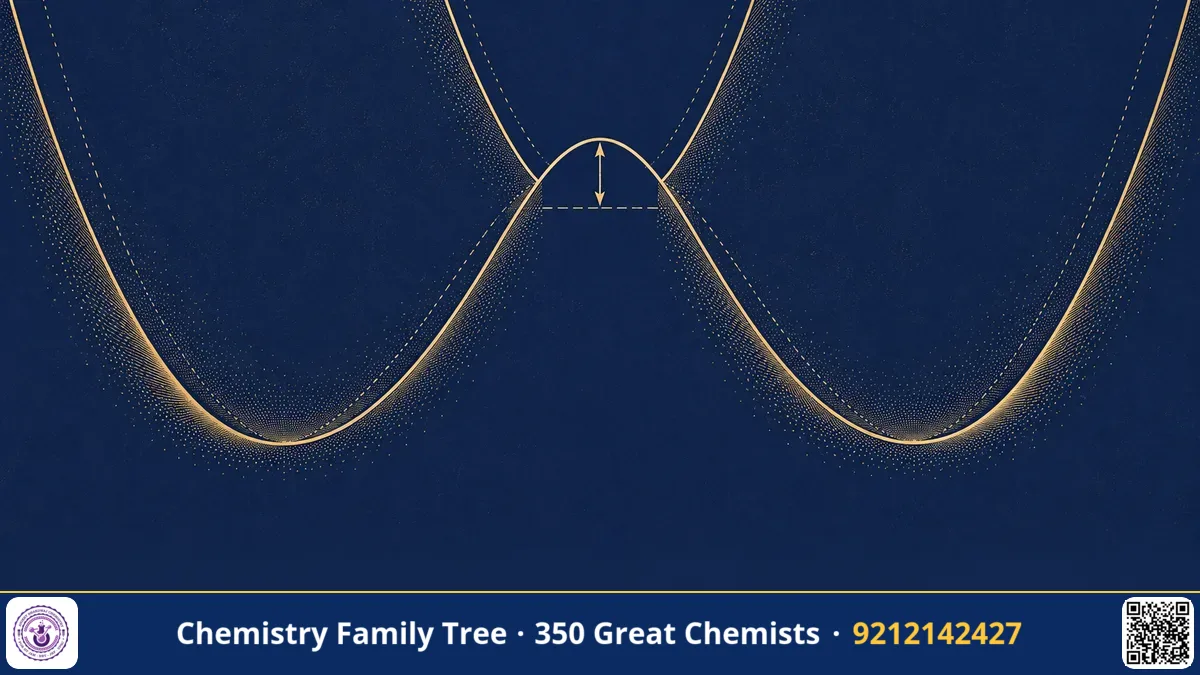
When a solar cell converts sunlight to current, when a plant carries out the first steps of photosynthesis, and when iron rusts, electrons move from one molecule to another. How fast do they move, and why do some reactions slow down when they become more favourable? The Canadian-born chemist Rudolph A. Marcus answered these questions with a theory he developed from the mid-1950s. It predicted a surprising result called the inverted region: beyond a certain point, making a reaction more exergonic makes it slower. Experiments confirmed this many years later. Marcus received the Nobel Prize in Chemistry in 1992 "for his contributions to the theory of electron transfer reactions in chemical systems". He is also known for a major extension of unimolecular reaction-rate theory, RRKM theory. This blog explains both ideas simply, with the equations you will need.
The Scientific Problem Before the Discovery
By the 1950s chemists could measure electron-transfer rates, for example in the exchange reaction Fe2+ + Fe3+. There was a puzzle. When an electron jumps from one ion to another, the surrounding solvent molecules (such as water) must rearrange, because the Fe2+ and Fe3+ ions have different sizes and different water-shell geometries. Yet the electron moves much faster than the heavy atoms can. This follows the Franck-Condon principle: electronic motion is so fast that nuclei do not move during the jump.
So how can the electron move without violating energy conservation? And can we predict the rate of a cross reaction between two different couples from the rates of the two self-exchange reactions? There was no general theory that answered these questions quantitatively.
The Discovery / Experiment — Step by Step
Marcus built a theory, not a lab experiment, and then experiments tested it. His logic was as follows:
- Energy surfaces. Describe the system by a single reaction coordinate that measures the arrangement of the solvent and ligands. Plot the free energy of the reactants and the products as two parabolas (the solvent responds like a harmonic, linear-response medium).
- Franck-Condon restriction. The electron can transfer only where the two parabolas cross, because only there are the energies equal and nuclei do not need to move during the jump.
- Activation energy. The height of the crossing point above the reactant minimum gives the activation free energy.
- Result. Marcus obtained a simple quadratic relation:
ΔG‡ = (λ + ΔG°)² / (4λ)

k_ET = A · exp( −ΔG‡ / RT )
Here ΔG° is the standard free energy change of the electron-transfer step, λ (lambda) is the reorganisation energy, and A is a pre-exponential factor. The reorganisation energy is the energy needed to distort the reactant and its surroundings into the geometry of the product, without transferring the electron. It has an inner-sphere part (bond lengths in the complex) and an outer-sphere part (solvent polarisation).
Three regions
| Condition | Meaning | Effect on rate |
|---|---|---|
| −ΔG° less than λ | Normal region | Rate increases as the reaction gets more favourable |
| −ΔG° = λ | Activationless point (ΔG‡ = 0) | Maximum rate |
| −ΔG° greater than λ | Inverted region | Rate decreases as the reaction gets even more favourable |
The inverted region was a bold prediction, because chemists had long assumed that a larger driving force always gives a faster reaction. For many years some doubted it. In 1984 John Miller, Lawrence Calcaterra and Gerhard Closs showed it in experiments on rigid molecules where a donor and acceptor are held at a fixed distance, and the rates indeed fell at large driving force.
The cross relation
Marcus also derived the cross relation, which lets us predict the rate constant of a cross reaction from those of the two self-exchange reactions and the equilibrium constant:
k12 ≈ (k11 · k22 · K12 · f)^(1/2)
where k11 and k22 are the self-exchange rate constants, K12 is the equilibrium constant of the cross reaction, and f is a correction factor close to 1. This relation worked well for many outer-sphere metal complex reactions.
The Chemistry Behind It
The central idea is that the nuclei must reach a special arrangement before the electron can jump. Thermal fluctuations of the solvent bring the system to the crossing point. A larger reorganisation energy means a higher barrier, so reactions that involve large structural change (for example Co(III)/Co(II) high-spin to low-spin changes) tend to be slower than those with little change (such as the large, delocalised aromatic radical ions).
Marcus's earlier work on gas-phase reactions is also important. Before he moved to electron transfer, he extended the Rice-Ramsperger-Kassel (RRK) theory of unimolecular reactions, with Marcus applying transition-state ideas to give RRKM theory. It explains the pressure dependence of unimolecular rate constants. At high pressure, a molecule A that has gained energy by collisions is converted to product by a first-order step; at low pressure the rate depends on collision frequency, giving second-order behaviour. In the Lindemann scheme:
A + M ⇌ A* + M A* → products
RRKM theory calculates the rate constant k(E) for the energised molecule A* using the number of accessible quantum states at the transition state, divided by the density of states of the reactant.
Applications Today
- Photosynthesis and biology: the long-range electron transfer steps in the photosynthetic reaction centre and in respiratory chains operate with small reorganisation energies, so they are fast and efficient.
- Solar cells and photocatalysis: dye-sensitised and organic solar cells are designed with Marcus theory to favour charge separation and slow the harmful back reaction, taking advantage of the inverted region.
- Electrochemistry and batteries: the Marcus-Hush model is used to describe electrode kinetics and to design redox mediators.
- OLEDs and chemiluminescence: the inverted region helps explain why certain electron-transfer reactions give light.
- Atmospheric and combustion chemistry: RRKM theory calculates rate constants used in models of the atmosphere and of engines.
Exam Corner — 5 Likely Points
- Marcus equation: ΔG‡ = (λ + ΔG°)² / 4λ.
- Activationless when −ΔG° = λ; inverted region when −ΔG° is greater than λ.
- Reorganisation energy has inner-sphere and outer-sphere (solvent) contributions.
- Cross relation: k12 = (k11k22K12f)1/2.
- RRKM theory describes unimolecular reactions and the pressure dependence of their rate constants (fall-off).
Common Misconceptions
- "A more exergonic reaction is always faster." Not in the inverted region of Marcus theory.
- "Electrons tunnel only through vacuum." In molecules, they tunnel through the solvent and through bonds, and the rate falls exponentially with distance.
- "Marcus theory only applies to metal ions." It applies to organic molecules, proteins, semiconductors and electrodes as well.
Quick Revision Box
- Marcus received the Nobel Prize in Chemistry in 1992 for electron-transfer theory.
- Two parabolas, crossing point gives the barrier: ΔG‡ = (λ + ΔG°)² / 4λ.
- λ is the reorganisation energy of the reactants and the solvent.
- Inverted region confirmed experimentally in 1984 (Miller, Calcaterra, Closs).
- Cross relation predicts k12 from self-exchange rates.
- RRKM theory extends Lindemann-Hinshelwood and RRK theory of unimolecular reactions.
FAQ
What is the reorganisation energy?
It is the energy needed to change the nuclear and solvent arrangement of the reactant to that of the product, without moving the electron.
Why is the inverted region important?
It explains why unwanted back electron transfer in solar devices and photosynthesis can be slow, which helps charges stay separated.
Is RRKM theory the same as Marcus theory?
No. RRKM theory is about unimolecular gas-phase reactions, and Marcus theory is about electron transfer. Both were developed by Marcus.
What does the Franck-Condon principle say?
Electronic transitions occur so quickly that the nuclei remain in fixed positions during the transition.
Published by ABC Chemistry — IIT-JAM | CSIR-NET | GATE Chemistry Coaching. Visit abcchemistry.com
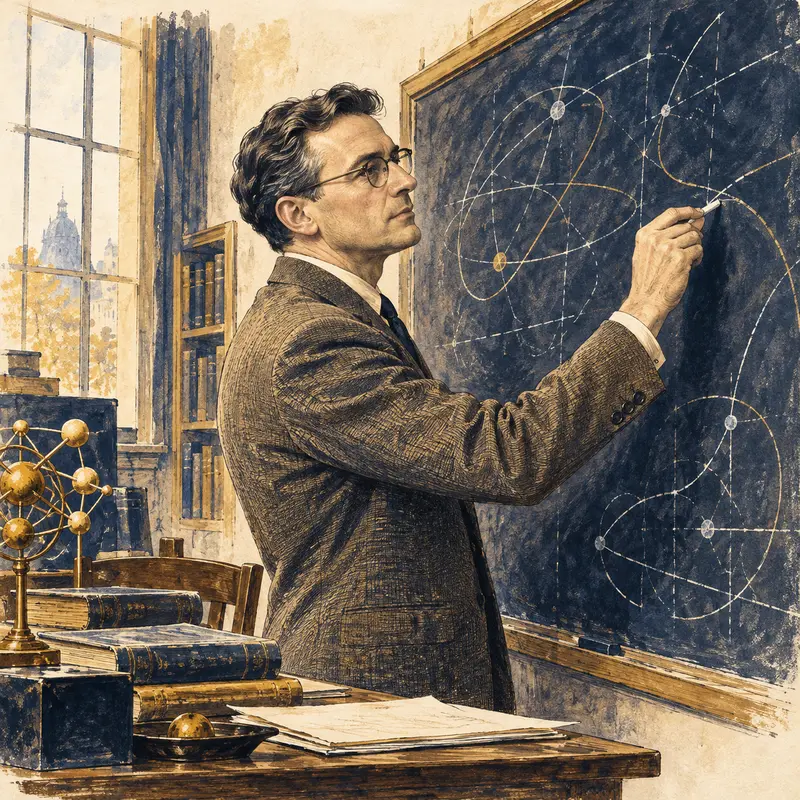
About the chemist
Rudolph A. Marcus
1923- · Canada/United States · Nobel Chemistry 1992
Marcus theory of electron transfer