Biography · Chemist no. 176 of 350
Ryoji Noyori: Japan's Master of Chiral Catalysis
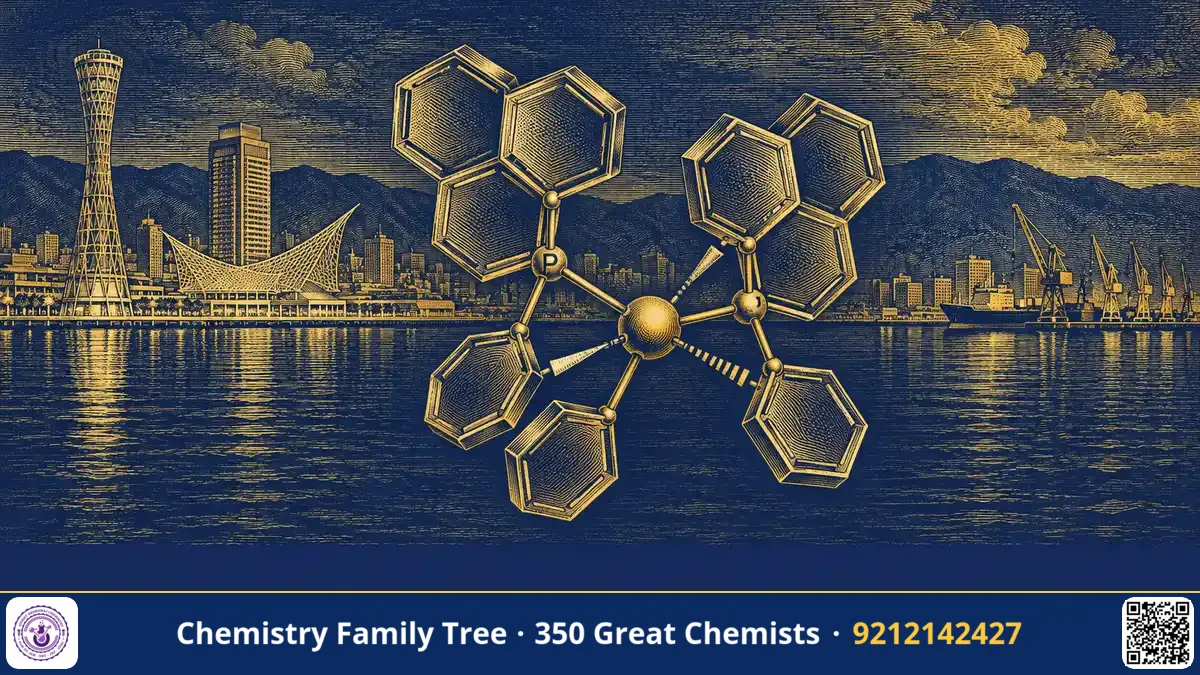
Ryoji Noyori, born in 1938, is a Japanese organic chemist whose BINAP catalysts made asymmetric hydrogenation a general tool of chemistry. He shared half of the 2001 Nobel Prize in Chemistry with William Knowles. He is known not only for his research but also for his strong belief that chemistry should be sustainable and should serve society. He is a leading voice for science education and green chemistry in Japan.
Early Life and Family
Ryoji Noyori was born on 3 September 1938 in Kobe, Japan. He grew up during the Second World War and in the years of postwar reconstruction. His father worked in the chemical industry, and as a boy Noyori became excited by news of nylon, the first fully synthetic fibre. In school he enjoyed science and decided to study chemistry.
Education and Mentors
Noyori studied chemistry at Kyoto University, earning his bachelor's degree in 1961 and a master's degree in 1963. At Kyoto he worked under Professor Hitosi Nozaki, an organic chemist who studied organometallic chemistry and the carbene reactions of copper catalysts. This was where Noyori learned about catalysis. He became an instructor at Kyoto and received his doctorate there in 1967. He moved to Nagoya University in 1968 as an associate professor, spent a period at Harvard University as a postdoctoral researcher with E. J. Corey, one of the greatest organic chemists, working on prostaglandin synthesis, and became a full professor at Nagoya in 1972.
Career Timeline
| Year | Event |
|---|---|
| 1938 | Born in Kobe, Japan, on 3 September |
| 1961 | Bachelor's degree, Kyoto University |
| 1967 | Doctorate from Kyoto University |
| 1968 | Associate professor, Nagoya University |
| 1969–70 | Postdoctoral research with E. J. Corey at Harvard |
| 1972 | Full professor, Nagoya University |
| 1980 | Introduced the BINAP ligand and its Rh and Ru complexes |
| 1990s | Developed Ru–diamine catalysts and transfer hydrogenation |
| 2001 | Nobel Prize in Chemistry, shared with Knowles and Sharpless |
| 2003 | Became president of RIKEN, Japan's largest research institution (served until 2015) |
Major Scientific Contributions
- BINAP ligand. The axially chiral diphosphine ligand developed in 1980 is one of the most important ligands in modern catalysis.
- Ru–BINAP hydrogenations. He showed hydrogenation of allylic alcohols, β-keto esters and unsaturated acids with excellent enantioselectivity.
- Industrial applications. His catalysts enabled large-scale manufacture of (−)-menthol (with Takasago Corporation) and intermediates for drugs such as naproxen and carbapenem antibiotics.
- Bifunctional catalysis. His work on Ru–diamine systems and transfer hydrogenation explained how the metal and the ligand can cooperate to transfer hydride and proton together.
- Earlier work. Early in his career, he studied reactions of organometallic and carbene species and helped to develop synthetic methods for prostaglandins.
- Green chemistry. He supported cleaner processes, such as reactions in supercritical CO2 and the oxidation of alcohols and alkenes with hydrogen peroxide.
Our companion discovery post covers the mechanism, atropisomerism and the equations.
Awards, Honours and the Nobel Prize
The 2001 Nobel Prize in Chemistry was awarded to William S. Knowles and Ryoji Noyori (jointly one half) "for their work on chirally catalysed hydrogenation reactions", and to K. Barry Sharpless (the other half) "for his work on chirally catalysed oxidation reactions". Noyori also received the Japan Academy Prize, the Wolf Prize in Chemistry (2001, shared with Sharpless and Henri Kagan), and was awarded the Order of Culture by the Japanese government. He is a member of the Japan Academy and a foreign member of several academies.
Personality, Struggles and Lesser-Known Facts
- Childhood inspiration. The nylon story that excited him as a boy shows how a single new material can change society.
- "Chemistry for society". After the Nobel Prize, he was a prominent supporter of science education in Japanese schools and of research support.
- Leader of RIKEN. In 2003 he became the head of RIKEN, which includes many institutes in physics, biology and chemistry. He led it through a period of reform.
- Believer in green chemistry. He often said that chemists have a duty to make processes that save energy and avoid waste.
- Close to industry. His work with Takasago showed how a university professor can partner with a company, and the menthol process is one of the biggest examples of asymmetric catalysis in industry.
Legacy and Influence on Modern Chemistry
Noyori's catalysts are standard in the pharmaceutical and fragrance industry, and BINAP appears in thousands of research papers. His concept of the bifunctional catalyst inspired many other designs, including organocatalysis and enzyme-mimicking systems. His career shows how basic research, careful design and industrial collaboration together lead to a technology that changes the world. For Indian students, BINAP, atropisomerism and the Noyori hydrogenation appear regularly in CSIR-NET and GATE questions on organometallic and organic chemistry.
Lessons for Students
- Design with symmetry. C2-symmetric ligands made problems simpler.
- Keep the goal broad. Noyori wanted a general catalyst, not just a catalyst for one reaction.
- Link science to society. Green and sustainable thinking is part of modern chemistry.
- Learn from the best. Training with Nozaki and Corey shaped his style.
Quick Facts Box
- Born: 3 September 1938, Kobe, Japan
- Died: Living (as of this writing)
- Nationality: Japanese
- Field: Organic and organometallic chemistry, asymmetric catalysis
- Famous for: BINAP and enantioselective hydrogenation
- Nobel: Chemistry, 2001 (half, shared with William Knowles)
FAQ
Where did Noyori study?
At Kyoto University, where he earned his bachelor's degree and doctorate.
Who was his postdoctoral supervisor?
E. J. Corey at Harvard University.
What is BINAP used for?
It is a chiral ligand used with Rh and Ru in asymmetric hydrogenation and isomerisation to make single-enantiomer products like (−)-menthol.
Did Noyori lead any institution?
Yes, he served as president of RIKEN, a major Japanese research organisation, from 2003.
Published by ABC Chemistry — IIT-JAM | CSIR-NET | GATE Chemistry Coaching. Visit abcchemistry.com
About the chemist
Ryoji Noyori
1938- · Japan · Nobel Chemistry 2001
Asymmetric hydrogenation catalysis