Biography · Chemist no. 317 of 350
Severo Ochoa: Complete Life and Legacy of the Spanish Biochemist
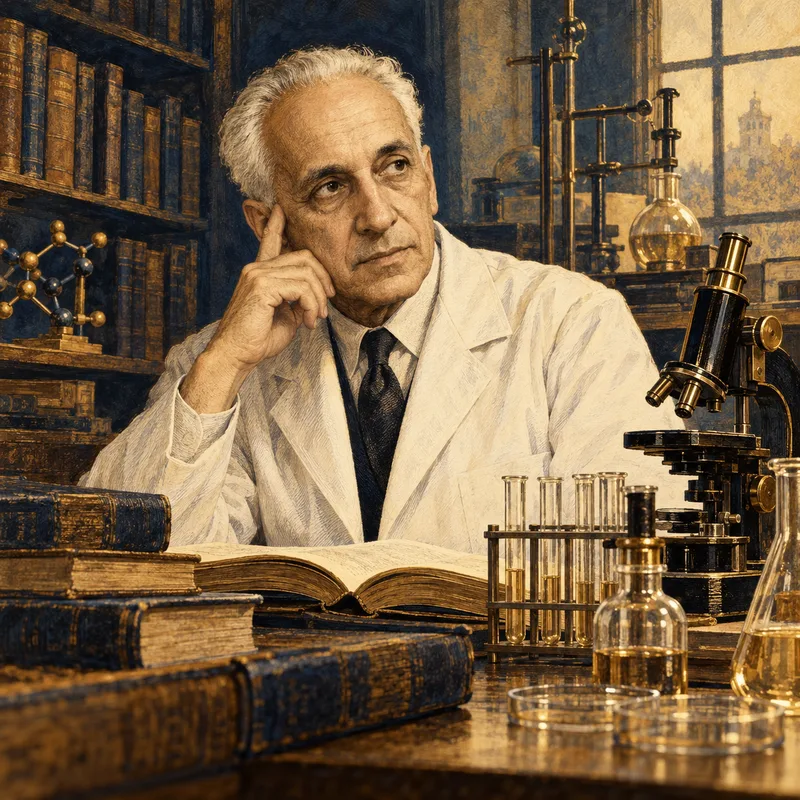
Severo Ochoa de Albornoz (1905-1993) was a Spanish-born American biochemist who isolated the first enzyme able to synthesise RNA outside a cell and helped to decode the genetic language of life. He shared the 1959 Nobel Prize in Physiology or Medicine with Arthur Kornberg. Ochoa's life crossed three countries and two wars, and his legacy is a simple message: serious science can be done anywhere, if the scientist is curious and patient.
Early Life and Family
Severo Ochoa was born on 24 September 1905 in Luarca, a small fishing town on the northern coast of Asturias, Spain. His father, Severo Manuel Ochoa, was a lawyer and businessman, and his mother was Carmen de Albornoz. The father died when Severo was about seven years old, and the family moved to Málaga, in the south, where he completed school. As a boy he loved reading, and he admired the work of the Spanish neuroscientist Santiago Ramón y Cajal, who had won the Nobel Prize in 1906. He later said that Cajal's writings inspired him to take up biology. His mother's encouragement was crucial.
Education and Mentors
Ochoa studied medicine at the University of Madrid, taking his degree in 1929. Like many Spanish medical students of his time he was drawn to research rather than clinical practice. He worked in the laboratory of Juan Negrín, professor of physiology, who later became a prime minister of the Spanish Republic. He published early research on creatine and muscle chemistry. He then went abroad to train with leading scientists: at the Kaiser Wilhelm Institute in Berlin with Otto Meyerhof (muscle biochemistry, Nobel Prize 1922), at the National Institute for Medical Research in London with Sir Henry Dale, and at Heidelberg again with Meyerhof. He obtained his doctorate in Madrid in 1930 and later worked on the glyoxalase enzyme at Mill Hill, London. At Oxford he worked with Rudolph Peters on the role of vitamin B1 (thiamine) in pyruvate oxidation.
Career Timeline
| Year | Event |
|---|---|
| 1905 | Born in Luarca, Asturias, Spain |
| 1929 | Medical degree, University of Madrid |
| 1930-1936 | Research stays in Berlin, Heidelberg and London; returned to Madrid |
| 1936 | Left Spain after the outbreak of the Spanish Civil War |
| 1938-1941 | Research at Oxford under Rudolph Peters |
| 1941 | Moved to the United States; worked with Carl and Gerty Cori at Washington University, St Louis |
| 1942 | Joined New York University School of Medicine |
| 1946 | Became professor of pharmacology; later head of biochemistry |
| 1955 | Discovered polynucleotide phosphorylase with Marianne Grunberg-Manago |
| 1959 | Nobel Prize in Physiology or Medicine |
| 1956 | Became a US citizen (1956) |
| 1974 | Joined Roche Institute of Molecular Biology, New Jersey |
| 1985 | Returned to Spain; worked at the Centro de Biología Molecular in Madrid |
| 1993 | Died in Madrid on 1 November |
Major Scientific Contributions
- Energy metabolism: Studies of the Krebs cycle, oxidative phosphorylation and P:O ratios, showing that more than one ATP is produced per atom of oxygen consumed.
- CO2 fixation: Discovery of carboxylation enzymes, including the "malic enzyme" fixing CO2 to pyruvate, and the study of photosynthetic reduction of NADP+.
- RNA synthesis: Polynucleotide phosphorylase, which led to synthetic polynucleotides.
- Genetic code: His laboratory helped assign the codon table using synthetic RNA, and he studied the direction of reading of mRNA.
- Protein synthesis and viral RNA: Studies of initiation factors and replication of RNA bacteriophages.
The details of the key RNA experiment are explained in our discovery blog on polynucleotide phosphorylase.
Awards, Honours and Nobel Prize
The 1959 Nobel Prize in Physiology or Medicine was awarded jointly to Severo Ochoa and Arthur Kornberg "for their discovery of the mechanisms in the biological synthesis of ribonucleic acid and deoxyribonucleic acid". He also received the Spanish Prince of Asturias Award for Scientific and Technical Research (1980), the National Medal of Science (US, 1979), and was a member of the US National Academy of Sciences and the Royal Society (foreign member). He was awarded dozens of honorary degrees. In Spain a research centre in Madrid, the Centro de Biología Molecular Severo Ochoa, carries his name.
Personality, Struggles and Lesser-Known Facts
- A scientist in exile: The Civil War forced him to leave Spain in 1936, and he moved from Germany to England to America, rebuilding his laboratory each time. He later said that moving did not harm his science because he kept his enthusiasm.
- Hero worship of Cajal: As a boy he read Cajal's essays on research life, and he often said that these books made him want to become a scientist rather than a practising doctor.
- Marriage: He married Carmen García Cobián in 1931. She helped him through his years of moving, and she supported his work to the end of her life. They did not have children.
- A leader who trained leaders: His laboratory in New York trained many scientists, including Marianne Grunberg-Manago of France, and Arthur Kornberg had worked in his laboratory briefly in the 1940s. Ochoa was known for a friendly and generous manner.
- Fond of his home country: After he retired he returned to Spain, 1985, and encouraged young scientists to take up research there. He remained active in his late eighties.
- Loved to read and play: He enjoyed classical music and reading, and he held strong beliefs in the value of science education.
Legacy and Influence on Modern Chemistry
Ochoa's work stands at the junction of classical biochemistry (ATP, cycles, enzymes) and the new molecular biology (nucleic acids, genes, codes). Polynucleotide phosphorylase gave Nirenberg, Khorana and others their first synthetic RNA to crack the genetic code, which in turn led to the Nobel Prizes of 1968. The enzyme is today an essential component in bacterial RNA turnover. He is also seen as the founder of modern Spanish biochemistry, since he trained many Spanish scientists and supported laboratories in Spain after his return. Students in India meet his name in the context of the genetic code, RNA synthesis and the energy yield of respiration.
Lessons for Students
- Learn from the best, in many places. Ochoa trained in Spain, Germany, England and the US, and combined all those ideas.
- Follow unexpected results. A phosphate exchange experiment turned out to be RNA synthesis, because he looked at the odd product.
- Stay resilient when circumstances change. War and exile forced him to restart, yet he never stopped working.
- Share credit and teach others. Collaboration with younger scientists was central to his success.
Quick Facts Box
- Born: 24 September 1905, Luarca, Spain
- Died: 1 November 1993, Madrid, Spain
- Nationality: Spanish, later American citizen
- Field: Biochemistry, molecular biology
- Famous for: Polynucleotide phosphorylase, synthetic RNA, work on the genetic code and energy metabolism
- Nobel: 1959, Physiology or Medicine (shared with Arthur Kornberg)
FAQ
Did Severo Ochoa win the Nobel Prize in Chemistry?
No. He won the 1959 Nobel Prize in Physiology or Medicine, which he shared with Arthur Kornberg.
Which country did Ochoa belong to?
He was born in Spain and worked in Germany, the UK and the US. He became a US citizen but returned to live in Spain in his later years.
What is Ochoa best known for?
For discovering polynucleotide phosphorylase, the enzyme that made synthetic RNA possible, and for work on energy metabolism and the genetic code.
Who inspired Ochoa to take up biology?
He was inspired by the writings of Santiago Ramón y Cajal, the Spanish neuroscientist and 1906 Nobel laureate.
Published by ABC Chemistry — IIT-JAM | CSIR-NET | GATE Chemistry Coaching. Visit abcchemistry.com
About the chemist
Severo Ochoa
1905-1993 · United States · Nobel Physiology/Medicine 1959
Enzymatic synthesis of RNA