The discovery, explained · Chemist no. 317 of 350
Severo Ochoa and the Enzyme That Made RNA in a Test Tube
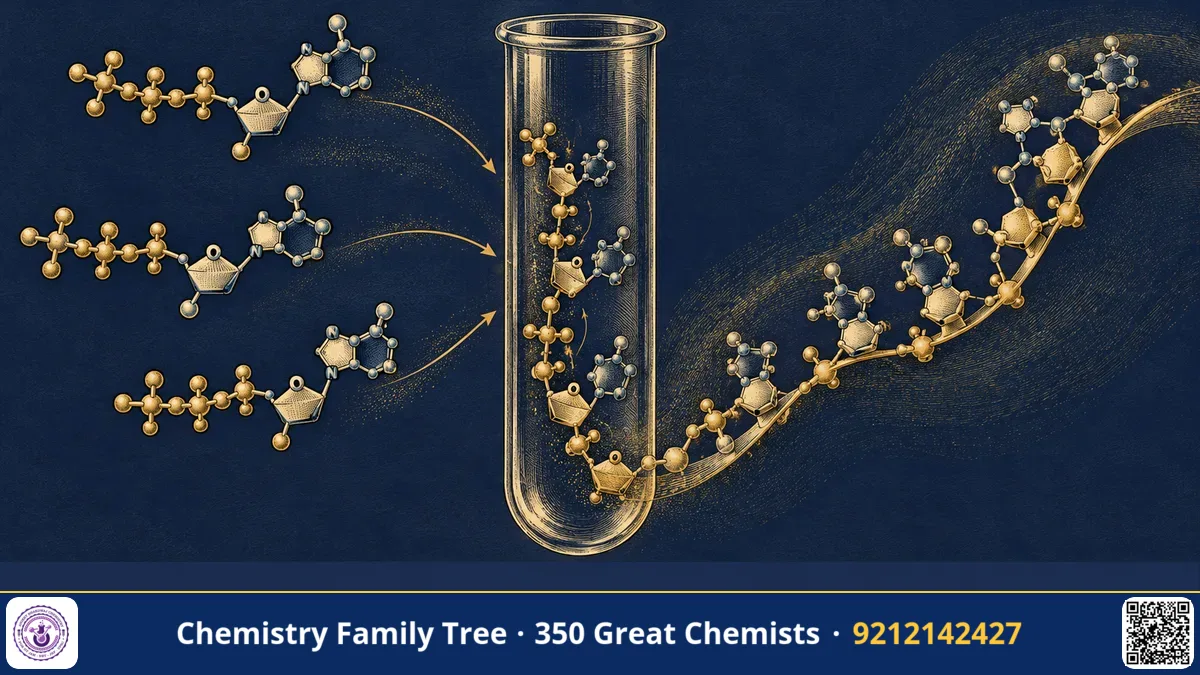
In 1955 the Spanish-American biochemist Severo Ochoa (1905-1993) and his colleague Marianne Grunberg-Manago isolated an enzyme from bacteria that could join nucleotides into long chains of RNA-like polymers. The enzyme, called polynucleotide phosphorylase, did not need a DNA template, and the product was random, but it gave scientists something priceless: synthetic RNA of known composition. When Marshall Nirenberg and Heinrich Matthaei used such synthetic RNA, polyuridylic acid, in 1961, they found it coded for polyphenylalanine, the first word of the genetic code. For this work on the biological synthesis of ribonucleic acid, Ochoa shared the 1959 Nobel Prize in Physiology or Medicine with Arthur Kornberg, who had synthesised DNA. Ochoa had also earlier clarified how cells make ATP and fix carbon dioxide.
The Scientific Problem Before the Discovery
By the early 1950s biologists agreed that nucleic acids carry heredity, but nobody knew how the long polymer chains were made. DNA's double helix was proposed in 1953. The questions that followed were: Which enzyme joins nucleotides? What energy source is used? Does a template guide the order of bases? Chemists could only make short oligonucleotides through painstaking organic synthesis, and the long chains of natural nucleic acids seemed far away.
Also, Ochoa's earlier research on respiration and energy metabolism had asked a related puzzle: how many ATP molecules are formed when substrates are oxidised? Understanding how energy-rich phosphate bonds are used to build polymers was therefore a natural next step for him.
The Discovery / Experiment
Step 1: Early work on phosphorylation
Ochoa studied oxidative phosphorylation and measured the P:O ratio, the number of phosphate molecules esterified per atom of oxygen used. He showed in the 1940s that oxidation of pyruvate and other substrates through the citric acid cycle forms more than one ATP per oxygen atom, supporting the idea that the cycle drives ATP generation. He also found enzymes which fix CO2 into organic acids, such as the malic enzyme and isocitrate dehydrogenase carboxylation, and discovered the carboxylation of propionyl-CoA.
Step 2: Looking for an enzyme that exchanges phosphate
In New York University, Ochoa and Grunberg-Manago worked with extracts from the bacterium Azotobacter vinelandii. They were studying an enzyme that exchanges radioactive inorganic phosphate (32P) into ADP. They noticed that the reaction apparently incorporated phosphate into nucleoside diphosphate, and that a high-molecular-weight product formed. The product was an RNA-like polymer.
Step 3: The reaction
n NDP  ⇌  (NMP)n  +  n Pi
(nucleoside diphosphates)   (polyribonucleotide)   (inorganic phosphate)

Example:  n ADP → poly(A) + n Pi
          n UDP → poly(U) + n Pi
The reaction is reversible, so in cells, where phosphate concentration is high, the enzyme likely breaks down RNA (it is a phosphorylase), but in the test tube with high NDP and low phosphate it synthesises RNA. Each nucleotide is joined by a 3'-5' phosphodiester bond. No template is needed, and no primer, in the strict sense, though short oligonucleotides speed up the start.
Step 4: Making designed RNA
By using only UDP, the enzyme formed poly(U); with ADP only, poly(A); with mixtures, random co-polymers whose composition matches the input ratio. Ochoa's laboratory prepared these polymers and studied them with physical techniques. They helped confirm that RNA forms helices and that poly(A) and poly(U) form double-stranded complexes by base pairing, A=U.
Step 5: Breaking the genetic code
In 1961 Nirenberg and Matthaei added poly(U) to a cell-free protein-synthesising system from E. coli and obtained polyphenylalanine. Therefore the codon UUU codes for phenylalanine. Ochoa's laboratory then used random co-polymers and later repeating sequences (by Khorana's chemical synthesis) to read the other codons. Ochoa's team contributed many code assignments, including data on the codons for lysine (AAA), proline (CCC) and glycine.
The Chemistry Behind It
- Phosphodiester bond formation: The 3'-OH of the growing chain attacks the α-phosphate of the incoming NDP; inorganic phosphate (or pyrophosphate in polymerases) is expelled.
- Energy: NDPs have a high-energy phosphoanhydride bond; the reaction is nearly thermoneutral and reversible, unlike DNA and RNA polymerases that use NTPs and release PPi, which is then hydrolysed to drive the process forward.
- Base pairing: poly(A) with poly(U) forms a double helix through two hydrogen bonds per A:U pair; three strands are possible with poly(U) in some salt conditions.
- Random order: the enzyme is template-independent, so the base sequence is determined only by the ratio of nucleotides.
Applications Today
- RNA research tools: Poly(A) and poly(U) are used in labs, e.g. oligo-dT affinity columns purify mRNA by binding the poly(A) tail.
- Immunology: Polyinosinic:polycytidylic acid (poly I:C), a double-stranded RNA analogue produced by phosphorylase-type methods, is used as an immune stimulant in research and a vaccine adjuvant.
- Bacterial RNA turnover: PNPase is an essential part of the RNA degradosome in E. coli, so it matters in microbiology and in studies of antibiotic resistance.
- Genetic code teaching: The poly(U) experiment is a classic textbook case in school and college syllabuses.
- mRNA technology: The idea of making RNA in vitro with defined sequences leads to the modern mRNA vaccines produced with phage RNA polymerases.
Exam Corner
- Polynucleotide phosphorylase (Ochoa and Grunberg-Manago, 1955) uses NDPs, needs no template, releases Pi.
- Ochoa shared the 1959 Nobel Prize in Physiology or Medicine with Arthur Kornberg.
- Poly(U) directs synthesis of polyphenylalanine: UUU = Phe (Nirenberg and Matthaei, 1961).
- Poly(A) tails on eukaryotic mRNA are not made by PNPase but by poly(A) polymerase, which uses ATP.
- In E. coli, PNPase degrades RNA in the 3' to 5' direction using phosphate.
Common Misconceptions
- "Ochoa discovered RNA polymerase." No. RNA polymerase (DNA-dependent) was found in 1960 by Samuel Weiss and others and by Jerard Hurwitz; Ochoa's enzyme was template-independent.
- "PNPase makes mRNA in cells." In cells it mainly degrades RNA. The synthesis is a laboratory result.
- "Ochoa and Kornberg got the Chemistry prize." Both received the Physiology or Medicine prize.
Quick Revision Box
- Enzyme: polynucleotide phosphorylase, from Azotobacter vinelandii, 1955.
- Substrates: ribonucleoside 5'-diphosphates; product: RNA + inorganic phosphate.
- No template, reversible reaction, random sequence.
- Gave poly(U), poly(A) for the genetic code experiments.
- Nobel 1959, Physiology or Medicine, shared with Arthur Kornberg.
- In vivo role: RNA degradation (RNA degradosome).
FAQ
What does polynucleotide phosphorylase do?
It joins ribonucleoside diphosphates into RNA chains and releases phosphate; in cells the reverse reaction, phosphorolytic degradation of RNA, is more important.
Why was the enzyme important for the genetic code?
It allowed scientists to make synthetic RNAs of known composition, such as poly(U), to test what amino acids they coded for in cell-free systems.
Did Ochoa work on anything else?
Yes. He worked on oxidative phosphorylation, the Krebs cycle, CO2 fixation, and later on protein synthesis initiation and RNA virus replication.
Is this topic asked in CSIR-NET or GATE?
Yes, genetic code, nucleic acid synthesis and the poly(U) experiment are regular topics for life science and biotechnology papers.
Published by ABC Chemistry — IIT-JAM | CSIR-NET | GATE Chemistry Coaching. Visit abcchemistry.com
About the chemist
Severo Ochoa
1905-1993 · United States · Nobel Physiology/Medicine 1959
Enzymatic synthesis of RNA