Biography · Chemist no. 328 of 350
Shanti Swarup Bhatnagar: The Chemist Who Built India's Laboratories
Introduction
Shanti Swarup Bhatnagar (1894–1955) was a physical chemist, a gifted teacher and above all an institution builder. As the first Director of the Council of Scientific and Industrial Research (CSIR), he helped create the network of national laboratories that carried Indian science into the post-independence era. Every year the Shanti Swarup Bhatnagar Prize, India's best-known science award, keeps his name alive. His legacy in one line: he gave Indian science a home.
Early Life and Family
Bhatnagar was born on 21 February 1894 in Bhera, in the Shahpur district of Punjab (now in Pakistan). His father, Parmeshwari Sahai Bhatnagar, died when the boy was very young, and he was raised largely in the home of his maternal grandfather, an engineer. From that home he picked up an interest in mechanical things, in building models and in music. He also wrote poetry in Urdu, a hobby he continued into adult life, and his Urdu verse is known to have won him a prize in a college competition.
Education and Mentors
He studied at Sikandarabad (Uttar Pradesh) and then at Dayal Singh College in Lahore, and later took his MSc at the Forman Christian College in Lahore. A Dayal Singh Trust scholarship took him to University College, London, where he worked under Professor F. G. Donnan, a leading physical chemist known for the Donnan membrane equilibrium. He received a DSc from London in 1921 for work on the physical chemistry of emulsions and colloids. The influence of Donnan is visible in Bhatnagar's later interest in colloids and surface chemistry.
Career Timeline
| Year | Event |
|---|---|
| 1894 | Born in Bhera, Punjab |
| 1921 | DSc, University of London, under F. G. Donnan |
| 1921 | Joins Banaras Hindu University as Professor of Chemistry |
| 1924 | Becomes Professor and Director of the University Chemical Laboratories, Punjab University, Lahore |
| 1928 | Work on magnetochemistry with K. N. Mathur begins to bear fruit |
| 1935 | Publishes Physical Principles and Applications of Magnetochemistry |
| 1940 | Moves to Delhi as Director of Scientific and Industrial Research |
| 1942 | Council of Scientific and Industrial Research (CSIR) established; Bhatnagar leads it |
| 1954 | Chairs important committees on scientific and educational policy; honoured with Padma Bhushan |
| 1955 | Dies in New Delhi on 1 January |
Major Scientific Contributions
Magnetochemistry. With K. N. Mathur he designed the Bhatnagar-Mathur magnetic interference balance, and they wrote a standard book on the subject. Their work helped chemists use magnetic susceptibility to study molecular structure. See our companion post on the discovery.
Colloids and emulsions. Bhatnagar studied the physical chemistry of emulsions, gels and colloidal solutions, and the effect of electrolytes on them. Colloid science underpins soaps, paints, milk and many biological systems.
Industrial research. He worked with industry to solve practical problems. A well-known example is the work on drilling mud for the Attock Oil Company, where he helped to solve a problem of the viscosity of the clay suspension used in drilling. The thixotropic behaviour of clay gels is part of colloid chemistry.
Awards, Honours and Nobel Prize
Bhatnagar was made an Officer of the Order of the British Empire (OBE) in 1936 and knighted in 1941. After independence he received the Padma Bhushan in 1954. He did not receive a Nobel Prize. The most lasting honour is the Shanti Swarup Bhatnagar Prize for Science and Technology, instituted by CSIR in 1957 after his death, which is awarded to Indian scientists in several disciplines.
Personality, Struggles and Lesser-Known Facts
- A poet-scientist. He wrote Urdu poetry, and he composed the CSIR anthem (Kulgeet), which is still associated with the institution.
- Persuasive organiser. His real talent was in bringing together scientists, industrialists and government officials. He convinced leaders of the need for public funding of research during wartime.
- War-time research. During the Second World War, the Board of Scientific and Industrial Research and later CSIR worked on materials such as shellac, vegetable oils and other products needed for the war effort.
- Teacher at heart. At Lahore and Banaras he built research groups and trained students at a time when research facilities in India were limited.
- Tribute to his teacher. He is counted among the students of the P. C. Ray tradition of Indian chemistry in the sense that he belonged to the first generation of Indian chemical researchers, although his own doctoral guide was Donnan.
Legacy and Influence on Modern Chemistry
After 1947, Bhatnagar worked with Jawaharlal Nehru to set up a chain of national laboratories. These include the National Chemical Laboratory in Pune, the National Physical Laboratory in Delhi, the Central Drug Research Institute in Lucknow, the Central Leather Research Institute in Madras and the Central Fuel Research Institute at Dhanbad, among others. Today CSIR has dozens of laboratories. He also played a part in setting up the University Grants Commission. The CSIR-UGC NET examination, taken by chemistry students across India for lectureship and research fellowship, is a direct descendant of his idea that science needs trained people.
Lessons for Students
- Research needs institutions as well as ideas. Learn to work in teams.
- Connect science with industry and society.
- Keep an interest outside your subject. Poetry and music made him a better communicator.
- Be persistent. Funding in the 1930s and 1940s was scarce, but he kept asking and persuading.
Quick Facts Box
- Born: 21 February 1894, Bhera, Punjab (now Pakistan)
- Died: 1 January 1955, New Delhi
- Nationality: Indian
- Field: Physical chemistry, colloids, magnetochemistry
- Famous for: Founding CSIR and national laboratories; magnetic interference balance
- Nobel: None
FAQ
Why is the Bhatnagar Prize important?
It is among the most prestigious Indian awards for science and technology, given by CSIR to scientists under 45 in several fields including chemical sciences.
What is CSIR?
The Council of Scientific and Industrial Research is India's largest network of research laboratories, set up in 1942 and expanded after independence.
What did Bhatnagar research?
Mainly colloids and emulsions, and magnetochemistry, along with applied industrial problems.
How is he linked to CSIR-NET?
CSIR conducts the NET exam jointly with UGC. It is the route to junior research fellowships and lectureships in chemistry.
Published by ABC Chemistry — IIT-JAM | CSIR-NET | GATE Chemistry Coaching. Visit abcchemistry.com
About the chemist
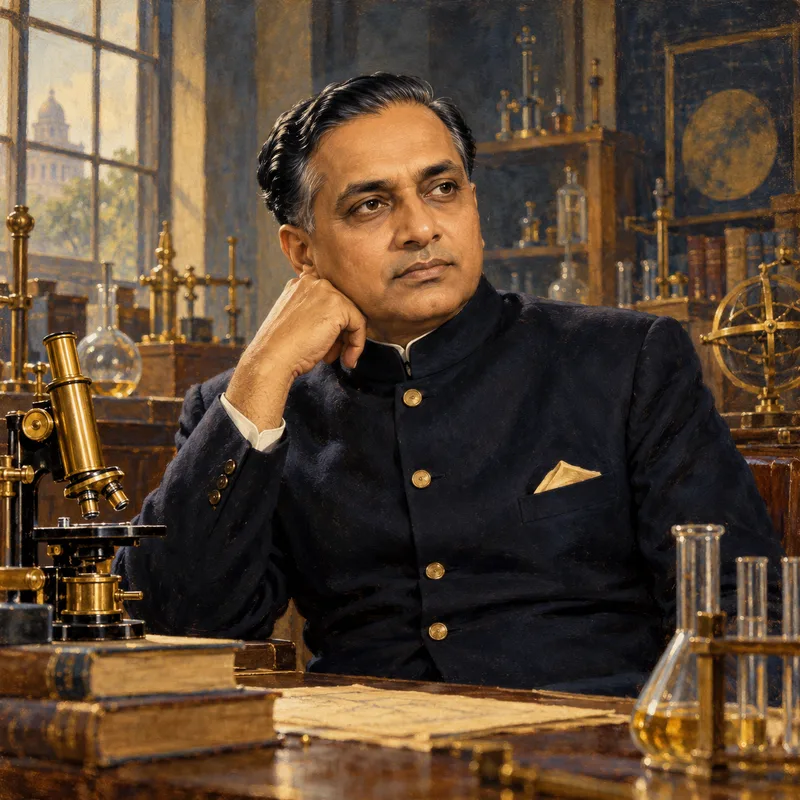
Shanti Swarup Bhatnagar
1894-1955 · India
Magnetochemistry; founded CSIR