The discovery, explained · Chemist no. 328 of 350
Bhatnagar-Mathur Magnetic Balance: How Indian Chemistry Measured Magnetism
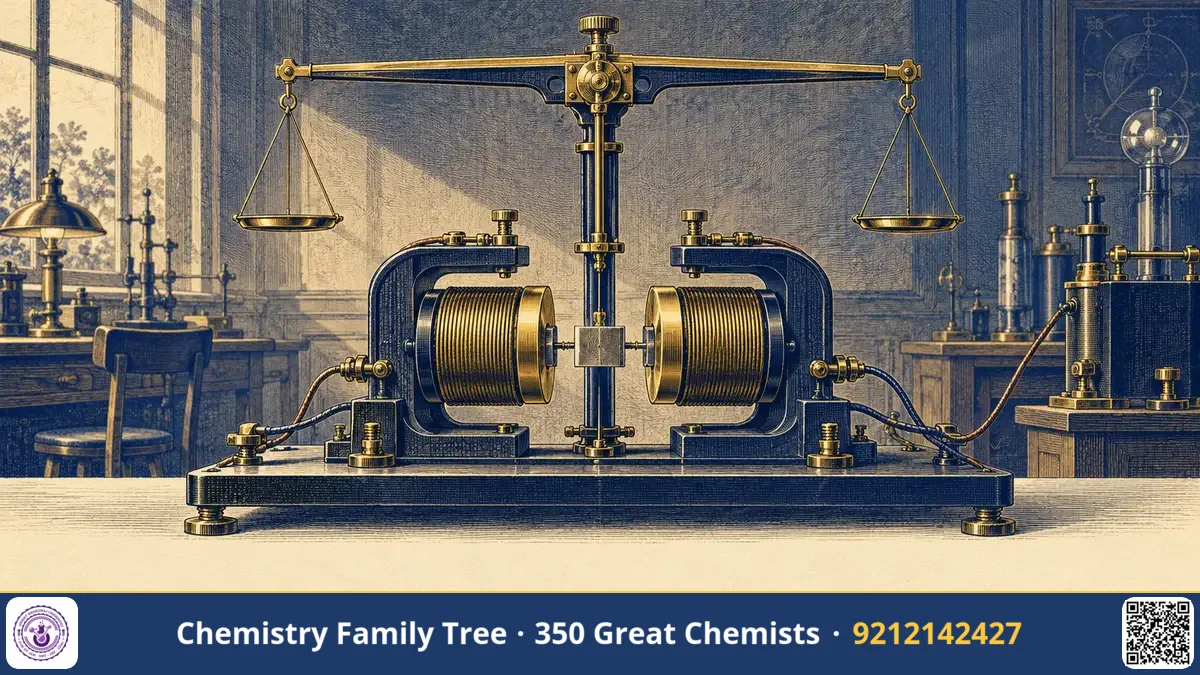
Why is liquid oxygen attracted to a magnet while water is slightly pushed away? Why is [Fe(CN)₆]⁴⁻ non-magnetic but [FeF₆]³⁻ strongly magnetic? These questions are answered by magnetochemistry, the study of how substances respond to magnetic fields. In the early 1930s, Shanti Swarup Bhatnagar and his colleague K. N. Mathur designed a sensitive instrument, the Bhatnagar-Mathur magnetic interference balance, for such measurements. It was manufactured and used widely, and it became one of the best-known Indian-designed instruments of its time. This post explains the problem, the method and the chemistry that every student of coordination chemistry should know.
The Scientific Problem Before the Discovery
By the 1920s, magnetic susceptibility had become a key tool for understanding atoms and molecules. Pierre Curie had shown how paramagnetism depends on temperature, and Paul Langevin had given a theory of diamagnetism and paramagnetism. Chemists wanted to use susceptibility to count unpaired electrons and learn the structure of complexes. The difficulty was instrumental. The classical methods of Gouy and Faraday were sensitive but demanded delicate arrangements, careful suspension of samples and considerable skill. Laboratories in India had few imported instruments and little funding. A robust, accurate and relatively simple balance was needed.
The Discovery: Step by Step
Bhatnagar worked with Mathur at the University of the Punjab, Lahore, where Bhatnagar was Professor of Chemistry from 1924. Their design is called an interference balance because the instrument uses a beam balance with a magnetic arrangement that gives very sensitive readings, and also because the apparatus was built so that the forces under study could be measured by balancing against opposing forces. Their work was described in the book Physical Principles and Applications of Magnetochemistry (1935). The general operating procedure of this class of magnetic balance is:
- Step 1: Prepare the sample. A tube is filled with a powdered solid, a liquid or a solution to a fixed height.
- Step 2: Place it in a non-uniform field. The sample hangs from or sits on the balance beam near the magnet poles.
- Step 3: Read the force. The apparent change in mass, with the field on and off, is measured accurately.
- Step 4: Calculate the susceptibility. The change in mass is converted to volume susceptibility, then to mass and molar susceptibility, after correction for the sample tube.
χ_g = (susceptibility per gram),  χ_M = χ_g × M
χ_M(corrected) = χ_M − (sum of diamagnetic corrections)
μ_eff = 2.84 √(χ_M·T) Bohr magnetons
The Chemistry Behind It
Diamagnetism. All matter has it. Paired electrons produce a weak induced magnetic moment opposed to the applied field, so the substance is repelled slightly. Susceptibility is small, negative and nearly independent of temperature.
Paramagnetism. A substance with unpaired electrons has permanent magnetic moments, which tend to align with the field and so it is attracted. Susceptibility is positive and falls with temperature according to the Curie law, χ = C/T.
Spin-only formula. For first-row transition metal ions, orbital contribution is often quenched, and the magnetic moment is given by:
μ_s = √[n(n + 2)] BM (n = number of unpaired electrons)
| Unpaired electrons (n) | μ (BM) | Example |
|---|---|---|
| 1 | 1.73 | Cu²⁺ (d⁹), Ti³⁺ |
| 2 | 2.83 | Ni²⁺ (d⁸), V³⁺ |
| 3 | 3.87 | Cr³⁺, Co²⁺ (high spin) |
| 4 | 4.90 | Fe²⁺ (high spin), Mn³⁺ |
| 5 | 5.92 | Mn²⁺, Fe³⁺ (high spin) |
Magnetic data therefore tell us whether a complex is high spin or low spin. For octahedral d⁶ Fe²⁺, [Fe(H₂O)₆]²⁺ has four unpaired electrons (about 4.9 BM) while [Fe(CN)₆]⁴⁻ has none (diamagnetic). The ligand field splitting Δo is small for weak-field ligands and large for strong-field ligands.
Applications Today
- Coordination chemistry. Magnetic moments help assign geometry and spin state, for example octahedral versus tetrahedral Co²⁺ and Ni²⁺.
- Modern instruments. SQUID magnetometers and vibrating-sample magnetometers have replaced balances in research, but the idea is the same.
- Materials. Magnetic susceptibility is used to study magnetic materials, superconductors and spin-crossover compounds.
- Oxygen analysers. Paramagnetism of O₂ is used in some gas analysers.
- Indian science policy. The same Bhatnagar is known as the founder-director of the Council of Scientific and Industrial Research (CSIR), whose national laboratories grew across India. The annual Shanti Swarup Bhatnagar Prize recognises Indian scientists.
Exam Corner
- Spin-only magnetic moment μ = √[n(n+2)] BM; learn the values 1.73, 2.83, 3.87, 4.90 and 5.92.
- O₂ is paramagnetic (two unpaired electrons in π*), as shown by molecular orbital theory.
- Strong-field ligands such as CN⁻ and CO tend to give low-spin complexes; F⁻ and H₂O tend to give high-spin complexes.
- Diamagnetic susceptibility is negative and independent of temperature; paramagnetic susceptibility follows Curie law.
- Curie-Weiss law: χ = C/(T − θ).
Common Misconceptions
- "Diamagnetic substances are not affected by magnets." They are weakly repelled. Diamagnetism is present in all substances.
- "Spin-only formula is exact for all complexes." It works best for first-row ions. For lanthanides and many second- and third-row ions, orbital contribution and spin-orbit coupling matter.
- "Bhatnagar was a physicist." He was a physical chemist, though magnetochemistry sits between chemistry and physics.
Quick Revision Box
- Instrument: Bhatnagar-Mathur magnetic interference balance (early 1930s).
- Book: Physical Principles and Applications of Magnetochemistry, 1935.
- Paramagnetism arises from unpaired electrons; diamagnetism from paired electrons.
- μ = √[n(n+2)] BM.
- Bhatnagar founded CSIR laboratories in independent India.
- The Shanti Swarup Bhatnagar Prize honours his memory.
FAQ
What is the Bhatnagar-Mathur balance used for?
It is used to measure magnetic susceptibility of solids, liquids and solutions with good sensitivity. From the susceptibility one can find the number of unpaired electrons.
Who was Mathur?
K. N. Mathur was Bhatnagar's collaborator at Lahore, and the two are credited together with the design and the 1935 book.
How is magnetic moment linked to colour and structure?
Both depend on d-electron configuration. Magnetic data give the number of unpaired electrons, while colour comes from d-d or charge-transfer transitions.
Is the magnetic balance still asked in exams?
The instrument is rarely asked, but spin-only moments, high and low spin complexes and Curie law are standard questions.
Published by ABC Chemistry — IIT-JAM | CSIR-NET | GATE Chemistry Coaching. Visit abcchemistry.com

About the chemist
Shanti Swarup Bhatnagar
1894-1955 · India
Magnetochemistry; founded CSIR