Biography · Chemist no. 242 of 350
Smithson Tennant: The Gentleman-Chemist Who Showed That Diamond Is Carbon
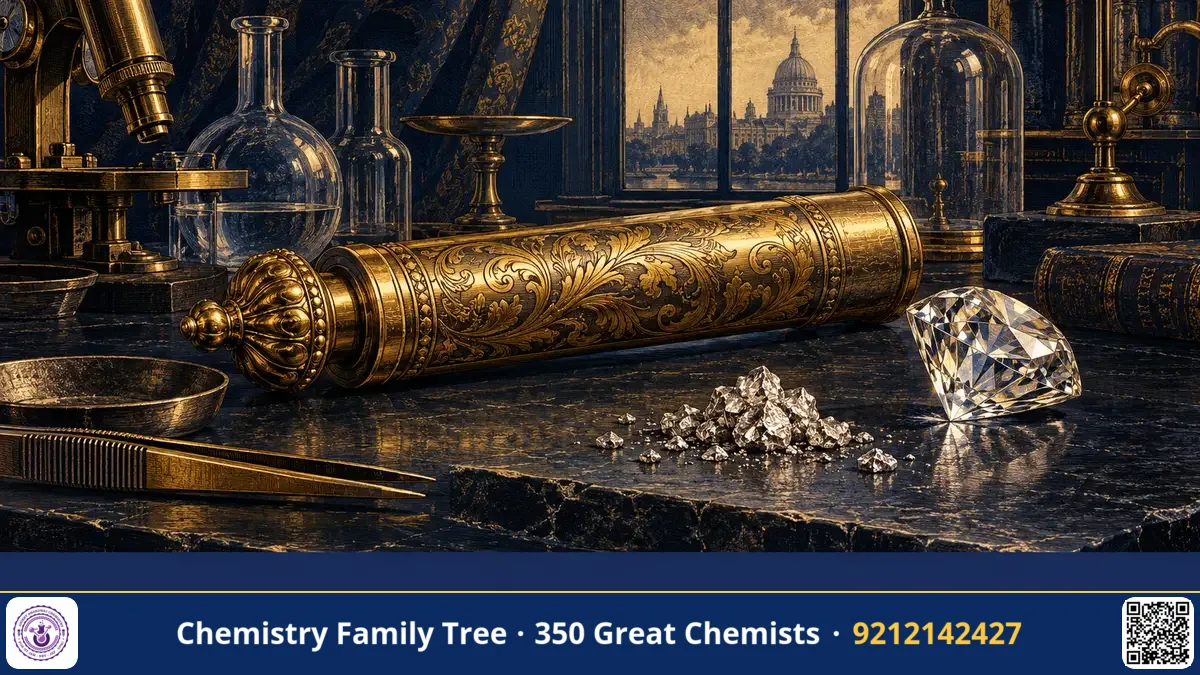
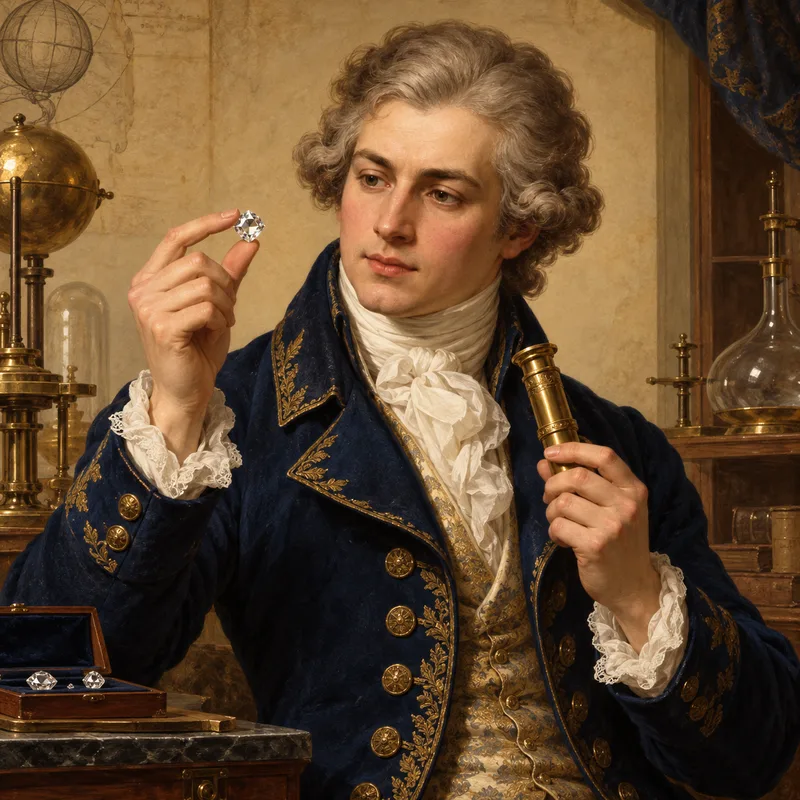
Smithson Tennant (1761–1815) was an English chemist known for one famous experiment and one remarkable discovery: he proved in 1797 that diamond is pure carbon, and in 1803 he found osmium and iridium in the residue of crude platinum. He published little, but what he did publish was exact. His one-line legacy: a quiet experimenter who connected the most precious of gems with the most ordinary of fuels.
Early Life and Family
Smithson Tennant was born on 30 November 1761 in Selby, Yorkshire, England. His father, Calvert Tennant, was a clergyman, a vicar of Selby. His mother, Mary Daunt, died in an accident when he was a boy, and his father also died when he was young, so Tennant was largely brought up by guardians. Some biographies report that he was left in the care of relatives; the details are limited. He was a student of average standing at school, interested in nature, and he took part in outdoor activities.
Education and Mentors
He attended school in Tadcaster and Beverley, then studied at the University of Edinburgh in 1781 where he attended the chemistry lectures of Joseph Black. After that he went to Cambridge, enrolling at Christ's College in 1782, and later moved to Emmanuel College. His interest in chemistry grew among the Cambridge circle of natural philosophers. He took a medical degree at Cambridge in 1796 but never practised medicine. Tennant also made tours in Europe, visiting scientific centres and manufacturing sites.
Career Timeline
| Year | Event |
|---|---|
| 1761 | Born in Selby, Yorkshire. |
| 1781 | Studies at Edinburgh and attends the lectures of Joseph Black. |
| 1782 | Enrols at Cambridge. |
| 1791 | Travels to Europe with interest in manufacturing and mineralogy. |
| 1796 | Takes a medical degree at Cambridge. |
| 1797 | Shows that diamond is pure carbon. |
| 1799 | Shows that magnesian limestone (dolomite) contains magnesium, noting its harmful effect on soil. |
| 1803 | Discovers osmium and iridium. |
| 1804 | Receives the Copley Medal of the Royal Society. |
| 1813 | Becomes Professor of Chemistry at Cambridge. |
| 1815 | Dies near Boulogne, France, on 22 February. |
Major Scientific Contributions
- Diamond is carbon (1797): burning diamond and charcoal gave identical products; details are in our discovery blog.
- Osmium and iridium (1803): from the black residue of platinum.
- Magnesium in limestone (1799): he found that dolomitic limestone contains magnesium carbonate, and showed that applying such lime to fields could harm crops. This is an early piece of agricultural chemistry.
- Chemistry of carbon and lime: his work on the combustion of carbon and on limestone showed how simple, well-designed gas and solid reactions can answer large questions.
- Experiments on carbon dioxide and nitric acid: he also studied the composition of other compounds in his private lab.
Awards, Honours and Nobel Prize
There was no Nobel Prize in his lifetime. Tennant received the Royal Society's Copley Medal in 1804 and was a Fellow of the Royal Society. He served as Professor of Chemistry at Cambridge from 1813 until his early death two years later, which is generally the career capstone of an English chemist at that time. Other honours were limited, as he published little and tended to avoid the limelight.
Personality, Struggles and Lesser-Known Facts
- Lecturing with energy. Although he held the Cambridge chair for only two years, his lectures were popular because of lively demonstrations, and he made an effort to establish chemistry as a regular subject at Cambridge.
- Wit and charm. Contemporaries described him as witty, absent-minded and agreeable company. He did not marry.
- Few publications. His output was very small, and he did not always record his observations, which is why his contribution is relatively little known.
- Partner of Wollaston. The two friends worked together on a platinum business, using the refined metal to provide a steady income, which enabled Tennant to continue his research without needing paid employment.
- Dramatic death. He died in an accident while riding near Boulogne, when a bridge or drawbridge collapsed under his horse. This is how most biographies tell it, though specific details vary between accounts.
Legacy and Influence on Modern Chemistry
His proof that diamond is carbon is a landmark of early quantitative chemistry and one of the first demonstrations of allotropy: the same element appearing in different structural forms. Osmium and iridium opened the platinum-group chemistry that now supports catalysis, spark plugs, electrical contacts and the understanding of the end-Cretaceous impact via the iridium layer. His work on dolomite helped to advance agricultural chemistry. The chair he held later passed to a series of leading Cambridge chemists.
Lessons for Students
- One clean experiment can settle a long debate. Burning diamond and measuring the CO₂ answered the question.
- Look at the residue. The black powder that others discarded contained two new elements.
- Write up your work. His small output limited his fame; document what you discover.
- Combine curiosity with practical sense. Big answers can come from simple, well-designed reactions.
Quick Facts Box
- Born: 30 November 1761, Selby, Yorkshire
- Died: 22 February 1815, near Boulogne, France
- Nationality: British (English)
- Field: Inorganic chemistry
- Famous for: Diamond is carbon; discovery of osmium and iridium
- Nobel Prize: None (pre-dates the prize)
FAQ
Is Smithson Tennant the same as the Glasgow bleach manufacturer Charles Tennant?
No. Charles Tennant of Glasgow, who industrialised bleaching powder, was a different person.
Why is he linked with James Smithson?
This is a common confusion with Smithson Tennant's first name. James Smithson, the founder of the Smithsonian, was a different chemist.
Where did Tennant teach?
He was Professor of Chemistry at Cambridge from 1813 to 1815.
How did he get such a unique first name?
The name Smithson was a family name; no further explanation is documented.
Published by ABC Chemistry — IIT-JAM | CSIR-NET | GATE Chemistry Coaching. Visit abcchemistry.com
About the chemist
Smithson Tennant
1761-1815 · United Kingdom
Discovered osmium and iridium