The discovery, explained · Chemist no. 242 of 350
Smithson Tennant: Two Heaviest Metals and the Proof That Diamond Is Carbon
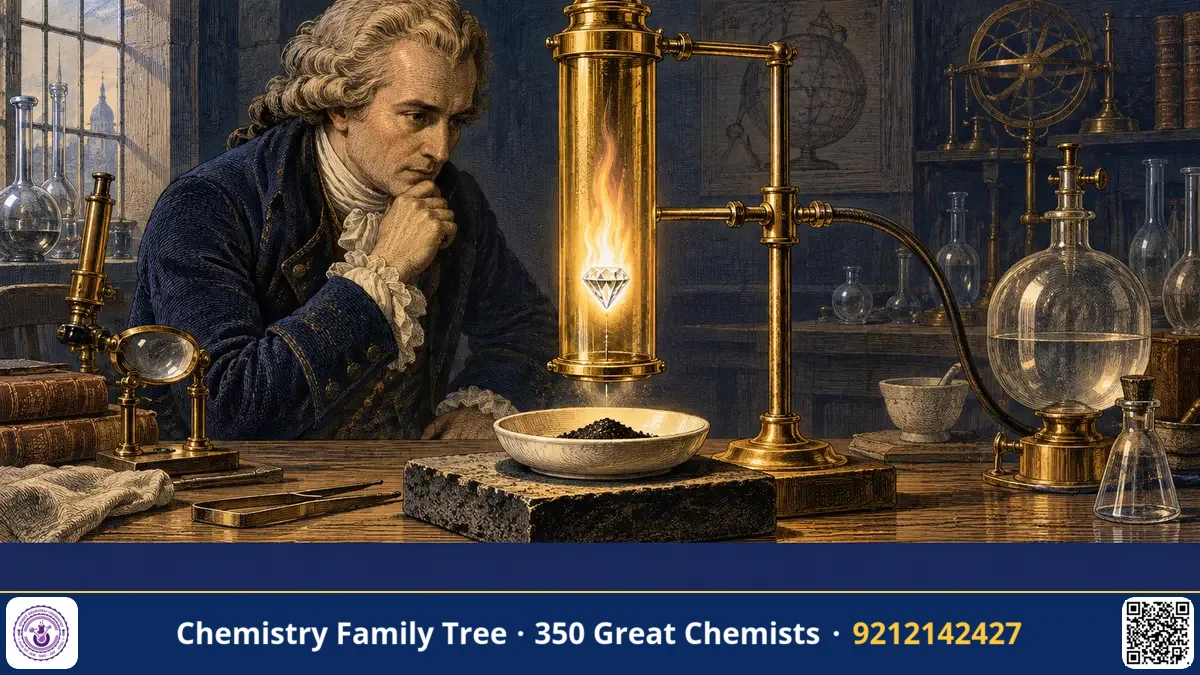
Diamond and graphite look nothing alike, yet both are carbon. Osmium and iridium are the two densest naturally occurring elements. Both stories belong to one English chemist, Smithson Tennant. In 1797 he burned diamond in a sealed gold tube and showed that it produces exactly the same gas as burning charcoal. In 1803, working with the black dregs left after crude platinum was dissolved in aqua regia, he discovered osmium and iridium. In this post we follow both discoveries and explain the chemistry you need for school and competitive exams.
The Scientific Problem Before the Discovery
Diamond: Before 1790s, no one agreed on what a diamond is. Newton had suggested in the 17th century that it is combustible, based on its optical properties. In 1772 Lavoisier and others heated diamonds in air using a large burning lens and found that they vanished, but they were not sure what was formed. Whether diamond was a form of carbon or a unique substance was unclear.
Platinum residue: When crude platinum is dissolved in aqua regia, a black powder stays behind. It was commonly assumed to be graphite or a plain impurity, such as a mixture of iron and chromium compounds. Tennant, who was working with Wollaston on refining platinum, suspected that the residue was more interesting.
The Discovery: Step by Step
Step 1: Diamond in a gold tube (1797)
Tennant placed diamond fragments with potassium nitrate (saltpetre) in a sealed gold tube and heated it strongly. Gold was used because it does not react with the oxidising nitrate. The diamond burned, and the gas formed was absorbed by the alkali that was present, forming a carbonate.
C(diamond) + O₂ → CO₂
CO₂ + 2KOH → K₂CO₃ + H₂O (in alkaline medium)
K₂CO₃ + 2HCl → 2KCl + H₂O + CO₂
He then added acid to the product and measured the CO₂ evolved. The mass of CO₂ matched what would be expected from burning charcoal of the same weight (the combustion of 1 g of carbon gives 3.67 g of CO₂). That showed diamond and charcoal gave the same product in the same proportion, and hence diamond is carbon.
Step 2: The black residue (1803)
Tennant treated the black residue left from platinum with alternating alkali and acid to separate different parts. He fused it with sodium hydroxide, dissolved the product in water, and got two different metallic substances.
Step 3: Osmium
One of them gave a solution that, on distillation with acid, produced a volatile oxide with a sharp, unpleasant smell. The compound is osmium tetroxide. The Greek word for smell is osme, so Tennant named it osmium:
Os + 2O₂ → OsO₄ (volatile, pale yellow solid, melting point about 40 °C)
Step 4: Iridium
The other metal formed salts of many colours: red, green, blue and yellow, depending on the oxidation state. He named it iridium after Iris, the Greek goddess of the rainbow. He announced both elements in a letter to the Royal Society in 1804. Antoine Collet-Descotils and others in France had meanwhile seen indications of the same metals, so the work was nearly simultaneous.
The Chemistry Behind It
- Allotropy of carbon: diamond (sp³, each carbon bonded to four others, density about 3.5 g/cm³) and graphite (sp², layers, density about 2.2 g/cm³) are different forms of the same element. Both burn to CO₂, though diamond needs a higher temperature, about 700–900 °C in oxygen.
- Quantitative evidence: C + O₂ → CO₂; 12 g C gives 44 g CO₂. Tennant's measurements agree within error for diamond and charcoal.
- Osmium and iridium: they are 5d transition metals (Group 8 and 9). Osmium has a density of about 22.59 g/cm³ and iridium about 22.56 g/cm³; they compete for the title of densest element, and in the most careful calculations osmium is slightly denser.
- Oxidation states: osmium reaches +8 in OsO₄, one of the highest oxidation states known (ruthenium also reaches +8 in RuO₄). Iridium shows +3 and +4 in common salts such as IrCl₃ and Na₂IrCl₆.
- Organic chemistry link: OsO₄ converts alkenes into cis-diols by syn dihydroxylation: RCH=CHR + OsO₄ → cyclic osmate ester → cis-RCH(OH)–CH(OH)R after hydrolysis. Sharpless's asymmetric dihydroxylation (Nobel Prize 2001) uses catalytic OsO₄ with a chiral ligand and a co-oxidant.
Applications Today
Osmium tetroxide is used for cis-dihydroxylation in organic synthesis and as a stain for electron microscopy of biological tissues, but it is highly toxic and volatile. Osmium–iridium alloys are very hard and were used in fountain pen nibs and instrument pivots; the word "iridium" lives on in spark plugs with fine iridium tips that last a very long time. Iridium crucibles allow crystal growth at very high temperatures, and the international standard prototype of the metre and kilogram were made of a platinum–iridium alloy. A thin layer of iridium-rich clay at the boundary between the Cretaceous and Paleogene periods supported the proposal that an asteroid struck Earth about 66 million years ago. The synthetic diamond industry depends on the knowledge that diamond is carbon: lab-grown diamonds, produced by high-pressure high-temperature and chemical vapour deposition methods, are used for gems and cutting tools, and India's Surat is a major diamond cutting and polishing centre.
Exam Corner
- Tennant (1797) showed diamond is pure carbon by burning it and measuring CO₂; (1803) discovered osmium and iridium in the residue left after aqua regia treatment of platinum.
- Osmium is named from Greek osme (smell), because of the odour of OsO₄; iridium is named from Iris (rainbow) because its salts are multicoloured.
- Os and Ir are among the densest elements, around 22.6 g/cm³.
- OsO₄ (Os in +8) is used in syn dihydroxylation of alkenes (Upjohn and Sharpless methods).
- Diamond and graphite are allotropes of carbon: diamond is sp³, hard and an electrical insulator; graphite is sp², soft and conducts electricity in the plane of the layers.
Common Misconceptions
- "Diamond is a different substance from graphite." Both are carbon; their properties differ because of structure.
- "Osmium is a gas because OsO₄ is volatile." Osmium metal is a dense solid; only its tetroxide is volatile.
- "Tennant discovered platinum metals alone." Wollaston discovered palladium and rhodium; Tennant, osmium and iridium.
Quick Revision Box
- Tennant (1761–1815): English chemist.
- 1797: diamond burned in a gold tube gives CO₂, so diamond is carbon.
- 1803–04: osmium (smell) and iridium (rainbow) from the aqua regia residue.
- OsO₄: volatile, toxic, used for cis-dihydroxylation.
- Os and Ir density about 22.6 g/cm³.
- Ir-rich layer links to the end-Cretaceous impact theory.
FAQ
Why a gold tube?
Gold resists the hot oxidising mixture of nitrate and does not form compounds with carbon dioxide or alkali, so the carbon products could be measured properly.
Which is denser, osmium or iridium?
Calculations from crystal structure make osmium very slightly denser, but both are about 22.6 g/cm³.
Did Tennant know about allotropes?
The word allotropy was introduced later by Berzelius (1841), but Tennant's experiment gave the key evidence for it.
Was Tennant a professor?
Yes. He became Professor of Chemistry at Cambridge in 1813.
Published by ABC Chemistry — IIT-JAM | CSIR-NET | GATE Chemistry Coaching. Visit abcchemistry.com
About the chemist
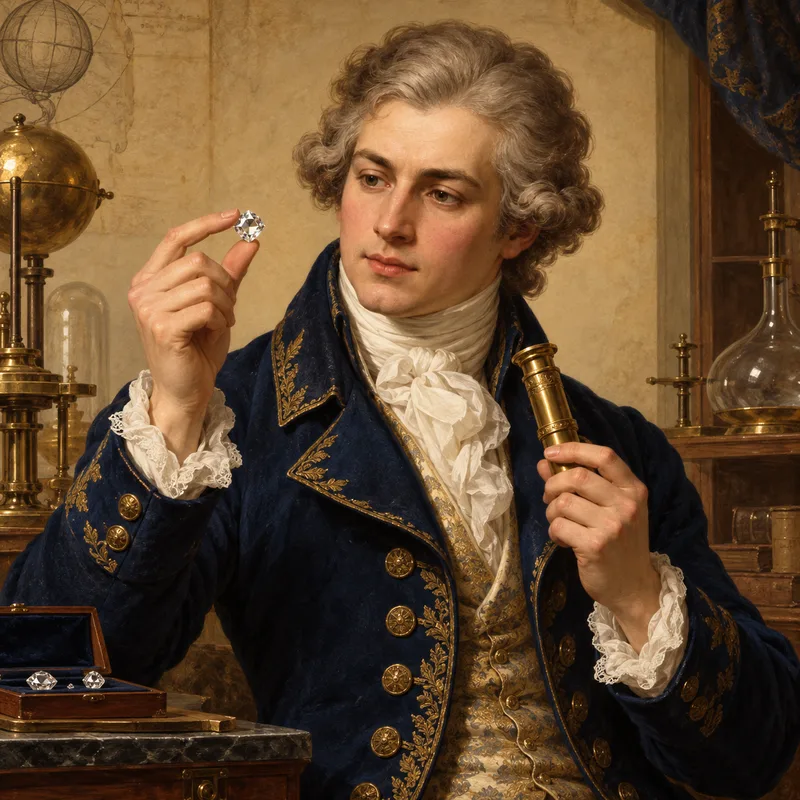
Smithson Tennant
1761-1815 · United Kingdom
Discovered osmium and iridium