Biography · Chemist no. 142 of 350
Stanford Moore: A Quiet Master of Protein Chemistry
Introduction
Stanford Moore (1913-1982) was an American biochemist who spent most of his career at the Rockefeller Institute (later Rockefeller University) in New York. Together with William H. Stein he developed methods to separate and measure amino acids, built the first automatic amino acid analyzer, and helped to unravel the structure and mechanism of ribonuclease. He shared the 1972 Nobel Prize in Chemistry. In one line: Moore made the composition of proteins measurable.
Early Life and Family
Stanford Moore was born on 4 September 1913 in Chicago, Illinois. He grew up in Nashville, Tennessee, in a family that valued learning, and the nearby Vanderbilt University shaped his path to chemistry.
Education and Mentors
Moore studied chemistry at Vanderbilt University and graduated in 1935. He then went to the University of Wisconsin for graduate study in organic chemistry, working with Karl Paul Link, a well-known biochemist whose group later discovered the anticoagulant dicoumarol, which led to warfarin. Moore obtained his PhD in 1938. After a short period in Wisconsin he joined the Rockefeller Institute for Medical Research in New York, where he first worked with Max Bergmann, a leading protein chemist who had fled from Germany. This is where Moore met William Stein, and the partnership shaped the rest of his career.
Career Timeline
| Year | Event |
|---|---|
| 1913 | Born in Chicago on 4 September |
| 1935 | Graduates from Vanderbilt University |
| 1938 | PhD, University of Wisconsin |
| 1939 | Joins the Rockefeller Institute, working with Max Bergmann |
| 1948 | Moore and Stein publish starch-column chromatography of amino acids |
| 1951 | Ion-exchange methods for amino acid analysis developed |
| 1958 | Automatic amino acid analyzer described with Darrel Spackman |
| 1960 | Amino acid sequence of ribonuclease A completed |
| 1972 | Nobel Prize in Chemistry, shared |
| 1982 | Dies in New York City on 23 August |
Major Scientific Contributions
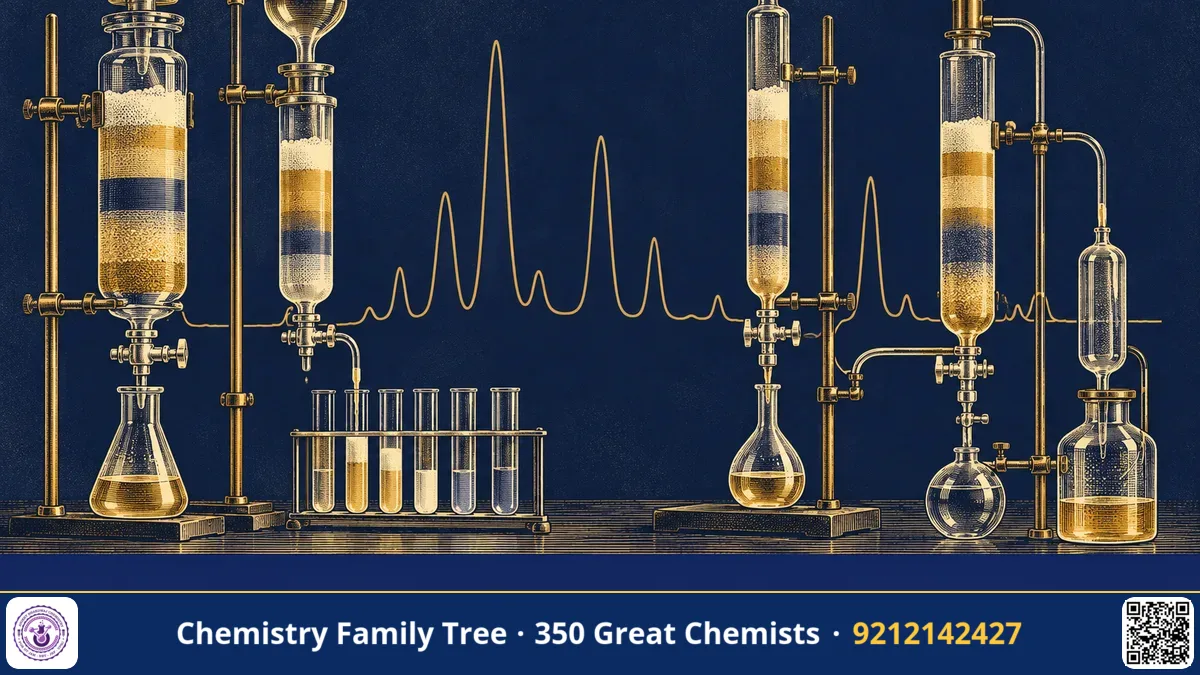
Moore's lasting contribution is the analytical machinery of protein chemistry: quantitative chromatography of amino acids on starch and then on ion-exchange resins, detection by the ninhydrin reaction, and finally automation. These methods made it routine to find the amino acid composition of a protein from tiny samples. With Stein, he applied them to ribonuclease, helping to establish the complete sequence of 124 amino acids, and showing by chemical modification that histidine residues 12 and 119 are central to catalysis. His methods were also used to study other enzymes such as deoxyribonuclease and proteases. The full chemistry is described in the companion discovery post.
To appreciate the impact, think about what a protein chemist faced before 1950. A protein hydrolysate contains up to twenty amino acids, several of which are chemically very similar. Moore and Stein's columns could separate them in a reproducible order, and the ninhydrin reaction made each one visible as a coloured peak whose area was proportional to the amount present. Instead of fifteen or twenty days of paper chromatography and careful spot cutting, a laboratory could obtain a complete analysis overnight. This speed allowed researchers to compare proteins from different species, follow chemical modifications and prove that a protein preparation was pure. In this sense, the analyzer was to protein chemistry what the balance is to inorganic analysis: a basic instrument that other discoveries depend on.
Their approach to ribonuclease also set a style for enzymology. Rather than guessing, they changed one chemical group at a time, measured what happened to activity, and then identified the modified residue by amino acid analysis of the products.
Awards, Honours and Nobel Prize
- Nobel Prize in Chemistry, 1972. Moore and Stein shared half of the prize for their contribution to understanding the connection between chemical structure and catalytic activity of the active centre of the ribonuclease molecule. The other half went to Christian Anfinsen.
- Member of the United States National Academy of Sciences.
- Honorary degrees from several universities.
Personality, Struggles and Lesser-Known Facts
- A thirty-year partnership. Moore and Stein worked together from the 1940s until Stein's death in 1980. They shared a laboratory and often published jointly, and they are remembered as one of the great collaborations in biochemistry.
- Automation pioneer. The amino acid analyzer was among the first automated analytical instruments in biochemistry, and it was commercialised so that laboratories everywhere could use it.
- A student of two great chemists. He learned natural-product chemistry from Karl Paul Link and protein chemistry from Max Bergmann, a rare combination that suited his later work.
- Modest and quiet. Colleagues described him as reserved, careful and generous in giving credit to his co-workers.
- Outlived his partner by two years. Stein died in 1980 and Moore in 1982.
Legacy and Influence on Modern Chemistry
Every protein laboratory that performs amino acid analysis, ion-exchange chromatography or HPLC owes something to Moore and Stein. Their work paved the way for automated protein sequencers and for modern proteomics, where mass spectrometry has replaced much of the older chemistry but the questions remain the same. The idea that enzyme mechanisms can be probed with specific chemical modifications is still used to identify catalytic residues. Moore's work strengthened the Rockefeller University's reputation as a centre for chemical biology.
Lessons for Students
- Build the tools you need. Moore and Stein made their own methods, and then used them to answer big questions.
- Value collaboration. Two people with complementary talents achieved more than either would alone.
- Improve accuracy step by step; quantitative science depends on reliable measurement.
- Be patient; the amino acid analyzer took about a decade of refinement.
- Share credit generously.
Quick Facts Box
- Born: 4 September 1913, Chicago, Illinois, USA
- Died: 23 August 1982, New York City, USA
- Nationality: American
- Field: Biochemistry, protein chemistry
- Famous for: Amino acid analyzer; structure and mechanism of ribonuclease
- Nobel: Chemistry, 1972 (shared with Stein and Anfinsen)
FAQ
Who did Stanford Moore share the Nobel Prize with?
He shared the 1972 Nobel Prize in Chemistry with William H. Stein (the two shared one half) and Christian B. Anfinsen (the other half).
What is the amino acid analyzer?
It is an instrument that separates amino acids by ion-exchange chromatography, reacts the eluate with ninhydrin, and records the colour automatically to give a quantitative composition.
Was his Nobel Prize in Medicine?
No. It was in Chemistry.
Where did he work?
Almost all of his research career was at the Rockefeller Institute, now Rockefeller University, in New York.
Published by ABC Chemistry — IIT-JAM | CSIR-NET | GATE Chemistry Coaching. Visit abcchemistry.com
About the chemist
Stanford Moore
1913-1982 · United States · Nobel Chemistry 1972
Ribonuclease structure, amino acid analysis