Biography · Chemist no. 247 of 350
Stanislao Cannizzaro (1826-1910): Chemist, Revolutionary and Senator
Introduction
Stanislao Cannizzaro was an Italian chemist from Sicily who lived through the unification of Italy and played a part in it. In science he is known for the Cannizzaro reaction and, more importantly, for convincing the chemical world to accept Avogadro's hypothesis and a consistent set of atomic weights. His legacy in one line: the man who cleared the confusion in atomic weights and made the periodic table possible.
Early Life and Family
Cannizzaro was born on 13 July 1826 in Palermo, Sicily, which was then part of the Kingdom of the Two Sicilies, under the Bourbon rulers. In 1841 he entered the University of Palermo, where he first studied medicine but was drawn instead to chemistry.
Education and Mentors
At Palermo he was drawn towards chemistry and the sciences of the laboratory. He then moved to Pisa, where he worked as an assistant to Raffaele Piria, the Italian chemist who had made salicylic acid chemistry famous. From Piria he learned organic analysis and the style of careful experiment. In 1849, after the failure of the Sicilian revolution, he escaped to Paris and worked in the laboratory of Michel-Eugene Chevreul. There he made a lasting friendship with Charles Adolphe Wurtz and others.
Career Timeline
| Year | Event |
|---|---|
| 1826 | Born in Palermo, Sicily |
| 1841 | Enters the University of Palermo |
| 1845-1847 | Works at Pisa as assistant to Piria |
| 1848 | Takes part in the Sicilian revolution as an artillery officer |
| 1849-1851 | Exile in Paris; works with Chevreul |
| 1851 | Appointed to teach physical chemistry at the National College of Alessandria |
| 1853 | Discovers the Cannizzaro reaction |
| 1855 | Professor at the University of Genoa |
| 1858 | Publishes the Sunto di un corso di filosofia chimica |
| 1860 | Speaks at the Karlsruhe Congress; joins Garibaldi's campaign in Sicily |
| 1861 | Professor at Palermo |
| 1871 | Moves to Rome as professor; later senator and vice-president of the Senate |
| 1891 | Awarded the Copley Medal |
| 1910 | Dies in Rome on 10 May |
Major Scientific Contributions
- Cannizzaro reaction (1853): Disproportionation of non-enolisable aldehydes in conc. base. It also gave an early route to benzyl alcohol.
- Atomic weights: He revived Avogadro's hypothesis, separated the ideas of atom, molecule and equivalent, and used vapour densities with the principle of smallest mass to find atomic weights.
- Organic chemistry: Work on benzyl compounds and on santonin, a drug against intestinal worms obtained from Artemisia plants.
- Teaching: His clear teaching of chemical philosophy at Genoa produced the Sunto, a short but influential text.
2 C6H5CHO + KOH -> C6H5CH2OH + C6H5COOK     (1853)
Atomic weight of an element = smallest mass of it in one molecular weight of any of its compounds
Awards, Honours and Nobel Prize
Cannizzaro received the Copley Medal of the Royal Society in 1891. He was a foreign member of the Royal Society and honoured by many academies. In Italy he became a senator of the Kingdom in 1871 and was vice-president of the Senate. He never received a Nobel Prize; the first prizes were given in 1901, and he lived until 1910, but chemistry prizes went to others in those years.
Personality, Struggles and Lesser-Known Facts
- As a young man he took part in the Sicilian revolution of 1848 against Bourbon rule, serving as an officer of artillery. When it failed, he had to flee the island,.
- The 1858 Sunto was written as a series of lecture notes for his students at Genoa and was printed in a journal, Il Nuovo Cimento. It was little noticed until copies were handed out at Karlsruhe in 1860.
- Lothar Meyer later said that reading the Sunto felt like scales falling from his eyes. Meyer's remark is often quoted as a sign of its influence, and Mendeleev, who was at the Karlsruhe Congress, also used Cannizzaro's atomic weights in his periodic table.
- In 1860 he went to Sicily at the time of Garibaldi's campaign, and afterwards he taught at Palermo.
- In Rome he built a modern chemistry institute and remained active in public life as a senator, supporting science education and public health.
Legacy and Influence on Modern Chemistry
Without Cannizzaro's plan, the periodic classification could not have been made. Atomic weights of 1860 became the base for Mendeleev's 1869 table, and Lothar Meyer's curves. The Cannizzaro reaction is a standard named reaction in all organic courses, and it is an example of hydride transfer, a theme that returns in the Meerwein-Ponndorf-Verley and Oppenauer reactions. In Italy, schools and streets are named after him.
Lessons for Students
- Clear explanation can be as valuable as new discovery. The Sunto contained few new experiments but a new logic.
- Do not give up on old ideas that are right. Avogadro's hypothesis waited almost fifty years.
- Science and society go together. Cannizzaro fought for his country and served it as a legislator while remaining a scientist.
- Prepare your work for the right audience. He took copies to the Congress to put them into the hands of those who mattered.
Quick Facts Box
- Born: 13 July 1826, Palermo, Sicily
- Died: 10 May 1910, Rome
- Nationality: Italian
- Field: Organic and general chemistry
- Famous for: Cannizzaro reaction; revival of Avogadro's hypothesis; atomic weights
- Nobel Prize: None; Copley Medal 1891
FAQ
Why is Cannizzaro important in chemistry?
He discovered the Cannizzaro reaction and persuaded chemists to use Avogadro's hypothesis to determine atomic weights, which made the periodic table possible.
What was the Sunto?
The Sunto di un corso di filosofia chimica (1858) was his summary of a course in which he set out a consistent method of atomic and molecular weights.
Was Cannizzaro a politician?
Yes. He took part in the Sicilian revolution of 1848 and Garibaldi's campaign of 1860, and became a senator of the Kingdom of Italy in 1871.
Did Cannizzaro win a Nobel Prize?
No. He received the Copley Medal in 1891 and many other honours, but not the Nobel Prize.
Published by ABC Chemistry — IIT-JAM | CSIR-NET | GATE Chemistry Coaching. Visit abcchemistry.com
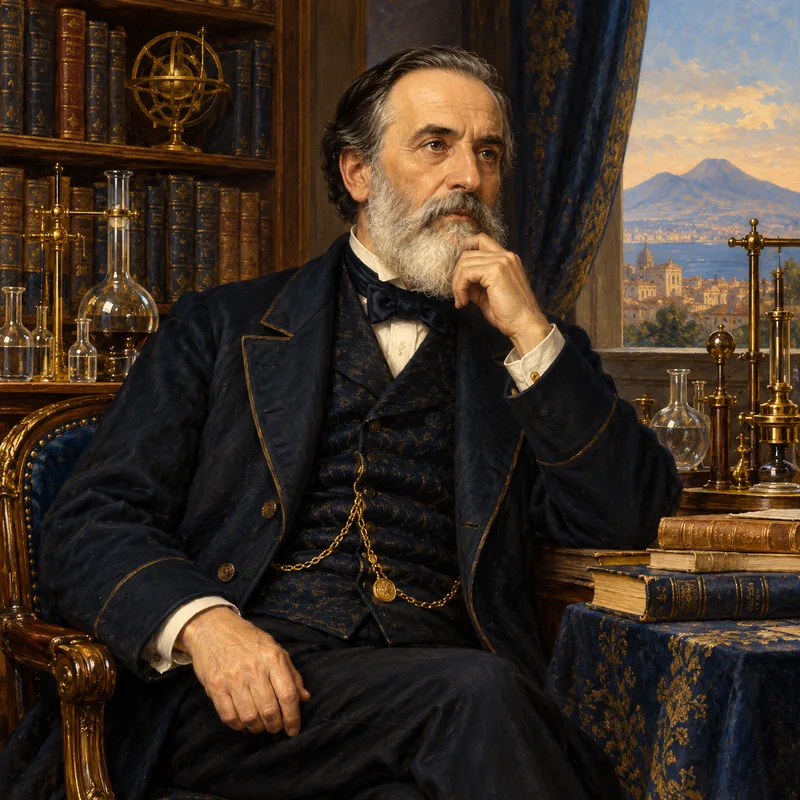
About the chemist
Stanislao Cannizzaro
1826-1910 · Italy
Cannizzaro reaction; atomic weight clarification