The discovery, explained · Chemist no. 247 of 350
Cannizzaro: The Reaction in Your Textbook and the Man Who Settled Atomic Weights
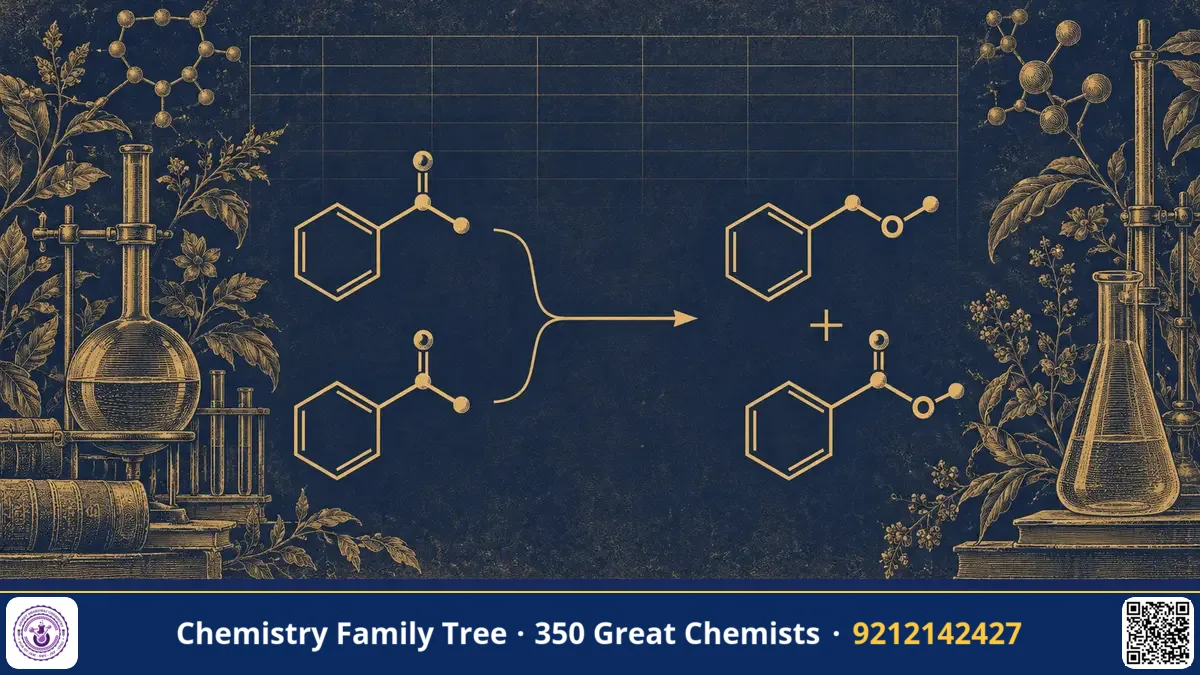
Stanislao Cannizzaro (1826-1910) is known to every student of organic chemistry for the Cannizzaro reaction, in which an aldehyde with no alpha hydrogen is converted by strong base into an alcohol and a carboxylate. But his larger contribution was to physical chemistry. In 1858 he published a clear plan for using Avogadro's hypothesis to find atomic and molecular weights, and in 1860 he presented it at the Karlsruhe Congress. This ended a long confusion about atomic weights and made possible the periodic table of Mendeleev and Meyer. In this post we look at both discoveries: the reaction from 1853 and the atomic weight method from 1858, with the equations and the exam points.
The Scientific Problem Before the Discovery
By 1850 chemists did not agree on atomic weights. Some used the equivalent system, with H = 1, O = 8 and C = 6, and others used Berzelius's values. Water was written as HO or H2O. The same compound had several formulas. Avogadro had proposed in 1811 that equal volumes of gases have equal numbers of molecules, and that elements such as hydrogen and oxygen exist as diatomic molecules. But most chemists, including Dalton and Berzelius, rejected it, since they could not accept that two identical atoms could combine.
The second problem was in organic chemistry: how do aldehydes behave with strong base? Aldehydes were known to be reducing agents and easily oxidised. A reaction in which one molecule of aldehyde is oxidised while another is reduced was not known.
The Discovery / Experiment
The Cannizzaro reaction (1853)
At the University of Alessandria, Cannizzaro treated benzaldehyde (from bitter almond oil) with a concentrated alcoholic solution of potassium hydroxide. After some time the mixture became a solid mass of potassium benzoate crystals. On adding water and extracting with ether, he isolated benzyl alcohol, a compound that he had not seen before from this source.
2 C6H5CHO + KOH (conc.)  ->  C6H5CH2OH + C6H5COOK
benzaldehyde            benzyl alcohol   potassium benzoate
This is a disproportionation: half of the aldehyde is oxidised to the acid (as its salt), and the other half is reduced to the alcohol.
The atomic weight method (1858)
In his "Sunto di un corso di filosofia chimica" (Sketch of a course of chemical philosophy), Cannizzaro explained how to determine atomic weights consistently. His steps were:
- Use Avogadro's hypothesis: the vapour density (relative to hydrogen) of a gas is proportional to its molecular weight. Take hydrogen as H2 = 2, so M = 2 x vapour density.
- Take many compounds that contain a given element and find their molecular weights from vapour densities.
- Analyse each compound, and find the mass of that element in one molecular weight of each compound.
- The smallest mass found is taken as the atomic weight of the element, since the atom cannot be split in chemical reactions.
- Check using Dulong and Petit's law and isomorphism.
Element: carbon.  Compound         M     Mass of C in one M
                  methane         16     12
                  carbon dioxide  44     12
                  ethane          30     24
                  benzene         78     72
                  ethanol         46     24
Smallest = 12  ->  atomic weight of carbon = 12
He also confirmed values with the law of Dulong and Petit: atomic weight x specific heat is about 6.4 (cal/mol/K) for solid elements, which gave approximate atomic weights of metals.
Atomic weight (approx.) = 6.4 / specific heat (cal g-1 K-1)
The Chemistry Behind It
Mechanism of the Cannizzaro reaction
- Hydroxide adds to the carbonyl carbon of one aldehyde molecule, forming a tetrahedral alkoxide that can lose a second proton in strong base to give a dianion.
- This intermediate transfers a hydride ion (H-) to the carbonyl carbon of a second aldehyde molecule. It is the rate-determining step.
- The first molecule becomes the carboxylic acid (as carboxylate), and the second becomes an alkoxide.
- Proton transfer gives the carboxylate and the alcohol.
PhCHO + OH(-)  <->  PhCH(O-)OH
PhCH(O-)OH + PhCHO  ->  PhCOOH + PhCH2O(-)      (hydride transfer)
PhCOOH + PhCH2O(-)  ->  PhCOO(-) + PhCH2OH
Conditions: the aldehyde must lack alpha hydrogen. If it has alpha H (such as acetaldehyde), the base removes the alpha proton and the aldol reaction takes place instead. Typical substrates are benzaldehyde, formaldehyde, furfural and trimethylacetaldehyde.
In the crossed Cannizzaro reaction between formaldehyde and another aldehyde, formaldehyde is oxidised to formate and the other aldehyde is reduced to alcohol. This works because formaldehyde has the most electrophilic carbonyl, so hydroxide adds to it, and it is the better hydride donor. An internal version occurs with glyoxal, which gives glycolate.
HCHO + C6H5CHO + KOH  ->  HCOOK + C6H5CH2OH
2 HCHO + NaOH  ->  HCOONa + CH3OH
The reaction is third-order overall in some conditions (second order in aldehyde and first order in hydroxide), and shows a kinetic isotope effect, evidence for the hydride shift.
Applications Today
- Synthesis: Preparation of benzyl alcohol and benzoic acid in teaching laboratories, and of pentaerythritol from formaldehyde and acetaldehyde, where the aldol steps are followed by a crossed Cannizzaro reduction with formaldehyde. Pentaerythritol is used for alkyd resins, paints and explosives such as PETN.
- Formates: Sodium formate is made from formaldehyde in a similar way.
- Atomic weights: Cannizzaro's method of using vapour density and the smallest fraction is the basis for what students learn as molar mass determination; mass spectrometry now does this directly.
- Periodic table: Reliable atomic weights were essential for the periodic law of 1869.
Exam Corner
- Cannizzaro reaction: aldehydes with no alpha-H + conc. NaOH or KOH gives alcohol + carboxylate salt (disproportionation).
- Rate-determining step: hydride transfer from the tetrahedral intermediate; rate = k[RCHO]2[OH-].
- Crossed Cannizzaro: HCHO is always oxidised to formate and the other aldehyde is reduced.
- Intramolecular: glyoxal gives glycolic acid; phthalaldehyde gives phthalide (after acidification).
- Atomic weight is the smallest mass of the element in the molecular weight of its compounds; Dulong-Petit: atomic weight x specific heat approx. 6.4.
Common Misconceptions
- "Any aldehyde gives the Cannizzaro reaction." Only those without alpha hydrogen. Others give aldol condensation under base.
- "The reaction needs a catalyst." Hydroxide is a reactant that is consumed; a stoichiometric amount of strong base is used.
- "Cannizzaro discovered Avogadro's hypothesis." No. Avogadro proposed it in 1811. Cannizzaro showed how to use it consistently and made chemists accept it.
Quick Revision Box
- Stanislao Cannizzaro (1826-1910), Italian chemist, born in Palermo.
- 1853: Cannizzaro reaction of benzaldehyde with conc. KOH.
- Products: benzyl alcohol and potassium benzoate (1:1).
- 1858: Sunto, using Avogadro's hypothesis; 1860: Karlsruhe Congress.
- Formaldehyde is the hydride donor in crossed Cannizzaro.
- Substrate must lack alpha-hydrogen.
FAQ
What is the Cannizzaro reaction?
It is the disproportionation of two molecules of a non-enolisable aldehyde in strong base, giving one molecule of alcohol and one of carboxylate salt.
Why does acetaldehyde not give the Cannizzaro reaction?
It has alpha hydrogens, which strong base removes, so the aldol reaction wins over hydride transfer.
What happened at the Karlsruhe Congress?
In 1860, chemists from many countries met to settle atomic weights and formulas. Cannizzaro argued for his method, and copies of his Sunto handed out there later convinced many, including Lothar Meyer.
How did Cannizzaro find atomic weights?
By finding molecular weights of volatile compounds from vapour density, then taking the smallest mass of the element found in a molecular weight of any compound.
Published by ABC Chemistry — IIT-JAM | CSIR-NET | GATE Chemistry Coaching. Visit abcchemistry.com

About the chemist
Stanislao Cannizzaro
1826-1910 · Italy
Cannizzaro reaction; atomic weight clarification