Biography · Chemist no. 201 of 350
Stefan W. Hell (born 1962): The Physicist Who Defied Abbe
Introduction
Stefan Walter Hell is a German physicist, born in Romania, who invented STED microscopy and thereby showed that the diffraction limit of Ernst Abbe, accepted for more than a century, could be overcome in a far-field light microscope. A director at the Max Planck Institute for Multidisciplinary Sciences in Göttingen (formerly the Institute for Biophysical Chemistry) and at the Max Planck Institute for Medical Research in Heidelberg, he shared the 2014 Nobel Prize in Chemistry with Eric Betzig and William E. Moerner. His story combines early doubt, stubborn belief in a physical idea, and eventual worldwide impact.
Early Life and Family
Hell was born on 23 December 1962 in Arad, in western Romania. He belongs to the Banat Swabian community, a German-speaking minority in that region. His family lived under the communist regime of Nicolae Ceaușescu, and in 1978, when Hell was 15, the family emigrated to West Germany. They settled in Ludwigshafen am Rhein, where he completed his schooling and graduated from secondary school. He has recalled that he was already interested in science as a teenager and that, after the move, he continued to study physics and maths with enthusiasm.
Education and Mentors
Hell studied physics at the University of Heidelberg and received his doctorate there in 1990 with a thesis on imaging in confocal microscopy, a method for obtaining sharper optical sections. During his student years he became intrigued by the Abbe limit, and he began to think about how it might be circumvented. After his PhD he worked for a time on his own ideas and then joined the European Molecular Biology Laboratory (EMBL) in Heidelberg, where he stayed from 1991 to 1993. The EMBL environment, with its mix of biology and physics, let him develop the 4Pi microscope, in which two opposing lenses give much better axial resolution.
Career Timeline
| Year | Event |
|---|---|
| 1962 | Born in Arad, Romania |
| 1978 | Moved with his family to Ludwigshafen, West Germany |
| 1990 | PhD in physics, University of Heidelberg |
| 1991-1993 | Researcher at the European Molecular Biology Laboratory, Heidelberg |
| 1993-1996 | Worked at the University of Turku, Finland |
| 1994 | Published the theory of STED microscopy |
| 1997 | Moved to the Max Planck Institute for Biophysical Chemistry in Göttingen |
| 1999 | First experimental demonstration of STED |
| 2002 | Became a director at the Max Planck Institute for Biophysical Chemistry |
| 2014 | Nobel Prize in Chemistry |
| 2017 | MINFLUX microscopy published; became director also at the Max Planck Institute for Medical Research, Heidelberg |
Major Scientific Contributions
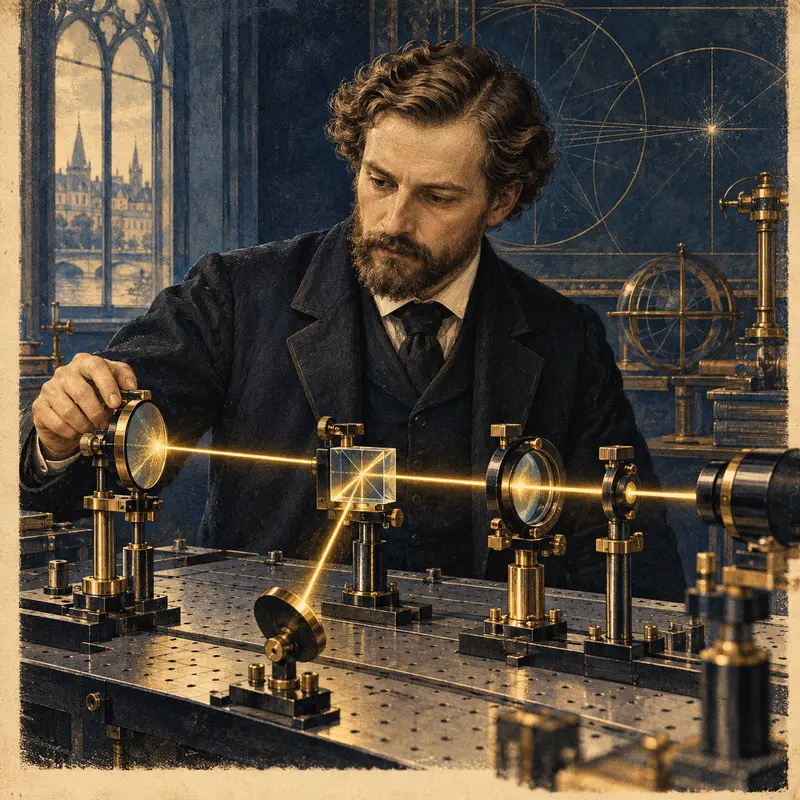
Hell's key contribution is STED, which uses a doughnut-shaped depletion laser to force fluorophores at the periphery of the focal spot back to the ground state, leaving only a tiny central region fluorescent. Earlier, he developed 4Pi microscopy, which sharpens resolution along the optical axis. He has also introduced a broader concept, RESOLFT (reversible saturable optical fluorescence transitions), in which any molecule with two distinct states can be used to improve resolution, not only through stimulated emission. In 2016-2017 his group published MINFLUX, which combines a doughnut-shaped excitation with single-molecule localisation to reach a precision of a few nanometres with very few photons. For the chemistry of STED, see our companion discovery post.
Awards, Honours and Nobel Prize
- Nobel Prize in Chemistry 2014, shared with Eric Betzig and William E. Moerner, "for the development of super-resolved fluorescence microscopy".
- Kavli Prize in Nanoscience (2014), shared with Thomas Ebbesen and Sir John Pendry.
- Gottfried Wilhelm Leibniz Prize (2008), Germany's most prestigious research prize.
- Head of the Department of NanoBiophotonics at the Max Planck Institute for Multidisciplinary Sciences in Göttingen and of a division at the German Cancer Research Center (DKFZ) in Heidelberg.
Personality, Struggles and Lesser-Known Facts
- A teenage migrant. He left Romania at 15 and rebuilt his life in Germany, an experience he cites as formative.
- Doubt from experts. The idea that the diffraction limit could be broken seemed strange to many established microscopists. He later said that finding support for the idea at first was difficult, and he moved to Finland where he could continue his work.
- Persistence. It took five years between his first theoretical paper (1994) and the experimental demonstration (1999).
- Clear thinker. He often explains that Abbe's limit applies to focusing light, not to what molecules can do, a simple but profound shift in view.
- Interest in technology transfer. His discoveries have led to commercial STED instruments, which are now used in laboratories worldwide.
Legacy and Influence on Modern Chemistry
STED and its descendants opened the nanoworld of the living cell to optical imaging. Biologists now routinely visualise structures such as synapses, mitochondria and chromatin at 20-50 nm. The idea of using molecular states, such as on and off, to separate features closer than the wavelength influenced the design of new dyes, proteins and imaging strategies in chemistry and biology. MINFLUX and related methods are pushing resolution to the molecular scale, near the size of a single protein. Hell's career shows that fundamental physical thinking can reshape applied fields like cell biology.
Lessons for Students
- Question accepted limits. Read the assumptions behind a law; Abbe's limit assumed a particular kind of focusing.
- Stay with an idea. Years passed between concept and demonstration, but the idea was sound.
- Cross disciplines. Physics of light and the chemistry of molecules met in STED.
- Do not fear starting at the margins. Great ideas often emerge outside the mainstream.
Quick Facts Box
- Born: 23 December 1962, Arad, Romania
- Died: Living (as of writing)
- Nationality: German (born in Romania)
- Field: Optical physics, nanoscopy, biophysical chemistry
- Famous for: STED, RESOLFT and MINFLUX microscopy
- Nobel: Chemistry 2014 (with Eric Betzig and William Moerner)
FAQ
Where did Stefan Hell study?
At the University of Heidelberg in Germany, where he earned his PhD in physics in 1990.
Why did he go to Finland?
He worked at the University of Turku in the mid-1990s, where he could develop the STED idea; it was there that his 1994 paper was written.
What is RESOLFT?
A general family of far-field methods that improve resolution by switching molecules between two states, extending the STED principle.
Is he still active in research?
Yes. He leads research groups at Max Planck institutes in Göttingen and Heidelberg.
Published by ABC Chemistry — IIT-JAM | CSIR-NET | GATE Chemistry Coaching. Visit abcchemistry.com
About the chemist
Stefan Hell
1962- · Germany · Nobel Chemistry 2014
STED super-resolution microscopy