Biography · Chemist no. 340 of 350
Stephanie Kwolek: The Woman Who Invented Kevlar
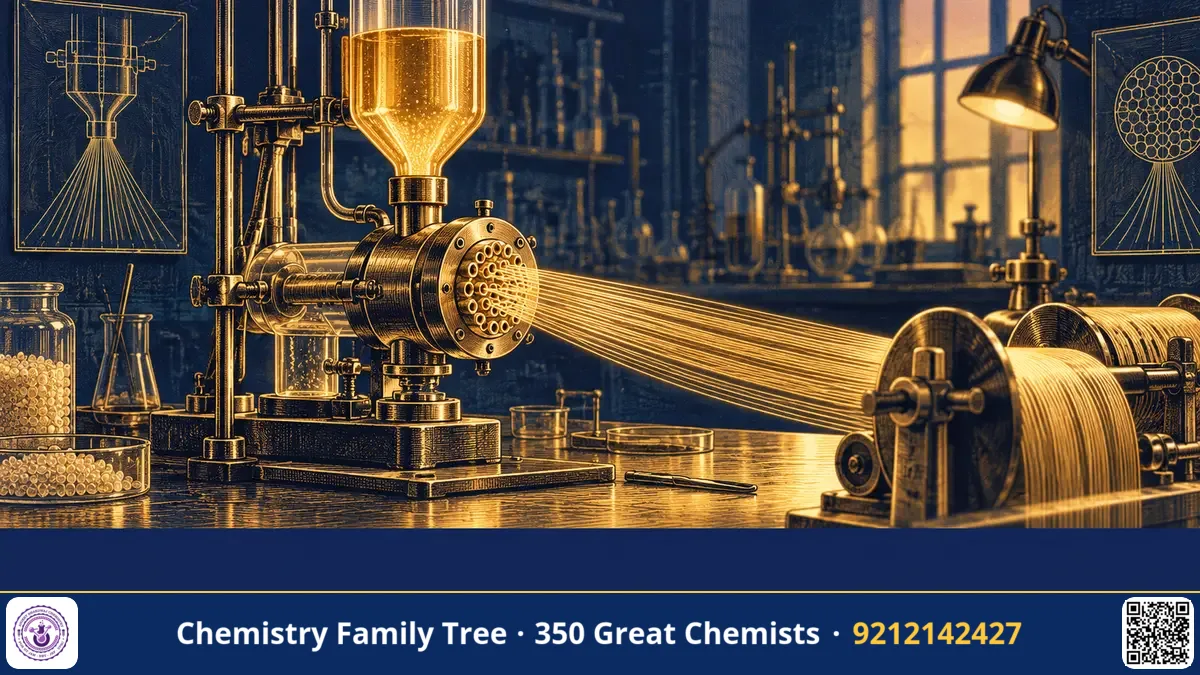
Stephanie Louise Kwolek (1923-2014) was an American polymer chemist who spent about forty years at DuPont. In 1965 she discovered the liquid-crystalline polymer solutions from which Kevlar fibre is spun. Her fibre has been credited with saving many lives, because it is the key material in bullet-resistant vests. Her one-line legacy: she looked closely at a strange cloudy solution when others would have thrown it away, and in doing so she created an entire family of high-performance materials. Her life is also a story of courage for women in science, at a time when few women were allowed to work as research chemists.
Early Life and Family
Kwolek was born on 31 July 1923 in New Kensington, Pennsylvania, near Pittsburgh. Her parents were Polish immigrants. Her father, John Kwolek, died when she was about ten years old. He was a naturalist at heart and spent his free time in the woods with his daughter, and she later recalled that he helped to awaken her love of science and observation. Her mother, Nellie, worked to support the family and encouraged her. As a child Stephanie also loved fashion and sewing, a combination of interests that, as she later reflected, prepared her well for a career with fibres and fabrics.
Education and Mentors
She studied chemistry at the Margaret Morrison Carnegie College for women in Pittsburgh, which is now part of Carnegie Mellon University, and graduated in 1946. Her original plan was to become a doctor, but she did not have the money for medical school. She took a job in chemistry planning to save for it. In 1946 she was hired by DuPont at its Buffalo laboratory, working with textile fibres. She enjoyed the research so much that she never left chemistry for medicine. At DuPont she worked under experienced polymer chemists and learned fibre technology and the chemistry of polyamides on the job rather than in a doctoral programme.
Career Timeline
| Year | Event |
|---|---|
| 1923 | Born in New Kensington, Pennsylvania |
| 1946 | Graduates in chemistry; joins DuPont in Buffalo, New York |
| 1950 | Moves with the group to the Pioneering Research Laboratory in Wilmington, Delaware |
| 1960s | Works on low-temperature polycondensation and aromatic polyamides |
| 1965 | Observes the liquid-crystalline polymer solution that leads to Kevlar |
| Early 1970s | Kevlar introduced commercially |
| 1986 | Retires from DuPont as a research associate, still working with the company as a consultant |
| 1995 | Inducted into the National Inventors Hall of Fame |
| 2014 | Dies in Wilmington, Delaware |
Major Scientific Contributions
- Low-temperature polycondensation: she developed methods to make polyamides in solution at low temperatures from diamines and diacid chlorides, which allowed her to prepare heat-sensitive and rigid polymers.
- Aramid fibres: she discovered that poly(p-phenylene terephthalamide) forms liquid-crystalline solutions that can be spun into extraordinarily strong fibres.
- Link to liquid-crystal polymers: her work showed practically how molecular alignment in solution gives alignment in the fibre.
- Related materials: she contributed to research on other aromatic polyamides, including meta-linked aramids known for heat resistance.
The core chemistry is the reaction of p-phenylenediamine with terephthaloyl chloride, giving amide links and HCl. The discovery post on this site explains the mechanism and the exam points in detail.
Awards, Honours and Nobel Prize
Kwolek did not win a Nobel Prize. She received many of the highest honours in industrial chemistry and invention, including:
- The National Medal of Technology (1996).
- Induction into the National Inventors Hall of Fame (1995), as only the fourth woman inducted at that time.
- The Perkin Medal of the Society of Chemical Industry, American Section (1997).
- Induction into the National Women's Hall of Fame (2003).
- The Lemelson-MIT Lifetime Achievement Award (1999).
Personality, Struggles and Lesser-Known Facts
- She nearly became a doctor. Chemistry was meant to be a stepping stone to earn tuition; she fell in love with research and stayed.
- A persuasive scientist. The technician responsible for the spinneret did not want to use the cloudy solution. Kwolek's persistence convinced him, and the result changed materials science.
- Few women in research. When she joined DuPont, women in industrial research were uncommon, and promotion was slow. She remained at the bench and became known as a careful, creative experimenter.
- Not rich from her invention. DuPont held the patents, as usual for employee inventions, and she did not become wealthy from Kevlar. She said she was proud of the lives it saved.
- Lifelong mentor. After retirement she encouraged young people, especially girls, to study science, and spoke at schools and events.
Legacy and Influence on Modern Chemistry
Kevlar was a breakthrough for high-performance fibres. It led directly to a generation of materials based on rigid-rod polymers and liquid-crystal processing. Researchers now design polymers for carbon-fibre precursors, flexible electronics and advanced composites using ideas of molecular alignment that her work clarified. Body armour made with aramid fibres has been used by police and armed forces around the world. Kevlar is also found in everyday products such as bicycle tyres, ropes and smartphone cases. Her story is regularly used in school and university teaching to show how observation of an unusual physical property can lead to new technology.
Lessons for Students
- Do not discard the odd result. A cloudy, thin solution was the clue to a great discovery.
- Advocate for your experiment. Kwolek had to convince a colleague to test her sample.
- Be flexible in career planning. Chemistry was a temporary job for her, and it became her life's work.
- Link structure to property. Rigid chain plus hydrogen bonds gives strength; this is a typical exam principle.
- Stay curious for decades. She kept working for a long time after her best-known discovery.
Quick Facts Box
- Born: 31 July 1923, New Kensington, Pennsylvania, USA
- Died: 18 June 2014, Wilmington, Delaware, USA
- Nationality: American
- Field: Polymer chemistry
- Famous for: Discovery of Kevlar (aramid fibre) liquid-crystal spinning
- Nobel Prize: None; National Medal of Technology 1996
FAQ
Did Stephanie Kwolek have a PhD?
No. She held a bachelor's degree in chemistry and gained her expertise through her research work at DuPont, which shows that great science can come from practical experience.
When was Kevlar discovered?
The key observation was in 1965, and Kevlar was introduced commercially in the early 1970s.
Did she win a Nobel Prize?
No, but she received the National Medal of Technology and many other honours.
Why is her work important for exams?
It is a common example of condensation polymers, polyamides, hydrogen bonding and liquid-crystalline behaviour in polymer chemistry papers.
Published by ABC Chemistry — IIT-JAM | CSIR-NET | GATE Chemistry Coaching. Visit abcchemistry.com

About the chemist
Stephanie Kwolek
1923-2014 · United States
Invented Kevlar aramid fibre