The discovery, explained · Chemist no. 340 of 350
Stephanie Kwolek and the Discovery of Kevlar
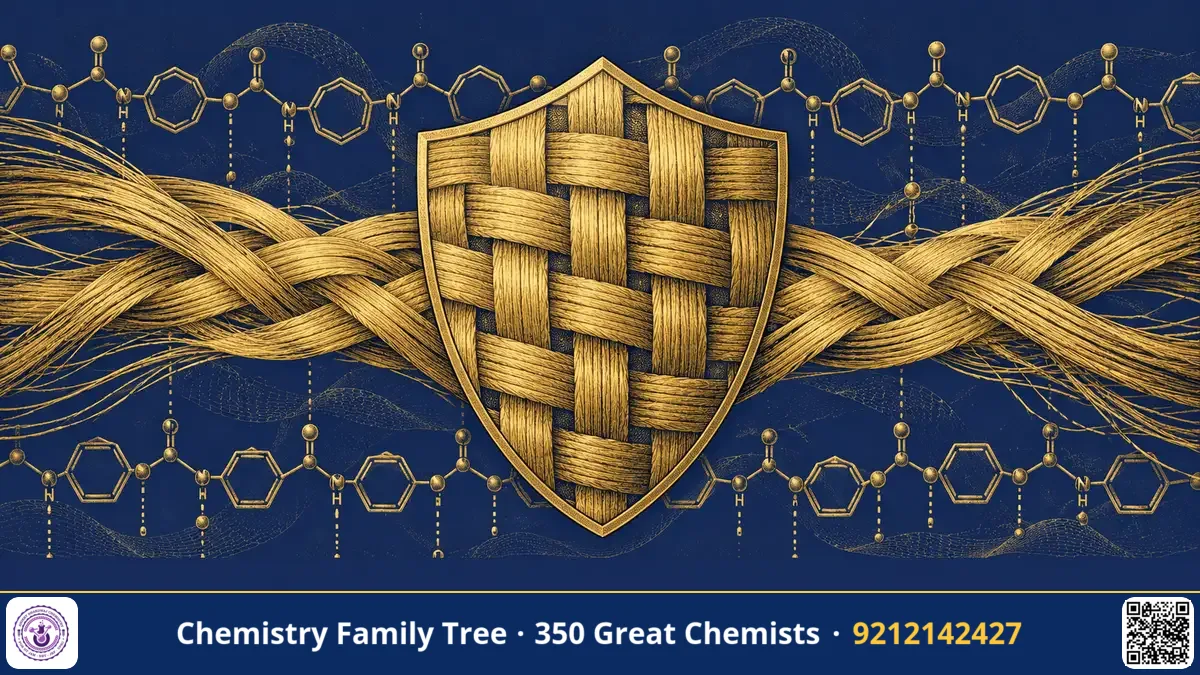
Kevlar is a fibre that is five times stronger than steel on an equal-weight basis, yet light enough to be worn as a jacket. It protects police officers, soldiers and motorcyclists, and it is used in tyres, ropes, aircraft parts and sports gear. It was discovered in 1965 by Stephanie Kwolek, a DuPont chemist who noticed that a cloudy, runny solution was not a failure but a clue. Her insight about liquid-crystalline polymer solutions produced a new class of materials, the aromatic polyamides or aramids. This article explains what she found, why the chemistry works, and how to answer questions on it in JAM, NET, GATE and board exams.
The Scientific Problem Before the Discovery
By the 1960s nylon, the first fully synthetic fibre, was well known. Nylon-6,6 is an aliphatic polyamide made from hexamethylenediamine and adipic acid. It was strong, but not strong or stiff enough for some jobs. There was also an anticipated shortage of petroleum in the early 1960s, and DuPont wanted a lightweight, strong fibre that could reinforce car tyres, so that tyres could be made lighter and more fuel-efficient.
Chemists knew that stiff, rod-like polymer chains that line up in parallel should give very strong fibres. Aromatic rings in the backbone make chains stiff, unlike the floppy chains of aliphatic polymers. But rigid aromatic polyamides are very difficult to dissolve and to process. The challenge was to find a polymer that was stiff and well aligned and could still be spun into fibre.
The Discovery: Step by Step
- Choice of monomers. Kwolek's team worked on polyamides made from aromatic monomers, in particular p-phenylenediamine and terephthaloyl chloride.
- Polymerisation in solvent. The condensation (polycondensation) was run at low temperature in a solvent mixture. The polymer formed was poly(p-phenylene terephthalamide), PPTA.
- The unusual solution. Most polymer solutions are thick, clear and syrupy. This one was thin, opalescent and cloudy, and it could be stirred easily. Normally such a solution would have been discarded.
- The spinning request. Kwolek asked the technician in charge of the spinneret (a device that extrudes solutions into fibres) to spin it. He was reluctant, believing the cloudy material might contain solid particles that would clog the spinneret. After she persuaded him, the solution spun smoothly.
- The result. The fibre was unusually stiff and strong. Testing confirmed that it was far stronger than nylon and glass fibre. Later work led to the product Kevlar, launched commercially in the early 1970s.
n H₂N–C₆H₄–NH₂ + n ClCO–C₆H₄–COCl
   →  –[NH–C₆H₄–NH–CO–C₆H₄–CO]ₙ–  +  2n HCl
The Chemistry Behind It
Condensation polymerisation
Kevlar is a condensation polymer. A diamine reacts with a diacid chloride, forming an amide bond (–CONH–) and eliminating HCl each time. Acid chlorides react much faster than carboxylic acids, so the reaction proceeds at low temperature. Compare this with nylon-6,6, which uses a diamine and a diacid at high temperature.
Why the cloudy solution?
The rigid rod-like PPTA molecules, when dissolved in concentrated sulphuric acid (the solvent used for spinning), do not tumble randomly. At high enough concentration, they line up in domains with a common direction. This is a lyotropic liquid crystal, an ordered phase formed by the effect of concentration on a solution. The ordered domains scatter light, giving the cloudy, opalescent look and lowering viscosity.
Why is the fibre so strong?
- The rigid para-linked benzene rings keep the chain stretched out straight.
- When the liquid-crystal solution is spun, the chains are already aligned and are further oriented by flow, so the fibre has almost perfect alignment along its axis.
- The amide groups form strong hydrogen bonds (N–H···O=C) between neighbouring chains, in sheets.
- Aromatic rings stack by π–π interactions, adding further cohesion.
- Because the force required to break the fibre is shared by the strong covalent bonds along the chain, the fibre has very high tensile strength.
| Feature | Nylon-6,6 | Kevlar (PPTA) |
|---|---|---|
| Monomers | Hexamethylenediamine + adipic acid | p-Phenylenediamine + terephthaloyl chloride |
| Backbone | Aliphatic, flexible | Aromatic, rigid |
| Type | Polyamide | Aromatic polyamide (aramid) |
| Strength | Good | Very high |
Applications Today
- Body armour and helmets: woven Kevlar layers absorb and spread the impact energy of bullets and fragments.
- Tyres and belts: Kevlar cord reinforces tyres and industrial belts.
- Ropes and cables: mooring lines and optical-fibre cable reinforcement.
- Aerospace and sport: composite panels, brake pads, sailcloth, protective gloves and boots.
- Fire protection: firefighters' clothing, because the fibre does not melt but decomposes at very high temperature.
Security forces and sports-gear makers in India use aramid-based protective equipment.
Exam Corner
- Kevlar is poly(p-phenylene terephthalamide), an aramid made by condensation of p-phenylenediamine and terephthaloyl chloride (or terephthalic acid).
- By-product of the acid-chloride route is HCl; for the acid route, it is H₂O.
- High strength comes from rigid chains, alignment and interchain hydrogen bonds.
- Lyotropic liquid crystals depend on solvent concentration; thermotropic ones depend on temperature.
- Distinguish Kevlar (para, strong and stiff) from Nomex (meta-linked aramid, mainly heat resistant).
Common Misconceptions
- "Kevlar is a type of metal or glass." No, it is an organic synthetic polymer.
- "Bulletproof means nothing can penetrate it." Armour is bullet-resistant; performance depends on the threat level and the number of layers.
- "It is made from nylon." Kevlar is a different polyamide that has aromatic rings in the main chain.
Quick Revision Box
- Discovered by Stephanie Kwolek at DuPont in 1965.
- Polymer: poly(p-phenylene terephthalamide), an aramid.
- Monomers: p-phenylenediamine and terephthaloyl chloride; byproduct HCl.
- Spun from a liquid-crystalline solution in sulphuric acid.
- Strength from rigid chains and N–H···O hydrogen bonding.
- Uses: body armour, tyres, ropes, aerospace.
FAQ
What is the chemical name of Kevlar?
Poly(p-phenylene terephthalamide), often abbreviated PPTA.
Is Kevlar addition or condensation polymer?
It is a condensation polymer, formed with the loss of HCl (or water) when amide bonds form.
Why is Kevlar spun from sulphuric acid?
The rigid polymer does not dissolve in ordinary solvents, but dissolves in concentrated sulphuric acid, forming the liquid-crystalline solution needed for spinning aligned fibres.
What is the difference between Kevlar and nylon?
Nylon has flexible aliphatic chains, while Kevlar has rigid aromatic rings in the chain and strong hydrogen-bonded sheets, so Kevlar is much stronger and stiffer.
Published by ABC Chemistry — IIT-JAM | CSIR-NET | GATE Chemistry Coaching. Visit abcchemistry.com

About the chemist
Stephanie Kwolek
1923-2014 · United States
Invented Kevlar aramid fibre