Biography · Chemist no. 228 of 350
Susumu Kitagawa: The Kyoto Chemist Who Taught Crystals to Breathe
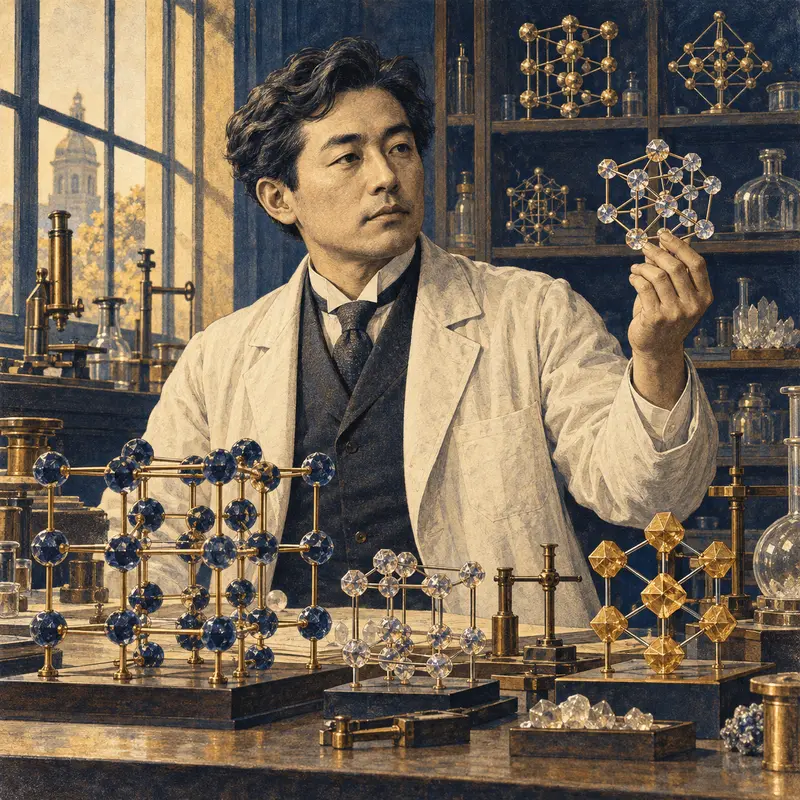
Susumu Kitagawa, born in 1951 in Kyoto, Japan, is a professor at Kyoto University and a pioneer of metal-organic frameworks, which he calls porous coordination polymers. He showed that such frameworks can hold gases reversibly and developed the concept of "soft porous crystals" that respond to their guests. In 2025 he shared the Nobel Prize in Chemistry with Richard Robson and Omar Yaghi. His legacy in one line: he turned coordination chemistry into a science of useful empty space.
Early Life and Family
Kitagawa was born on 4 July 1951 in Kyoto, the old imperial capital of Japan and a city with a strong tradition of both arts and science. Kyoto University has produced multiple Nobel laureates, and the atmosphere of academic freedom in the city is often credited as an influence on Japanese scientists. Detailed accounts of his childhood and family are limited in public sources, so this post does not elaborate further.
Education and Mentors
Kitagawa studied at Kyoto University and graduated in 1974 with a degree in hydrocarbon chemistry. He continued with graduate study there and received his doctorate in 1979. His doctoral training was in the Department of Hydrocarbon Chemistry, a part of the engineering faculty, and it gave him a foundation in organic and inorganic chemistry and in the study of metal complexes.
Career Timeline
| Year | Event |
|---|---|
| 1951 | Born in Kyoto, Japan |
| 1974 | Graduates from Kyoto University |
| 1979 | Doctorate from Kyoto University; joins Kindai University |
| 1979-1992 | Faculty member at Kindai University, Osaka |
| 1997 | Reports gas adsorption in a porous coordination polymer |
| 1992 | Moves to Tokyo Metropolitan University |
| 1998 | Returns to Kyoto University as professor |
| 2007 | Takes a leading role at the Institute for Integrated Cell-Material Sciences (iCeMS), Kyoto University |
| 2025 | Nobel Prize in Chemistry (shared) |
Major Scientific Contributions
Permanent porosity of coordination polymers (1997). Kitagawa and colleagues demonstrated reversible adsorption of methane, nitrogen and oxygen by a three-dimensional coordination polymer. See our discovery post for the experiment.
Soft porous crystals. He introduced and developed the idea that crystalline porous solids can be flexible, with breathing and gate-opening responses to guests. This distinguishes MOFs from rigid zeolites and has become an important design principle.
Functional pores. His group made frameworks with pores that adsorb specific molecules, for example for selective separation of gases, and demonstrated safe storage of acetylene. He also explored conducting MOFs, proton-conducting materials and frameworks hosting catalysts.
Integration of chemistry and cell science. At iCeMS, he led collaboration between chemists, materials scientists and cell biologists, exploring how porous materials can be used in controlling molecules in biological systems.
Building a community. Through reviews, lectures and collaborations he helped unite researchers from coordination chemistry, materials science and engineering into a single MOF community.
Awards, Honours and Nobel Prize
The Nobel Prize in Chemistry 2025 was awarded jointly to Susumu Kitagawa, Richard Robson and Omar M. Yaghi "for the development of metal-organic frameworks". Only the Nobel Prize is listed here, because other award details could not be checked with certainty.
Personality, Struggles and Lesser-Known Facts
- Empty space as a feature. His work rests on the idea that the empty space inside a crystal can be as valuable as the atoms around it.
- Working outside the main trend. In the 1990s, coordination polymers were seen by many as curiosities; he persevered and developed them for decades.
- Kyoto tradition. He joins a line of Kyoto University scientists who won Nobel Prizes, such as Hideki Yukawa (Physics, 1949) and Kenichi Fukui (Chemistry, 1981).
- Collaboration, not competition. His story with Robson and Yaghi is one of complementary contributions: design (Robson), robust frameworks and reticular chemistry (Yaghi), and permanent porosity and flexibility (Kitagawa).
- Interdisciplinary leadership. He led an institute designed to blend chemistry and biology, which is unusual for a coordination chemist.
Legacy and Influence on Modern Chemistry
Tens of thousands of MOF structures have been reported, and the field has grown to thousands of laboratories. Kitagawa's contribution was to show that the empty space inside a crystal is controllable and useful, and that frameworks can be dynamic. The flexible MOF concept now guides materials designed for selective gas separation, sensing and drug delivery. Pilot plants and companies are bringing MOFs to carbon capture, gas storage and industrial separations. For India, which faces air pollution and energy challenges, MOF research offers practical routes to cleaner technology.
Lessons for Students
- Think about empty space. What is not there can be as important as what is.
- Stay with an unfashionable idea. Years of patient work turned curiosity into a field.
- Prove your claims. The adsorption measurements made the difference between a hole on paper and a real pore.
- Link disciplines. Chemistry and biology meet in his institute.
- Share credit. Great fields are built by many hands.
Quick Facts Box
- Born: 4 July 1951, Kyoto, Japan
- Died: Living
- Nationality: Japanese
- Field: Coordination chemistry, materials chemistry
- Famous for: Porous coordination polymers, soft porous crystals
- Nobel: Chemistry 2025, shared with Robson and Yaghi
FAQ
Where does Susumu Kitagawa work?
He is a distinguished professor at Kyoto University, Japan, associated with its institute for integrated cell-material sciences.
What is a soft porous crystal?
It is a crystalline porous solid whose framework can change shape reversibly in response to guest molecules, heat or pressure.
How are the three 2025 laureates related?
Robson proposed the design concept in 1989, Kitagawa and Yaghi demonstrated stable, porous frameworks in the late 1990s, and Yaghi developed robust MOFs and reticular chemistry.
Which exam topics connect to MOFs?
Coordination compounds, crystal field theory, adsorption isotherms, surface area and supramolecular chemistry.
Published by ABC Chemistry — IIT-JAM | CSIR-NET | GATE Chemistry Coaching. Visit abcchemistry.com
About the chemist
Susumu Kitagawa
1951- · Japan · Nobel Chemistry 2025
Metal-organic frameworks