The discovery, explained · Chemist no. 228 of 350
Porous Coordination Polymers: How Susumu Kitagawa Showed That Crystals Can Hold and Release Gas
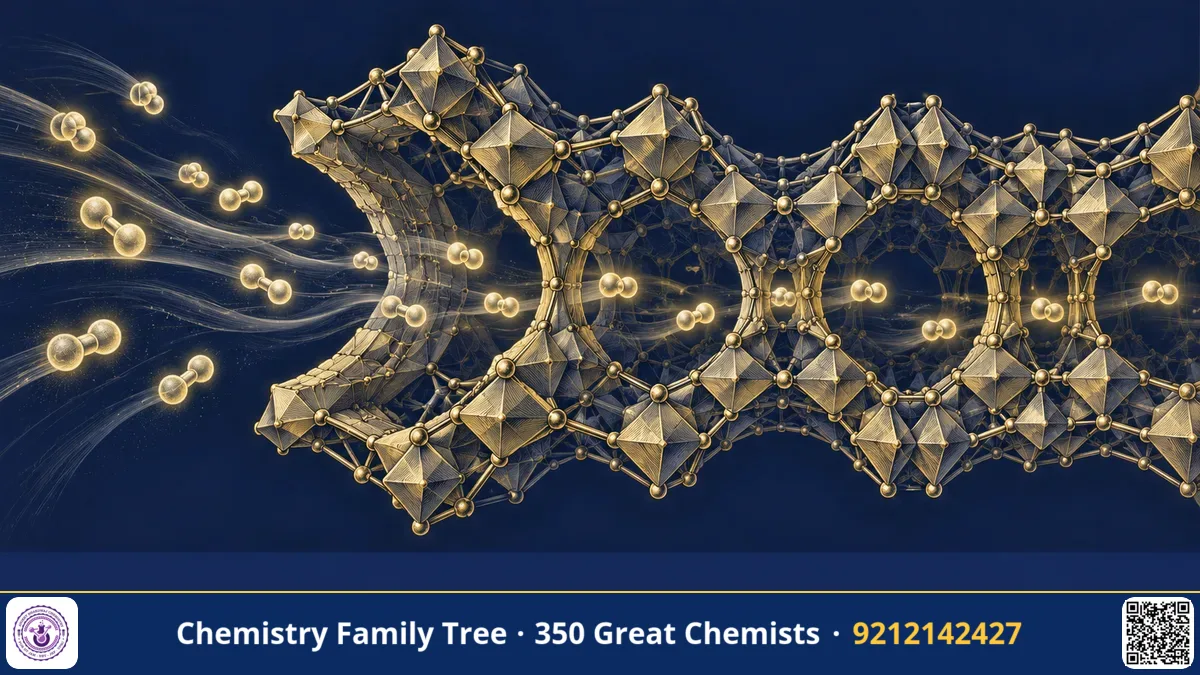
A crystal is usually thought of as a hard, solid block. But in the 1990s, the Japanese chemist Susumu Kitagawa made crystals that are mostly empty space, with tunnels so regular that gas molecules such as methane, nitrogen and oxygen can enter, stay and leave again, while the framework remains intact. He also showed that some of these crystals are soft and flexible, "breathing" as guest molecules come and go. These materials are now known as metal-organic frameworks (MOFs) or porous coordination polymers (PCPs). In 2025 Kitagawa, Richard Robson and Omar Yaghi shared the Nobel Prize in Chemistry "for the development of metal-organic frameworks".
This post explains Kitagawa's key experiments, the chemistry of coordination polymers, and the properties that matter for exams.
The Scientific Problem Before the Discovery
Porous solids were known, but mostly of two types: zeolites (aluminosilicates, rigid and inorganic, used as molecular sieves and catalysts) and activated carbons (disordered, with a wide range of pore sizes). Zeolites have regular pores but limited variety and limited tunability. Carbons have large surface areas but random pores.
Coordination chemistry offered a different path. When metal ions (nodes) and organic molecules with several donor atoms (linkers) are combined, they can form extended networks, known as coordination polymers, in one, two or three dimensions. Chemists such as Robson (1989) had shown that such networks could be designed. But there was a major question: when the solvent molecules are removed from the pores, does the framework collapse? Most early coordination polymers did. Without proof that the empty framework was stable and could take up gas, the pores were "paper holes". The field needed a demonstration of permanent porosity.
The Discovery / Experiment
Kitagawa, working at Kindai University in Osaka in the 1990s, and then at Tokyo Metropolitan University and Kyoto University, studied coordination polymers built from transition-metal ions and simple linkers such as 4,4'-bipyridine (bpy). His key experiment, published in 1997 in Angewandte Chemie with Kondo, Matsuzaka and others, can be summarised as:
- Mix a metal salt (for example of Co, Ni or Zn) with 4,4'-bipyridine in solution and crystallise a three-dimensional framework with channels filled with water or solvent.
- Heat gently under vacuum to remove the guest solvent molecules, and check by X-ray powder diffraction that the framework retains its structure.
- Measure how much gas the material adsorbs at different pressures: methane, nitrogen and oxygen at room temperature or low temperature.
- Plot the amount adsorbed against pressure (an adsorption isotherm) and show that it is reversible and reproducible.
The result was the first clear demonstration that a coordination polymer can have permanent porosity, adsorb gases reversibly and keep its crystalline structure on removal of the solvent. This showed that coordination frameworks could compete with zeolites in gas storage.
Kitagawa then went further and developed the concept of soft porous crystals in which the framework is flexible. Several types of response were discovered:
- Breathing: the framework expands or contracts as guest molecules enter or leave.
- Gate-opening: the framework remains closed until the gas pressure passes a threshold, and then opens abruptly; the isotherm has a step shape.
- Interpenetration and sliding: multiple networks can slide relative to each other.
The Chemistry Behind It
Coordination bonds. The bonds between metal and linker are dative covalent bonds: the donor atom of the linker (such as the N lone pair of pyridine, or the O of a carboxylate) donates an electron pair to the metal ion's empty orbitals. These bonds are directional and typically weaker than C-C covalent bonds, but strong enough to build a framework. This relative weakness gives flexibility, and is also the reason why the framework can reorganise.
Geometry from coordination numbers. A metal ion with octahedral geometry (coordination number six) such as Co(II) or Ni(II) can link up to six linkers; tetrahedral Zn(II) links four. The shape of the node and the length of the linker decide the topology (net) and pore size.
| Material class | Pore regularity | Tunability | Flexibility |
|---|---|---|---|
| Zeolite | High | Limited | Rigid |
| Activated carbon | Low | Limited | Rigid |
| MOF / PCP | High | Very high | Can be soft |
Adsorption. Gas molecules adhere to pore walls by physisorption (van der Waals forces), which is reversible. Isotherms are classified by the IUPAC scheme: Type I is characteristic of microporous solids, with a steep rise at low pressure and a plateau (Langmuir-like). Flexible frameworks show stepped isotherms because the structure changes with loading. Surface area is estimated by the BET method.
Kitagawa also introduced the idea of creating pores of tailored chemistry, for example pores that selectively adsorb CO2 over N2 or that hold acetylene safely in a stable state, a gas that is dangerous to compress as such.
Applications Today
- Gas storage and safe handling. Storing hydrogen, methane or acetylene at lower pressure; MOFs have been made that store toxic gases used in semiconductor manufacturing.
- Carbon capture. Selective adsorption of CO2 from flue gas or air, an area of high interest in India's climate efforts.
- Separation. Separation of hydrocarbons, such as ethylene and ethane, with much lower energy demand than distillation.
- Sensing and catalysis. Pores can host catalytic sites or react with analytes to give a signal.
- Drug delivery and water harvesting are further directions explored by various groups.
Exam Corner
- MOFs are crystalline porous materials made from metal ions or clusters (nodes) and organic linkers.
- Coordination bond: dative bond from ligand lone pair to metal; ligand field theory applies.
- Physisorption: weak van der Waals forces, reversible; chemisorption: chemical bonding, usually irreversible.
- Type I isotherm: microporous materials; BET method estimates surface area.
- 2025 Nobel Prize in Chemistry: Kitagawa, Robson, Yaghi.
Common Misconceptions
- "MOFs are just zeolites with organic parts." They have organic-inorganic hybrid structures with far greater chemical variety and flexibility.
- "All MOFs are rigid." Kitagawa's soft porous crystals respond to guests.
- "Porosity means holes are visible." Pores are of molecular size, often 0.3 to 3 nm.
Quick Revision Box
- 1997: Kitagawa and co-workers show gas adsorption in a 3D coordination polymer framework.
- Building units: metal ions and linkers such as 4,4'-bipyridine.
- Key concept: soft porous crystals with breathing and gate-opening.
- Adsorption by physisorption; stepped isotherms for flexible MOFs.
- Uses: gas storage, carbon capture, separations.
- Nobel Prize in Chemistry 2025 (shared with Robson and Yaghi).
FAQ
What is a coordination polymer?
It is an extended structure formed by repeating metal centres linked through coordinate bonds by bridging ligands.
Is a MOF the same as a PCP?
The terms overlap strongly. PCP is the term favoured by Kitagawa and Japanese researchers, and MOF is the term popularised by Yaghi.
What does gate-opening mean?
It is a sudden structural opening of a flexible framework at a certain gas pressure, producing a step in the adsorption isotherm.
Why do MOFs matter for India?
They offer ways to capture CO2, store clean fuels and provide cleaner separations, all linked to national energy and climate goals; many Indian laboratories research them.
Published by ABC Chemistry — IIT-JAM | CSIR-NET | GATE Chemistry Coaching. Visit abcchemistry.com

About the chemist
Susumu Kitagawa
1951- · Japan · Nobel Chemistry 2025
Metal-organic frameworks