Biography · Chemist no. 15 of 350
Svante Arrhenius: The Swedish Chemist Who Saw Ions Where Others Saw Doubt
Svante August Arrhenius (1859–1927) was a Swedish scientist whose ideas touched chemistry, physics, biology and the study of climate. He is best remembered for the theory of electrolytic dissociation, which won him the 1903 Nobel Prize in Chemistry, for the Arrhenius equation of reaction kinetics, and for his definition of acids and bases. His legacy: he showed that bold ideas can survive a poor reception if experiments back them.
Early Life and Family
Arrhenius was born on 19 February 1859 at Vik (also written Wik), near Uppsala in Sweden. His father, Svante Gustav Arrhenius, worked as a land surveyor and later as a supervisor for Uppsala University. The family moved to Uppsala soon after his birth. Biographies agree that the boy was a quick learner and could do arithmetic at a very young age, helped by watching his father's account books.
He later married twice. His first wife was Sofia Rudbeck, a former student and assistant, in 1894; they had a son, Olof, but the marriage was brief. In 1905 he married Maria Johansson, and they had children together.
Education and Mentors
Arrhenius studied at the cathedral school in Uppsala and entered Uppsala University in 1876 to study physics, chemistry and mathematics. Finding little support there for his interest in electrolytes, he moved to Stockholm and worked with Erik Edlund at the Physical Institute of the Swedish Academy of Sciences. In 1884 he submitted his doctoral thesis on the conductivity of electrolytes. The examiners were not convinced of its central idea and gave it a low pass.
He sent copies to leading scientists abroad. Wilhelm Ostwald in Riga travelled to Uppsala to meet him, and offered him a position. With a travel grant from the Swedish Academy, Arrhenius then worked in several leading laboratories during 1886–1890:
- Riga, with Wilhelm Ostwald.
- Würzburg, with Friedrich Kohlrausch.
- Graz, with Ludwig Boltzmann.
- Amsterdam, with Jacobus van 't Hoff.
Career Timeline
| Year | Event |
|---|---|
| 1859 | Born near Uppsala on 19 February |
| 1884 | Presents doctoral thesis on electrolytic conductivity |
| 1887 | Publishes the theory of electrolytic dissociation and the definition of acids and bases |
| 1886–1890 | Works with Ostwald, Kohlrausch, Boltzmann and van 't Hoff |
| 1889 | Proposes the Arrhenius equation for the temperature dependence of rate |
| 1891 | Lecturer at Stockholm University College (Högskola) |
| 1895 | Becomes professor of physics at Stockholm |
| 1896 | Publishes calculations on carbon dioxide and surface temperature |
| 1897 | Becomes rector of the Stockholm Högskola |
| 1903 | Awarded the Nobel Prize in Chemistry |
| 1905 | Becomes director of the Nobel Institute for Physical Chemistry |
| 1927 | Dies in Stockholm on 2 October |
Major Scientific Contributions
- Electrolytic dissociation. Electrolytes split into ions in solution. This explained conductivity and the abnormal colligative properties noted by van 't Hoff, linked by the factor i = 1 + α(n − 1).
- Acid–base definition. Acids give H⁺ in water; bases give OH⁻.
- Arrhenius equation.
k = A e−Ea/RTbrought in the idea of activation energy. - Greenhouse effect. In 1896 he estimated how much atmospheric CO₂ would warm the Earth. His calculation, done by hand, suggested that doubling CO₂ could raise temperature by several degrees Celsius.
- Immunochemistry. In the 1900s he applied physical chemistry to toxins and antitoxins, writing a book on the subject in 1907.
You can read the details of the first three in our discovery post on Arrhenius's theory.
Awards, Honours and Nobel Prize
The Royal Swedish Academy of Sciences awarded him the Nobel Prize in Chemistry in 1903 "in recognition of the extraordinary services he has rendered to the advancement of chemistry by his electrolytic theory of dissociation". He was the first Swede to win a Nobel Prize in Chemistry. He also received the Davy Medal of the Royal Society in 1902 and the Willard Gibbs Award in 1911, and he held honorary degrees and memberships in many academies. A crater on the Moon and a crater on Mars carry his name.
Personality, Struggles and Lesser-Known Facts
- A hard start. His thesis was judged poorly by the Uppsala examiners, and this delayed his chance of an academic post at home. Support from foreign scientists changed his career.
- Strong views, sometimes controversial. Arrhenius was outspoken. In the Nobel committees he took a strong interest in the awards, and some historians note that he used his influence to support colleagues in physical chemistry and sometimes to oppose rivals such as Walther Nernst. Like many scientists of his time, he also took part in the racial hygiene movement in Sweden, a view we now reject.
- Looking beyond Earth. He wrote popular books such as Worlds in the Making (1908) and supported the idea of panspermia, that life spreads through space as spores. This idea is not accepted as established science.
- A warmer world, welcomed. He thought that burning coal and warming the climate might be beneficial, as it could improve crop growth in cold regions. Today we know the risks are much more serious.
- Popular science writer. He wrote clearly for the general public, and this helped to make chemistry and physics more visible in Sweden.
Legacy and Influence on Modern Chemistry
Arrhenius, Ostwald and van 't Hoff are often called the founders of physical chemistry. His theory of ions led directly to our understanding of pH, buffers, conductometric titrations and electrochemistry. His rate equation is used in every kinetics course, from the Class 12 chapter on chemical kinetics to GATE numerical questions. His climate calculation of 1896 is now seen as a pioneering paper, and the Nobel Institute he directed became a centre for research in physical chemistry.
Lessons for Students
- Do not give up when examiners are not convinced. Present evidence, and seek out people who can see its value.
- Link ideas from different areas: Arrhenius joined conductivity data with colligative properties.
- Learn to make estimates. His climate calculation shows how reasoning with simple data can lead to powerful conclusions.
- Accept corrections. Debye and Hückel later refined his theory for strong electrolytes, and that is how science grows.
Quick Facts Box
- Born: 19 February 1859, Vik, near Uppsala, Sweden
- Died: 2 October 1927, Stockholm, Sweden
- Nationality: Swedish
- Field: Physical chemistry
- Famous for: Theory of electrolytic dissociation, Arrhenius equation, Arrhenius acid–base concept
- Nobel: Chemistry, 1903
FAQ
Why did Arrhenius win the Nobel Prize in Chemistry although he trained as a physicist?
His theory of electrolytic dissociation was a major advance for chemistry, and physical chemistry sits between the two sciences.
Who were Arrhenius's closest scientific friends?
Wilhelm Ostwald and Jacobus van 't Hoff, who helped spread his ideas. Together they developed the new field of physical chemistry.
Did Arrhenius work on global warming?
Yes. In 1896 he published calculations on how changes in atmospheric carbon dioxide would affect the temperature of the Earth's surface.
Where did he live and work?
He was born near Uppsala and spent most of his working life in Stockholm, with study periods in Riga, Würzburg, Graz and Amsterdam.
Published by ABC Chemistry — IIT-JAM | CSIR-NET | GATE Chemistry Coaching. Visit abcchemistry.com
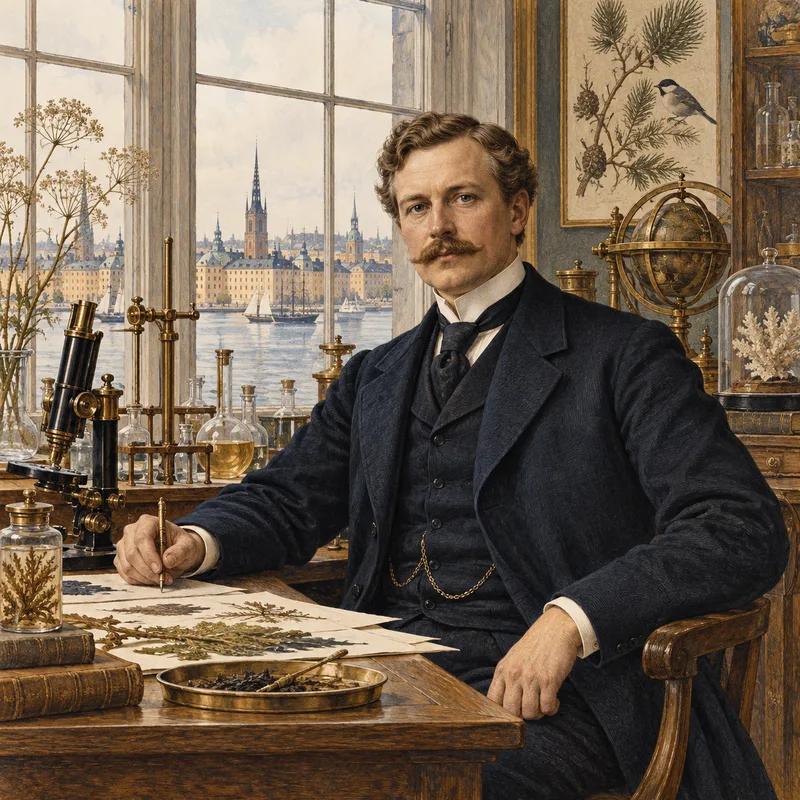
About the chemist
Svante Arrhenius
1859-1927 · Sweden · Nobel Chemistry 1903
Electrolytic dissociation; Arrhenius equation