The discovery, explained · Chemist no. 15 of 350
Svante Arrhenius: Ions in Water and the Equation Behind Reaction Rates
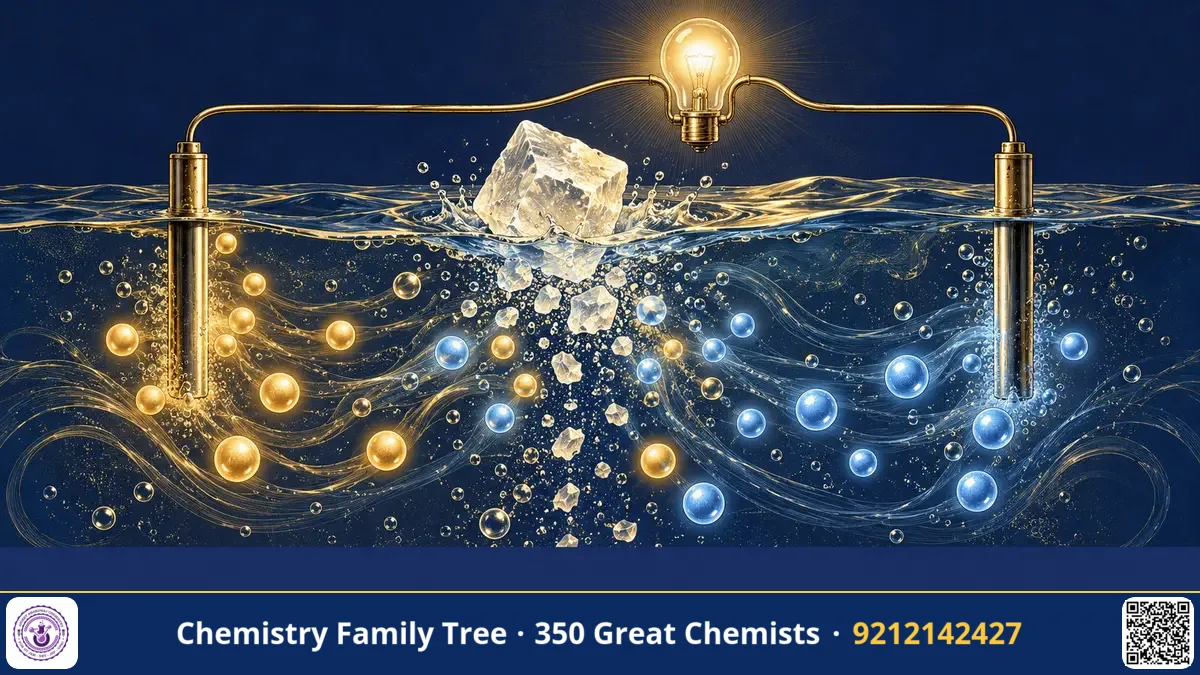
Salt dissolves in water and the solution conducts electricity. Pure sugar dissolves and does not. Why? In 1884 a young Swedish student, Svante Arrhenius, answered with a bold idea: when electrolytes dissolve, they split into charged particles called ions, even without any current passing. This theory of electrolytic dissociation became a pillar of physical chemistry, earned him the 1903 Nobel Prize in Chemistry, and led to two more tools you will use throughout your studies: the Arrhenius definition of acids and bases, and the Arrhenius equation for the rate constant.
The Scientific Problem Before the Discovery
Michael Faraday had explained that electrolysis happens when current flows through a solution, and he used the word "ions" for the particles that move. But most scientists believed that the current itself tore the compound apart. Rudolf Clausius had earlier suggested that a tiny fraction might be split spontaneously, but the matter was unsettled.
Two experimental puzzles stood out:
- Conductivity. Friedrich Kohlrausch had measured the conductivity of solutions carefully, and found that the molar conductivity increased as solutions were diluted. Why would a weaker solution conduct better per mole?
- Abnormal colligative properties. Jacobus van 't Hoff and François-Marie Raoult found that salts, acids and bases lowered freezing point and raised osmotic pressure by more than the formula for a single particle predicted. NaCl behaved as if there were nearly two particles per formula unit.
No one had connected these two sets of facts.
The Discovery: Ionic Dissociation
Arrhenius studied at Uppsala and measured the conductivity of very dilute solutions. In his doctoral thesis of 1884 he proposed that an electrolyte in water exists in two states: undissociated molecules (inactive) and ions (active). Only the ions carry current. On dilution, a greater fraction dissociates, so the molar conductivity rises and approaches a maximum at infinite dilution.
He defined a degree of dissociation, α, as the ratio of molar conductivity at a given concentration to the limiting value:
α = Λm / Λ°m
He then connected this to the van 't Hoff factor, i, which counts how many particles result per formula unit:
i = 1 + α(n − 1), where n is the number of ions formed by one formula unit.
For NaCl (n = 2) with α near 1, i is close to 2, which explained the abnormal freezing point depression. The thesis was received with doubt by his professors at Uppsala, who gave it a low pass grade. But Wilhelm Ostwald in Riga and van 't Hoff in Amsterdam recognised its value, and Arrhenius worked in their laboratories. Their support brought the idea into mainstream science. The 1903 Nobel Prize for it made Arrhenius the first Swedish winner in chemistry.
The Chemistry Behind It
Dissociation. For a weak acid such as acetic acid, the equilibrium is:
CH₃COOH ⇌ CH₃COO⁻ + H⁺
Ostwald's dilution law, built on the Arrhenius idea, gives Ka = cα² / (1 − α), which for small α becomes α ≈ √(Ka/c). So α rises as concentration falls, as Kohlrausch had seen.
Acids and bases. In 1887 Arrhenius defined an acid as a substance that gives H⁺ ions in water, and a base as one that gives OH⁻ ions. Neutralisation is therefore:
H⁺ + OH⁻ → H₂O (ΔH ≈ −57.3 kJ/mol for strong acid with strong base)
This explains why the heat of neutralisation is nearly constant for all strong acid–strong base pairs.
The Arrhenius equation. In 1889 he studied how reaction rate changes with temperature, building on van 't Hoff's work, and proposed:
k = A e−Ea/RT
Taking logarithms gives ln k = ln A − Ea/RT, so a graph of ln k against 1/T is a straight line with slope −Ea/R. Here A is the pre-exponential (frequency) factor and Ea is the activation energy. From two temperatures:
log(k₂/k₁) = (Ea / 2.303R)(1/T₁ − 1/T₂)
The fraction of molecules with energy at least Ea is e−Ea/RT. This is why a small rise in temperature, typically 10 K near room temperature, roughly doubles or triples the rate of many reactions.
Limits of the theory. Arrhenius's picture works well for weak electrolytes. Strong electrolytes are fully ionised, and the apparent α less than 1 comes from interionic attraction. Peter Debye and Erich Hückel explained this in 1923. The Arrhenius acid definition also applies only to water, and it was later broadened by Brønsted–Lowry and Lewis.
Applications Today
- Batteries and electroplating: the idea of mobile ions underlies all electrochemical cells, from lead-acid batteries in Indian vehicles to lithium-ion cells.
- Medicine: ORS (oral rehydration solution) works because dissolved Na⁺, K⁺ and Cl⁻ ions are absorbed by the gut; ionic balance matters in blood and in saline drips.
- Industry: the chlor-alkali industry that makes NaOH and Cl₂ from brine depends on ions migrating to electrodes.
- Kinetics: food shelf life, drug stability testing and industrial reactor design use the Arrhenius equation to predict rates at different temperatures. This is why medicines carry storage temperatures.
- Climate science: in 1896 Arrhenius also calculated how changes in atmospheric carbon dioxide could change surface temperature, an early step towards modern climate modelling.
Exam Corner
- Arrhenius acid gives H⁺ in water; base gives OH⁻. Know its limits (for example NH₃ is not an Arrhenius base by this definition without water forming NH₄OH).
- Van 't Hoff factor: i = 1 + α(n − 1) for dissociation. For K₂SO₄ with α = 1, i = 3.
- Arrhenius equation: slope of ln k vs 1/T is −Ea/R; the intercept is ln A.
- Catalysts lower Ea and increase k, but do not change ΔH or the equilibrium constant.
- Ostwald's dilution law: α = √(Ka/c) for weak electrolytes; molar conductivity increases on dilution.
Common Misconceptions
- "Current makes ions." No. Ions are present in the solution, and the field only makes them move.
- "Higher Ea means faster reaction." The opposite is true: a higher Ea gives a smaller k at the same temperature.
- "The Arrhenius equation applies only to gases." It describes many reactions in solutions and in the gas phase, though not all reactions fit it perfectly.
Quick Revision Box
- Theory of electrolytic dissociation: 1884 thesis; Nobel Prize in Chemistry 1903.
- α = Λm/Λ°m; i = 1 + α(n − 1).
- Arrhenius acid gives H⁺, base gives OH⁻ in water.
- k = A e−Ea/RT; ln k vs 1/T is linear.
- Strong electrolytes: Debye–Hückel theory explains deviations.
- Heat of neutralisation of strong acid and base is about −57 kJ/mol.
FAQ
What is the Arrhenius theory in simple words?
It says that electrolytes break into ions when dissolved in water, and these ions carry the electric current.
What does the factor A mean in the Arrhenius equation?
It is the pre-exponential factor, related to the frequency of collisions and their orientation. It has the same units as k.
Why was Arrhenius's thesis given a low grade?
The examiners at Uppsala doubted the idea that ions exist without a current. Later experiments proved it correct.
Does a catalyst change the Arrhenius equation?
A catalyst provides a path with lower activation energy, so k increases at a given temperature. The form of the equation stays the same.
Published by ABC Chemistry — IIT-JAM | CSIR-NET | GATE Chemistry Coaching. Visit abcchemistry.com
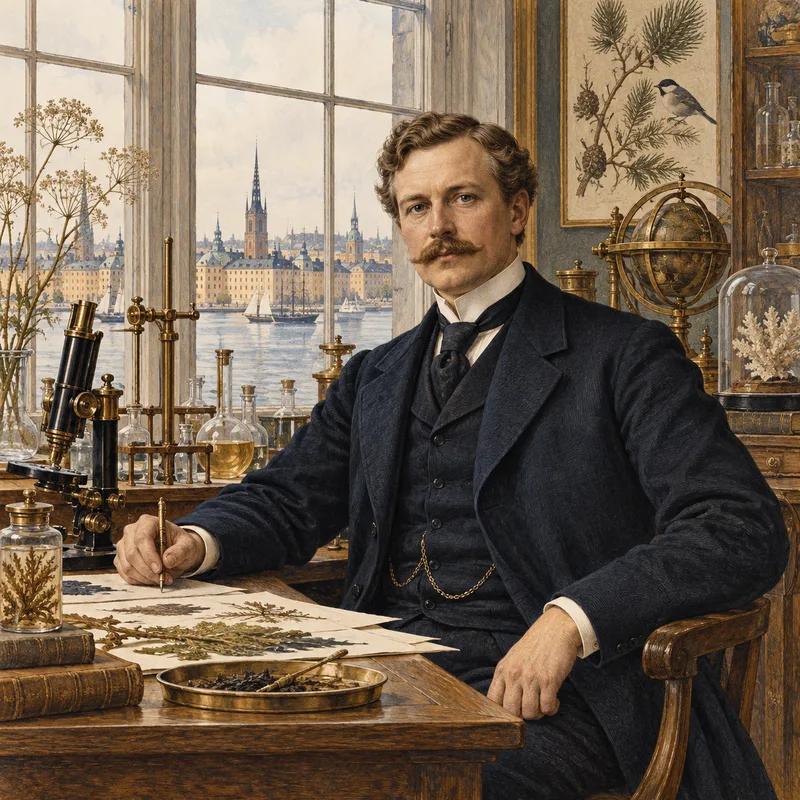
About the chemist
Svante Arrhenius
1859-1927 · Sweden · Nobel Chemistry 1903
Electrolytic dissociation; Arrhenius equation