Biography · Chemist no. 329 of 350
T. R. Seshadri: The Natural Products Chemist Who Built the Delhi School
Introduction
Thiruvengadam Rajendram Seshadri (1900–1975) was one of the foremost Indian organic chemists of the twentieth century. He isolated and determined the structures of a vast number of natural products, especially flavonoids, from Indian plants, and he built a research school first at Andhra University and then at the University of Delhi. He was elected a Fellow of the Royal Society. Students of organic chemistry meet his name whenever they study flavones and the reactions used to make them.
Early Life and Family
Seshadri was born on 3 February 1900 in Kulitalai, in the Tiruchirappalli area of the Madras Presidency (present-day Tamil Nadu). His family was of modest means. His school days were spent in the Tamil country, and his talent in science and mathematics was noticed early. Like many Indian students of his time, he progressed through scholarships and the patronage of good teachers.
Education and Mentors
He studied at Presidency College, Madras, and took his degree in chemistry there. He then went to the University of Manchester, where he worked under Robert Robinson, one of the great organic chemists of the century and a future Nobel laureate (1947). Seshadri obtained a PhD from Manchester and also worked for a time with Fritz Pregl in Graz, learning microanalysis, which is the analysis of very small quantities of material. Back in India, he carried these skills into a field where only minute amounts of pure compounds were available. Robinson's influence on his choice of natural products is clear, since Robinson himself worked on plant pigments and alkaloids.
Career Timeline
| Year | Event |
|---|---|
| 1900 | Born in Kulitalai, Madras Presidency |
| 1920s | Studies at Madras and then at Manchester under Robert Robinson |
| 1930s | Joins Andhra University, Waltair, and begins building a research school in natural products |
| 1940 | Moves to Delhi University as Professor and Head of Chemistry |
| 1940s to 1960s | Trains large numbers of PhD students; publishes hundreds of papers |
| 1960 | Elected Fellow of the Royal Society |
| 1960s | Serves in leading Indian scientific bodies and receives national honours |
| 1975 | Dies in Delhi on 27 September |
Major Scientific Contributions
Flavonoids. His group isolated and characterised a great many flavones, flavonols, isoflavones, chalcones and related pigments from plants such as cotton flowers, safflower and various Indian trees. Many of these structures were confirmed by synthesis. See the companion discovery post for the reactions involved.
Other natural products. He and his students also worked on chromones, coumarins, xanthones, lignans, terpenoids and the colouring matters of dye plants.
Chemotaxonomy and methods. His school used colour reactions, shifts in UV absorption on adding reagents, and chromatographic methods, and later adopted IR and NMR as they arrived. The approach linked plant classification with chemical constituents.
Teaching and training. The department at Delhi became a magnet for research students from across India and some from abroad.
Awards, Honours and Nobel Prize
Seshadri was elected a Fellow of the Royal Society in 1960, and he received a Padma Bhushan from the Government of India. He served as president of the Indian Chemical Society and the Indian National Science Academy in his later career. He did not receive a Nobel Prize.
Personality, Struggles and Lesser-Known Facts
- Research in poor conditions. In the 1930s and 1940s, Indian laboratories lacked many chemicals and instruments, and his students often prepared their own starting materials.
- Prolific publisher. Hundreds of research papers appeared from his group, mainly in Indian journals such as the Proceedings of the Indian Academy of Sciences and the Journal of the Indian Chemical Society, which also helped to build Indian scientific publishing.
- Disciplined and demanding. He is remembered as a strict but fair guide, with a strong emphasis on careful experimentation and correct structure proof.
- Link to Robinson. The Manchester connection brought modern organic chemistry into Indian universities.
- Move to Delhi. Moving from the south to the north in 1940 meant starting a new school again, and he succeeded.
Legacy and Influence on Modern Chemistry
Seshadri's students became professors and scientists across India, which spread natural product chemistry through the country. The chemistry of Indian medicinal plants, now of strong interest to the pharmaceutical and nutraceutical industries, rests on foundations laid by his school. The Delhi University chemistry department remains an important centre. Today, structures are solved in hours by NMR and mass spectrometry, but the logic he used, to propose a structure and prove it by synthesis, still underlies organic synthesis courses and examination problems on structure elucidation.
Lessons for Students
- Build a research school patiently. Good students and a clear theme matter more than expensive equipment.
- Choose problems linked to your own surroundings. Indian plants gave Seshadri unlimited material.
- Prove your claims. A structure becomes certain only when it is confirmed by synthesis.
- Learn fundamentals deeply. The classical reactions he used are still tested in JAM, NET and GATE.
Quick Facts Box
- Born: 3 February 1900, Kulitalai, Madras Presidency
- Died: 27 September 1975, Delhi
- Nationality: Indian
- Field: Organic chemistry, natural products
- Famous for: Flavonoid chemistry; Delhi University school
- Nobel: None; elected FRS in 1960
FAQ
Who was Seshadri's guide?
He did his doctoral work with Sir Robert Robinson at Manchester, and he also trained in microanalysis under Fritz Pregl.
Why is he important for Indian chemistry?
He created a major school of natural products chemistry, trained many scientists and described the chemistry of numerous Indian plants.
Was he a Fellow of the Royal Society?
Yes, he was elected FRS in 1960.
Which exam topics link to his work?
Flavonoid classification, Baker-Venkataraman and Algar-Flynn-Oyamada reactions, chalcones and structure elucidation of natural products.
Published by ABC Chemistry — IIT-JAM | CSIR-NET | GATE Chemistry Coaching. Visit abcchemistry.com
About the chemist
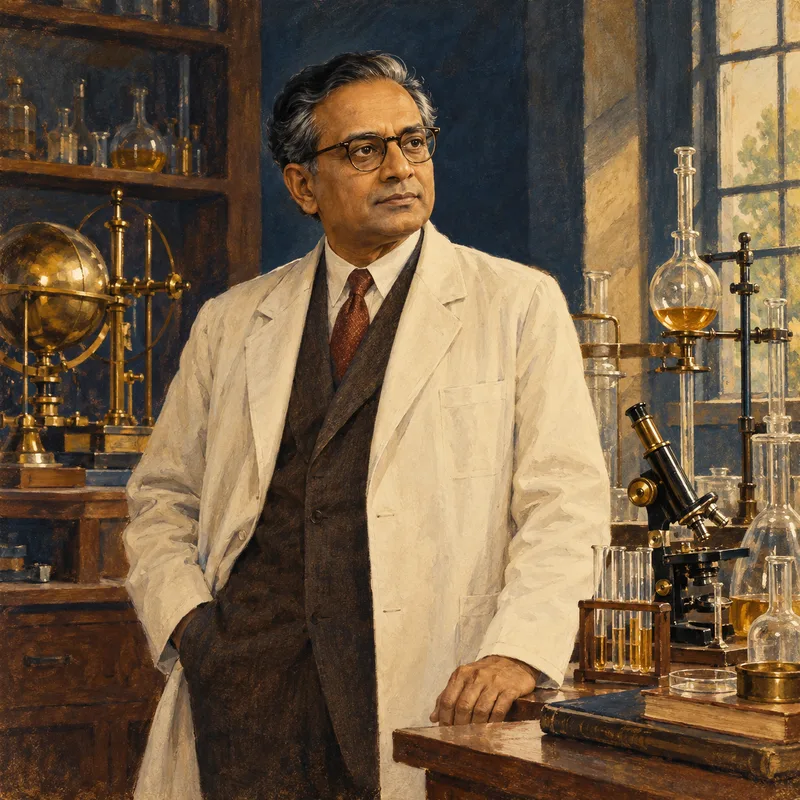
T. R. Seshadri
1900-1975 · India
Flavonoid and natural product chemistry