The discovery, explained · Chemist no. 329 of 350
T. R. Seshadri and the Chemistry of Flavonoids: Colours of the Plant World
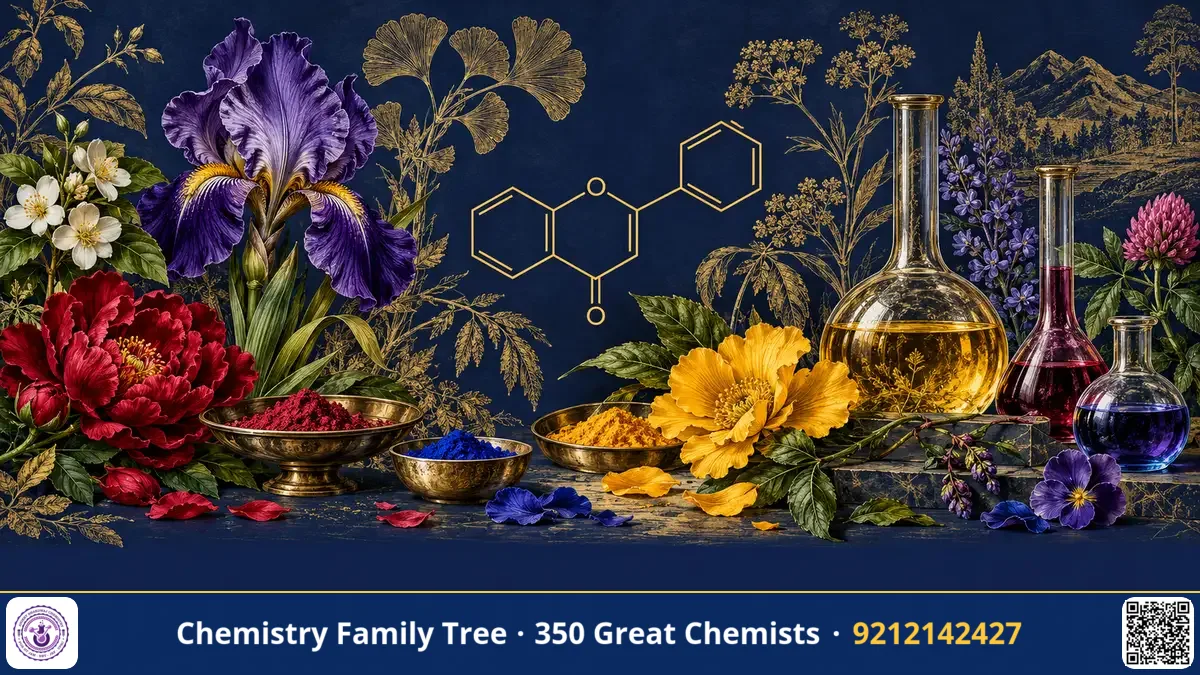
The yellow of a marigold, the red of a rose and the deep colour of many fruits come from natural pigments. Many of them belong to one large family called flavonoids. Thiruvengadam Rajendram Seshadri, an Indian organic chemist, spent a lifetime isolating these compounds from Indian plants, working out their structures and synthesising them. His school at the University of Delhi became one of the leading centres of natural product chemistry in the world. The work is a perfect example of how structure determination was done before the age of NMR: by degradation, synthesis and clever use of classical reactions.
The Scientific Problem Before the Discovery
In the early twentieth century, chemists knew that plants contain a large range of coloured and colourless phenolic compounds. Work by Robert Robinson, Richard Willstätter and others had shown that anthocyanins and flavones share a common carbon skeleton. But there were hundreds of compounds from different plants, and each needed its structure established. The problems were severe. The compounds were obtained in small amounts, the hydroxyl groups could be at many positions, and there were no spectroscopic methods. Many reported structures were wrong. A systematic method of proof was needed, as well as a reliable way to prepare the proposed structure in the laboratory to confirm it.
The Discovery: Step by Step
Seshadri and his students approached each natural product with the same logic.
- Step 1: Isolation. Extract plant material (flowers, bark, seeds, heartwood) with solvents, then separate by crystallisation and chromatography.
- Step 2: Degradation. Break the molecule with alkali or acid into simple phenols and acids that can be identified. For a flavonol, alkali fission gives a phenolic acid from ring B and a phloroglucinol-type fragment from ring A.
- Step 3: Locate the hydroxyl groups. Methylate with dimethyl sulphate, observe colour tests such as ferric chloride and the shift of colour on adding aluminium chloride, and compare with known compounds.
- Step 4: Synthesis. Build the proposed structure by a known route, and compare melting point and derivatives with the natural compound.
Several classical reactions were central in this work. The Baker-Venkataraman rearrangement converts an o-acyloxyacetophenone into a 1,3-diketone with base, and acid-catalysed cyclisation of the diketone gives a flavone:
o-HO-C₆H₄-COCH₃ + ArCOCl → o-ArCOO-C₆H₄-COCH₃
o-ArCOO-C₆H₄-COCH₃ --(KOH or NaH)--> o-HO-C₆H₄-CO-CH₂-CO-Ar  (1,3-diketone)
1,3-diketone --(H⁺, heat)--> flavone  (loss of H₂O)
The Wessely-Moser rearrangement is the conversion of a 5,7,8-trioxygenated flavone into the 5,6,7-isomer when it is demethylated with hot hydroiodic acid, through ring opening and reclosing of the pyran ring. It was valuable for proving the positions of substituents in ring A. Seshadri studied these reactions extensively and applied them to many natural products. (The Wessely-Moser rearrangement was developed by Wessely and Moser, not by Seshadri, but his group used and refined it.)
The Chemistry Behind It
Flavonoid skeleton. Flavonoids have a C6–C3–C6 structure: two aromatic rings (A and B) joined by a three-carbon unit that usually forms a pyran ring (C).
| Class | Key feature | Example |
|---|---|---|
| Flavone | 2-phenylchromen-4-one | Apigenin |
| Flavonol | 3-hydroxyflavone | Quercetin, kaempferol |
| Flavanone | C2–C3 saturated | Naringenin |
| Isoflavone | B ring at C3 | Genistein |
| Anthocyanidin | Flavylium cation | Cyanidin |
Biosynthesis. Ring A comes from three acetate units (polyketide pathway) and ring B with the three carbon bridge from phenylalanine via a cinnamoyl-CoA, joined by chalcone synthase. The chalcone cyclises to a flavanone.
Colour. The extended conjugation of the chromone and aryl rings absorbs in the near UV and visible region. Adding OH groups moves absorption to longer wavelength, which is why shift reagents are used in UV spectroscopy of flavonoids.
Applications Today
- Nutrition and health. Flavonoids such as quercetin and catechins in tea, onions and fruits are studied as antioxidants.
- Dyes. Natural dyes from flowers and bark have a long history in India, and Seshadri's group studied the colouring matter of Indian dye plants.
- Drug leads. Many flavonoids are being investigated for anti-inflammatory and cardiovascular activity.
- Training. His school at Delhi trained many professors and industry chemists. The Baker-Venkataraman reaction remains a standard way to make flavones and chromones.
- Indian biodiversity. His work on plants from India added valuable chemical knowledge about the flora of the subcontinent.
Exam Corner
- Flavone is 2-phenylchromen-4-one; flavonol has an extra OH at C-3; isoflavone has the aryl group at C-3.
- Baker-Venkataraman: o-acyloxyacetophenone + base gives 1,3-diketone, which cyclises with acid to flavone.
- Algar-Flynn-Oyamada reaction: oxidative cyclisation of 2'-hydroxychalcone with alkaline H₂O₂ gives a flavonol.
- Allan-Robinson synthesis: o-hydroxyaryl ketone with aromatic anhydride and its sodium salt gives flavone.
- Chalcone is the biosynthetic precursor of flavonoids; it is an α,β-unsaturated ketone made by Claisen-Schmidt condensation.
Common Misconceptions
- "Seshadri discovered the Baker-Venkataraman reaction." The reaction is named for W. Baker and K. Venkataraman, who worked in Britain and Bombay. Seshadri used it widely.
- "Flavonoids are all yellow." The word flavus means yellow, but many flavonoids are colourless and anthocyanins are red, blue or purple.
- "Flavones and flavonols are the same." A flavonol carries an OH at C-3.
Quick Revision Box
- Flavonoid skeleton: C6–C3–C6, rings A, B, C.
- Flavone: no 3-OH; flavonol: 3-OH present.
- Baker-Venkataraman: ester to 1,3-diketone with base.
- Algar-Flynn-Oyamada: chalcone to flavonol with H₂O₂/NaOH.
- Chalcone from Claisen-Schmidt condensation.
- Seshadri built the natural products school at Delhi University.
FAQ
What was T. R. Seshadri known for?
He was known for the isolation, structure determination and synthesis of natural products, especially flavonoids, from Indian plants.
Why were synthesis and degradation both needed?
Degradation suggested the structure and synthesis proved it. If the synthetic compound matched the natural one in melting point and derivatives, the structure was confirmed.
Which flavonoids are common in food?
Quercetin in onions and apples, catechins in tea, hesperidin in citrus fruits and genistein in soy.
How is this topic asked in exams?
Typical questions ask for the product of Baker-Venkataraman, the classification of flavonoids, and the name reactions used to make flavones and flavonols.
Published by ABC Chemistry — IIT-JAM | CSIR-NET | GATE Chemistry Coaching. Visit abcchemistry.com
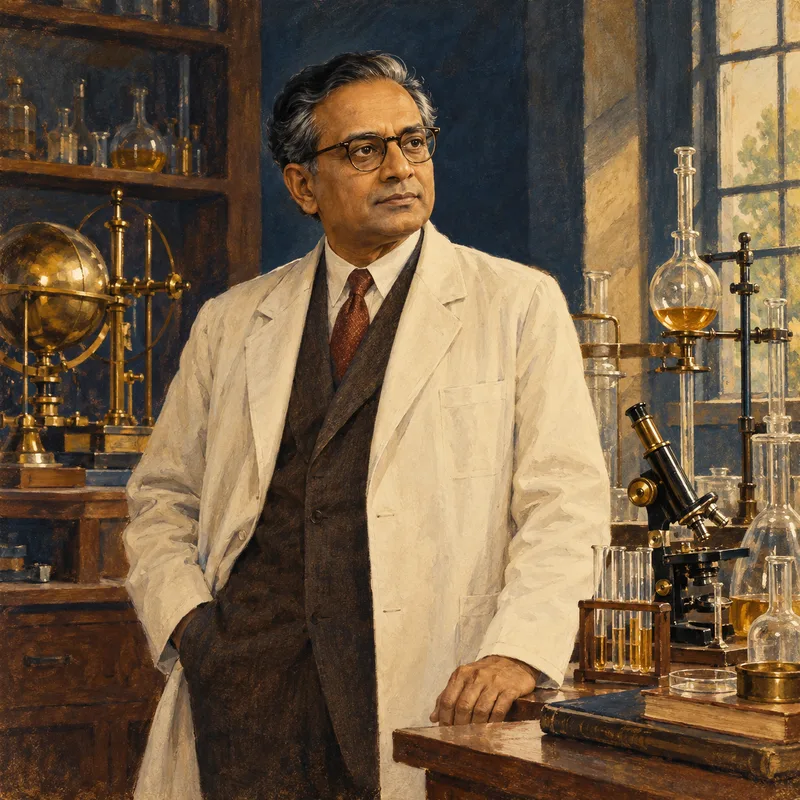
About the chemist
T. R. Seshadri
1900-1975 · India
Flavonoid and natural product chemistry