Biography · Chemist no. 285 of 350
Theodor Curtius (1857–1928): The Chemist Who Mastered Nitrogen
Introduction
Theodor Curtius was a German organic chemist who opened up the chemistry of nitrogen–nitrogen bonds. In a career that took him from Leipzig to Munich, Kiel, Bonn and finally Heidelberg, he discovered diazoacetic ester, hydrazine and hydrazoic acid, and the rearrangement that carries his name. Outside the laboratory he was a talented singer and a keen mountaineer. In one line: Curtius gave chemistry the first aliphatic diazo compound, the simplest hydrazine and a gentle way to turn acids into amines.
Early Life & Family
Theodor Curtius was born on 27 May 1857 in Duisburg, a Rhineland industrial city in Prussia. He came from a well-educated family. Duisburg was a growing centre of coal, iron and trade, and the practical atmosphere of an industrial city may have helped to direct his attention to chemistry. He attended school locally, showing an interest in both science and music from an early age.
Education & Mentors
Curtius studied chemistry at Leipzig under Hermann Kolbe, one of the leading German organic chemists, and received his doctorate there in 1882. Kolbe was a strong personality who famously opposed the new structural theories of Kekulé and van't Hoff, but he was an excellent practical teacher. After his doctorate, Curtius worked in Munich in the laboratory of Adolf von Baeyer, where he gained experience in the wider range of modern organic chemistry. Combining Kolbe's rigorous bench training and Baeyer's openness to new ideas gave him a strong foundation. Curtius also studied singing seriously during his student years.
Career Timeline
| Year | Event |
|---|---|
| 1857 | Born in Duisburg |
| 1882 | Doctorate at Leipzig under Kolbe |
| 1883 | Discovers diazoacetic ester while in Munich with Baeyer |
| 1887 | Isolates hydrazine (as sulphate) |
| 1889 | Appointed professor at Kiel |
| 1890 | Prepares hydrazoic acid; reports acyl azide chemistry |
| 1897 | Moves to Bonn |
| 1898 | Takes the chair at Heidelberg, succeeding Victor Meyer |
| 1928 | Dies on 8 February in Heidelberg |
Major Scientific Contributions
- Diazoacetic ester (1883): the first aliphatic diazo compound, later central to carbene chemistry.
- Hydrazine (1887): the discovery of the parent compound of a large family of hydrazines, hydrazones and hydrazides.
- Hydrazoic acid (1890): HN₃, the parent of the azides.
- Curtius rearrangement: acyl azide to isocyanate with loss of N₂, a mild way to shorten a carbon chain and make amines.
- Peptide chemistry: using hydrazides and azides, he prepared hippuryl-glycine-type peptides, one of the earliest syntheses of a peptide-like compound (1881–1883), and the "azide method" of peptide coupling became a classical technique for amide bond formation.
- Heterocycles and triazoles: work on nitrogen-rich ring systems, including triazoles and tetrazoles.
The mechanisms are described in our companion discovery post on Theodor Curtius.
Awards, Honours & Nobel Prize
Curtius did not win a Nobel Prize. He received recognition as a leading professor at Heidelberg and was a respected member of the German scientific community. His name is permanently attached to the Curtius rearrangement, the Curtius reaction in peptide chemistry, and Curtius's hydrazine. For students, the name has lasted far better than any medal could ensure.
Personality, Struggles & Lesser-Known Facts
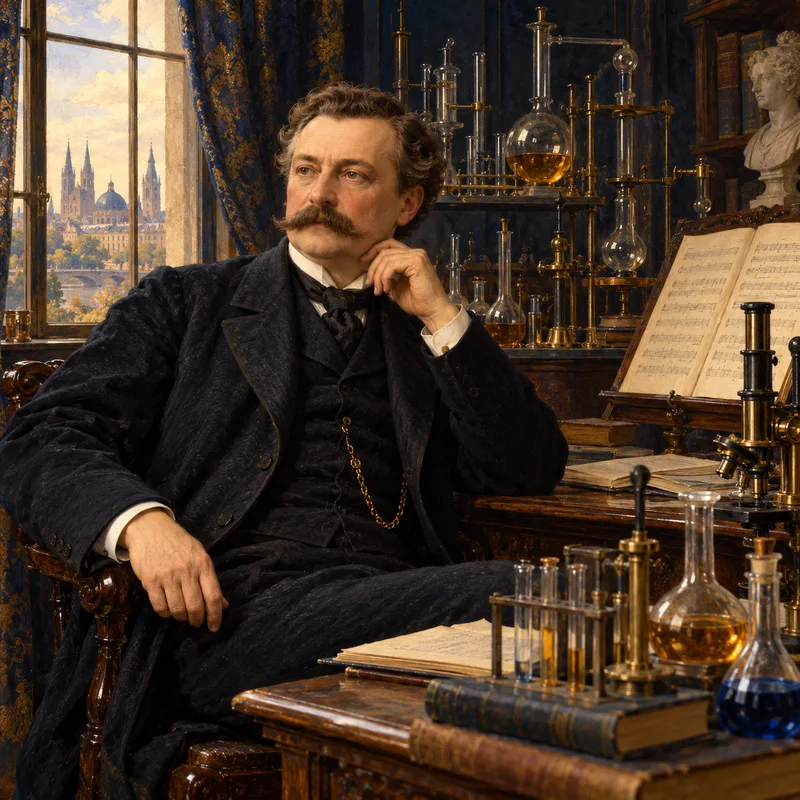
- A trained singer. Curtius had a fine baritone voice, studied singing and performed publicly, and music remained a serious part of his life.
- A mountaineer. He was a keen climber who made ascents in the Alps and continued mountaineering well into later life.
- Devoted to students. He trained many doctoral students at Kiel, Bonn and Heidelberg, who carried his methods into other laboratories.
- A dangerous chemistry. His work with diazo compounds, hydrazoic acid and azides was dangerous; explosions were a real hazard, and he took exceptional care in handling these substances.
- Long wait for hydrazine in pure form. Curtius obtained hydrazine only as its salts. It was Cornelis Lobry de Bruyn who produced pure anhydrous hydrazine in 1895.
- Successor to Victor Meyer. He took over the Heidelberg chair after Victor Meyer's death in 1897, a prestigious position.
Legacy & Influence on Modern Chemistry
Curtius's discoveries influence a wide area of modern science. Hydrazine fuels spacecraft thrusters and is used in boilers to remove dissolved oxygen. Diazo compounds produce carbenes for cyclopropanation. Azides now play a central role in click chemistry. The Curtius rearrangement is still used in industrial and pharmaceutical synthesis, because of its mildness and its retention of stereochemistry. Peptide chemists still use acyl azides to couple amino acids with minimal racemisation. For Indian students, the Curtius rearrangement is a recurring question in organic chemistry papers, usually paired with Hofmann, Schmidt and Lossen.
Lessons for Students
- Follow a new functional group. One discovery, diazoacetic ester, led Curtius to hydrazine, then azides and then a rearrangement.
- Safety is part of science: energetic compounds demand careful technique and small scale.
- Interests outside science, such as music and mountains, can sustain a long career.
- Understand families of reactions together (Hofmann, Curtius, Schmidt, Lossen) and learn what they share.
- Persistence pays; pure hydrazine required additional work by others, and science is a relay race.
Quick Facts Box
- Born: 27 May 1857, Duisburg, Prussia
- Died: 8 February 1928, Heidelberg, Germany
- Nationality: German
- Field: Organic chemistry (nitrogen compounds)
- Famous for: Curtius rearrangement, hydrazine, hydrazoic acid, diazoacetic ester
- Nobel Prize: None
FAQ
Who was Curtius's teacher?
He earned his doctorate at Leipzig under Hermann Kolbe and later worked with Adolf von Baeyer in Munich.
Where did Curtius spend his final years?
At Heidelberg, where he was professor from 1898 until his later years, and where he died in 1928.
Did Curtius win a Nobel Prize?
No, although his discoveries still influence several areas of chemistry that later received Nobel recognition.
What hobbies did Curtius have?
He was an accomplished singer and a mountaineer.
Published by ABC Chemistry — IIT-JAM | CSIR-NET | GATE Chemistry Coaching. Visit abcchemistry.com
About the chemist
Theodor Curtius
1857-1928 · Germany
Curtius rearrangement; discovered hydrazoic acid