The discovery, explained · Chemist no. 285 of 350
Theodor Curtius: Nitrogen Chemistry from Diazoacetic Ester to the Curtius Rearrangement
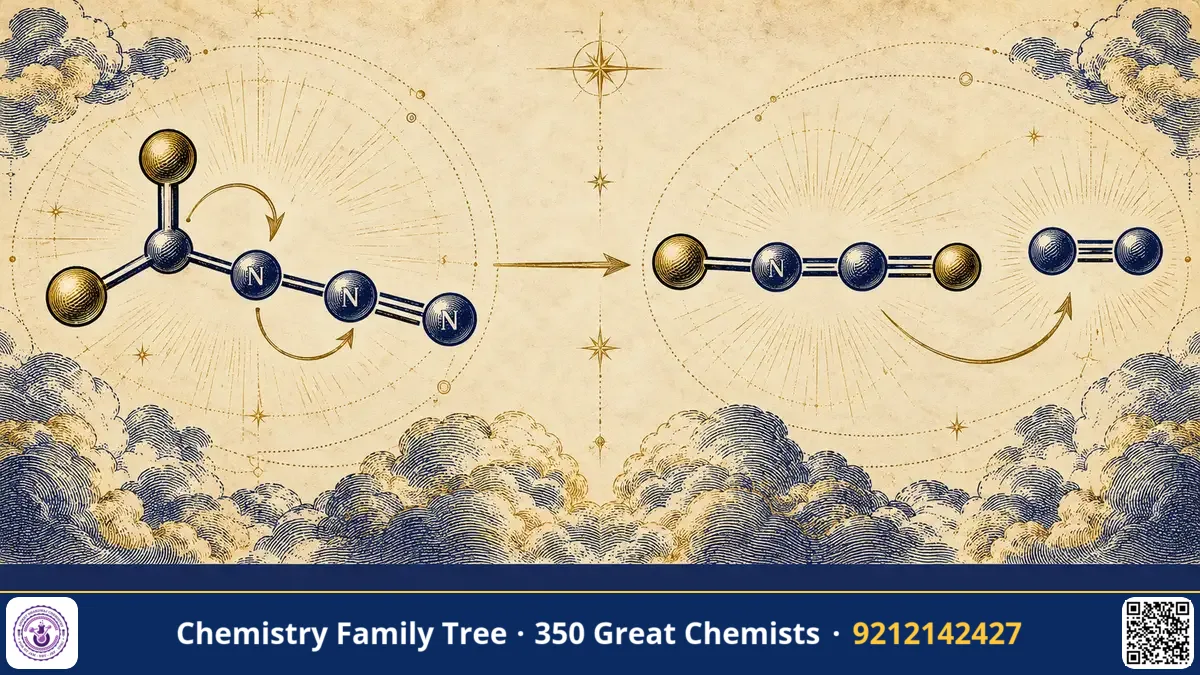
Nitrogen makes up nearly four-fifths of the air, yet in the nineteenth century the chemistry of nitrogen–nitrogen bonds was still poorly explored. One German chemist changed that. Theodor Curtius discovered diazoacetic ester in 1883, isolated hydrazine in 1887, prepared hydrazoic acid in 1890, and found the reaction we now call the Curtius rearrangement, which converts a carboxylic acid into an amine with one carbon less. These discoveries gave organic chemistry some of its most useful nitrogen reagents and tools for making rocket fuels, drugs and polymers. This post explains each one with mechanisms and exam points.
The Scientific Problem Before the Discovery
In the 1880s, chemists knew diazonium salts (Ar–N₂⁺), thanks to Peter Griess, but nitrogen compounds with N–N bonds in aliphatic systems were mysterious. Questions included: Is there an aliphatic diazo compound? Can the simplest N–N hydride, N₂H₄, be isolated? What is the formula of the acid formed with three nitrogens? Even the basic problem of shortening a carbon chain by one carbon, converting R–COOH into R–NH₂, lacked a mild and general method. The Hofmann degradation of amides worked but required strongly oxidising conditions (Br₂/NaOH) that many sensitive molecules could not survive.
The Discovery / Experiment
1. Diazoacetic ester (1883). Curtius treated the hydrochloride of glycine ethyl ester with sodium nitrite in cold water and obtained a yellow oil with a formula containing two nitrogens:
H₂N–CH₂–COOEt·HCl + NaNO₂ → N₂=CH–COOEt + NaCl + 2 H₂O
This was the first aliphatic diazo compound, a compound that later became a source of carbenes.
2. Hydrazine (1887). Working from diazoacetic ester, he obtained a new nitrogen-rich compound, and by hydrolysis he isolated hydrazine as its sulphate salt, N₂H₄·H₂SO₄. The pure anhydrous liquid was prepared later by Lobry de Bruyn.
3. Hydrazoic acid (1890). He prepared HN₃, a colourless, volatile, explosive and toxic liquid whose salts are azides, such as NaN₃.
4. The Curtius rearrangement (1890s). Starting from an acid chloride and sodium azide (or via hydrazide and nitrous acid), he obtained an acyl azide, and found that on heating it loses nitrogen gas and rearranges to an isocyanate:
R–COCl + NaN₃  →  R–CO–N₃ + NaCl
R–CO–N₃  --(heat)-->  R–N=C=O + N₂↑
R–N=C=O + H₂O  →  R–NH₂ + CO₂
R–N=C=O + R'OH  →  R–NH–COOR' (carbamate)
The Chemistry Behind It
Mechanism. On heating, the acyl azide loses N₂ and the R group migrates from carbon to nitrogen at the same time. Modern studies support a concerted pathway: the loss of nitrogen gas and the migration of R happen together, with no free acyl nitrene intermediate under thermal conditions. This explains why the migrating group keeps its stereochemistry, a key exam point. A chiral migrating carbon retains its configuration (migration with retention).
Why N₂ is a great leaving group. Formation of the very stable N≡N triple bond (bond energy about 945 kJ/mol) provides a large driving force and makes the reaction irreversible.
Comparison with related rearrangements.
- Hofmann: amide + Br₂/NaOH gives amine with one carbon less, through an isocyanate.
- Curtius: acyl azide gives isocyanate; mild, neutral, thermal conditions.
- Schmidt: carboxylic acid + HN₃ + H₂SO₄ gives amine, with the same acyl azide-type chemistry in one pot.
- Lossen: hydroxamic acid derivative gives isocyanate.
All four go through an isocyanate and give a product with one carbon fewer.
Hydrazine and azides. Hydrazine, H₂N–NH₂, is a strong reducing agent and a nucleophile, and its two lone pairs make it useful for making hydrazones (Wolff–Kishner reduction) and heterocycles. Hydrazoic acid is a weak acid (pKa about 4.7) with a linear azide ion N₃⁻ that has resonance structures.
Applications Today
- Rocket fuel: hydrazine and methylhydrazine are used as propellants, including in spacecraft thrusters such as those on many satellites and space missions.
- Pharmaceutical synthesis: The Curtius rearrangement is used to build amines and carbamates in drug synthesis, including intermediates for antiviral drugs, and to make Boc- and Cbz-protected amines under mild conditions.
- Polymers: Diisocyanates formed this way are precursors of polyurethanes used in foams, coatings and elastomers.
- Safety devices: Sodium azide decomposes to nitrogen gas rapidly and was historically used in automobile airbags: 2 NaN₃ → 2 Na + 3 N₂.
- Click chemistry: Organic azides now underlie copper-catalysed azide–alkyne cycloaddition, which was awarded the 2022 Nobel Prize in Chemistry (Sharpless, Meldal, Bertozzi).
- Agriculture: hydrazine derivatives are found in some plant growth regulators and pesticides.
Exam Corner
- Curtius rearrangement: RCON₃ → RN=C=O + N₂; hydrolysis gives RNH₂ (one carbon less).
- Migrating group retains configuration, and no nitrene is involved in the thermal process.
- Hofmann, Curtius, Schmidt and Lossen all go through isocyanates.
- Hydrazine N₂H₄ has N oxidation state –2; HN₃ has average –1/3.
- Diazoacetic ester N₂CH–COOEt is a source of carbenes and carbenoids for cyclopropanation.
Common Misconceptions
- "The Curtius rearrangement gives a longer chain." It loses one carbon as CO₂ in the hydrolysis step.
- "Acyl nitrene is always the intermediate." Thermal Curtius is concerted; nitrenes appear mainly in photochemical versions.
- "Sodium azide is harmless because it is used in airbags." Azides and HN₃ are highly toxic and potentially explosive; they must be handled with great care.
Quick Revision Box
- Curtius: RCOCl → RCON₃ → RNCO → RNH₂ + CO₂.
- Product amine has one carbon less than the acid.
- Migration is with retention of configuration.
- Curtius discovered diazoacetic ester (1883), hydrazine (1887) and HN₃ (1890).
- Isocyanate trapped with alcohols gives carbamates.
- Same family: Hofmann, Schmidt, Lossen.
FAQ
What is the Curtius rearrangement used for?
It converts carboxylic acids into amines, carbamates or ureas, with the loss of one carbon atom, under mild conditions.
How is the Curtius rearrangement different from the Schmidt reaction?
The Schmidt reaction uses hydrazoic acid with acid directly on the carboxylic acid in one pot, while the Curtius route prepares the acyl azide first from an acid chloride or similar derivative.
Why is stereochemistry retained?
The migrating group moves with its bonding electrons to the neighbouring nitrogen in a single step, never becoming free, so its configuration does not change.
What was Curtius's first major discovery?
Diazoacetic ester in 1883, made by treating glycine ethyl ester hydrochloride with nitrite.
Published by ABC Chemistry — IIT-JAM | CSIR-NET | GATE Chemistry Coaching. Visit abcchemistry.com
About the chemist
Theodor Curtius
1857-1928 · Germany
Curtius rearrangement; discovered hydrazoic acid