Biography · Chemist no. 107 of 350
Theodor Svedberg: Complete Life and Legacy
Introduction
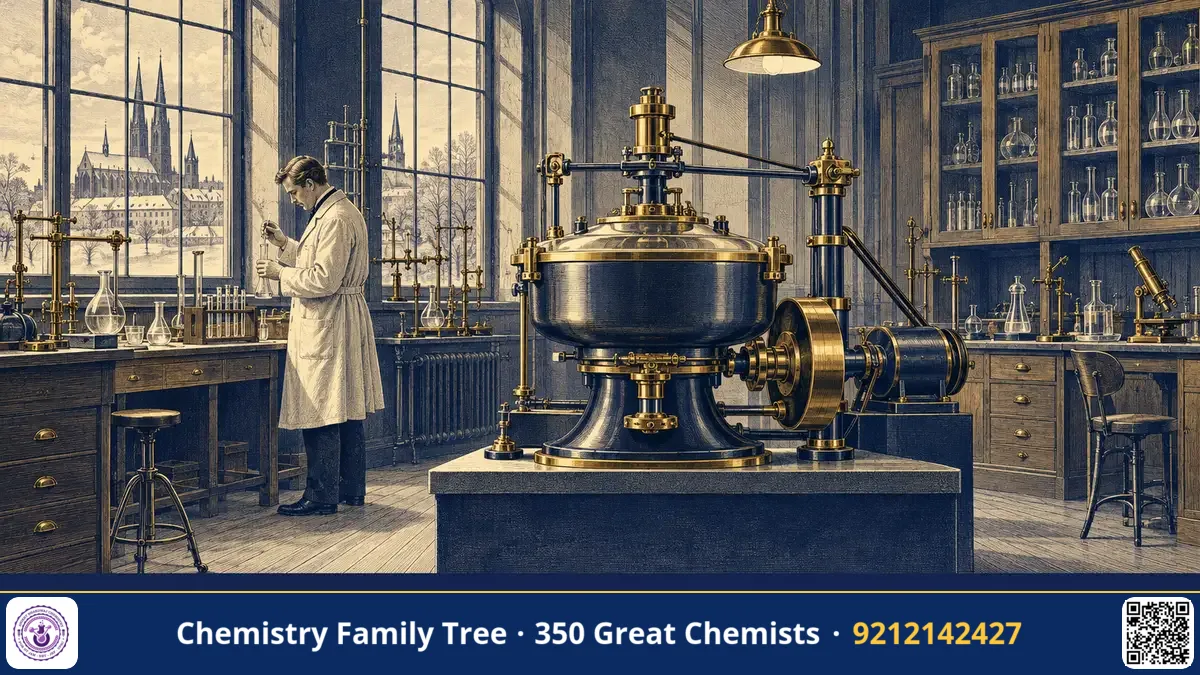
Theodor "The" Svedberg (1884–1971) was a Swedish physical chemist whose machines changed biochemistry. His analytical ultracentrifuge showed that proteins are large molecules of defined mass, and his name is used for the unit in which we describe the size of ribosomes. He received the Nobel Prize in Chemistry in 1926, and he trained Arne Tiselius, who won the same prize in 1948. His career also reached into nuclear chemistry and radiochemistry at Uppsala. He is remembered as a creative builder of instruments who made it possible to study the molecules of life in solution.
Early Life and Family
Theodor Svedberg was born on 30 August 1884 in Fleräng, near Valbo in Gävleborg County, Sweden. His father, Elias Svedberg, worked as a manager at an ironworks. He was an only child. Because of his father's work, the family moved between a number of ironworks in central Sweden, and the boy grew up in an environment shaped by iron, machinery and industrial chemistry.
He had a strong interest in nature from a young age and was especially keen on botany. In fact, he considered at one point becoming a botanist. He attended school in Örebro and showed ability in all natural sciences. He later said that his father's industrial surroundings made him comfortable with practical apparatus, which became a major strength in building his instruments.
Education and Mentors
Svedberg enrolled at Uppsala University in 1904. He studied chemistry and received his doctorate in 1907, with research on colloidal solutions, particularly the preparation of colloidal metal sols by electrical methods. He was strongly influenced by the work of Einstein, Smoluchowski and Zsigmondy on Brownian motion and colloids.
He became a docent in Uppsala in 1907 and, in 1912, was appointed professor of physical chemistry there at the age of only 27.
Career Timeline
| Year | Event |
|---|---|
| 1884 | Born in Fleräng, Sweden, on 30 August. |
| 1907 | Doctorate at Uppsala on colloidal solutions. |
| 1912 | Appointed professor of physical chemistry at Uppsala. |
| 1923 | Visits the University of Wisconsin; builds first ultracentrifuge prototypes. |
| 1924–1926 | Develops the oil-turbine ultracentrifuge and measures protein molecular weights. |
| 1926 | Awarded the Nobel Prize in Chemistry. |
| 1940s | Turns to nuclear research; builds a cyclotron in Uppsala. |
| 1949 | Becomes director of the Gustaf Werner Institute for nuclear chemistry in Uppsala. |
| 1967 | Retires from the institute. |
| 1971 | Dies in Örebro on 25 February. |
Major Scientific Contributions
- Analytical ultracentrifuge: a rotor-and-optics system for observing sedimentation of macromolecules in real time. See our discovery post for the principle and equation.
- Proof of macromolecular nature of proteins: haemoglobin, albumins, haemocyanin and others sedimented as homogeneous species of definite mass.
- Sedimentation velocity and equilibrium methods: two complementary approaches for finding molar mass and distribution.
- Colloid preparation: his early work on preparing metal sols by electrical sparking, known as the Svedberg method, produced pure colloids without chemical additives.
- Nuclear chemistry: promoted cyclotron research and radiochemistry at Uppsala in his later career.
Awards, Honours and Nobel Prize
The Nobel Prize in Chemistry for 1926 was awarded to Theodor Svedberg "for his work on disperse systems". It was a recognition of the ultracentrifuge as a quantitative scientific tool. The 1925 prize, held over for a year, went to Richard Zsigmondy in the same period, so the two great colloid chemists were honoured together.
Today the Svedberg unit (S) is used throughout biology, and The Svedberg Laboratory in Uppsala, an accelerator centre, carries his name.
Personality, Struggles and Lesser-Known Facts
- Instrument builder. He believed that new instruments open new science. His laboratory in Uppsala had its own workshop, and he often designed the apparatus himself.
- Visits to America. His stay at the University of Wisconsin in 1923 gave him the chance to collaborate with American colleagues, and he established contacts which later helped the spread of ultracentrifugation in the United States.
- Remarkable students. Arne Tiselius, Nobel laureate 1948 for electrophoresis and adsorption analysis, did his doctorate under Svedberg.
- Interest in the whole of nature. Apart from chemistry, he kept his interest in botany and in the larger questions of science and society.
- Family life. He married more than once and had children.
Legacy and Influence on Modern Chemistry
The ultracentrifuge became central to twentieth-century biology. In the 1930s and 1940s, it was used to classify viruses, to separate plasma proteins, and to define the size of the first known enzymes. Matthew Meselson and Stahl showed in 1958 that DNA replication is semi-conservative, by following heavy nitrogen-labelled DNA in a caesium chloride density gradient. The classification of ribosomes as 70S and 80S and of ribosomal RNA species such as 16S and 23S rely on sedimentation coefficients.
Today the machine is found in every serious biochemistry laboratory. Modern analytical ultracentrifuges have computer-controlled optics, but the principle is still Svedberg's. At the same time, the physical chemistry of macromolecules, from Staudinger's polymers to protein structures, owes a great deal to the proof that large molecules are real, defined entities.
Lessons for Students
- Build tools for the questions you want to answer. Svedberg's machine opened a field.
- Test controversial ideas with decisive experiments, as he did for the nature of proteins.
- Collaborate across borders; his students and visits spread his ideas.
- Stay curious beyond your speciality: he moved from colloids to proteins to nuclear chemistry.
- Train good students. Tiselius' later Nobel Prize is a part of Svedberg's legacy.
Quick Facts Box
- Born: 30 August 1884, Fleräng, Sweden.
- Died: 25 February 1971, Örebro, Sweden.
- Nationality: Swedish.
- Field: Physical chemistry, colloid and biochemistry.
- Famous for: Ultracentrifuge; Svedberg unit; Svedberg equation.
- Nobel: Chemistry, 1926.
FAQ
What is the Svedberg unit?
It is the unit of sedimentation coefficient, equal to 10⁻¹³ seconds, named after Theodor Svedberg. It describes how fast a particle sediments in a centrifugal field.
Which of Svedberg's students won a Nobel Prize?
Arne Tiselius won the 1948 Nobel Prize in Chemistry for his work on electrophoresis and adsorption analysis, and for the study of serum proteins.
Where did Svedberg work?
He worked almost all his life at Uppsala University, Sweden, where he was professor of physical chemistry and later director of the Gustaf Werner Institute.
Why is he important in biochemistry?
Because the ultracentrifuge gave the first reliable way to measure the mass of proteins and other macromolecules and to characterise ribosomes, viruses and DNA.
Published by ABC Chemistry — IIT-JAM | CSIR-NET | GATE Chemistry Coaching. Visit abcchemistry.com
About the chemist
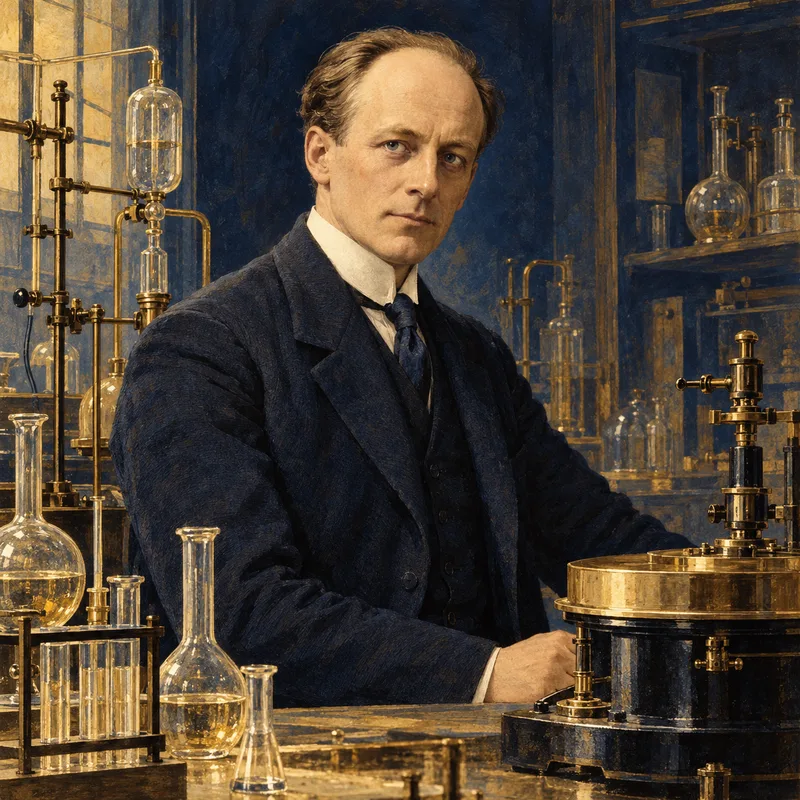
Theodor Svedberg
1884-1971 · Sweden · Nobel Chemistry 1926
Ultracentrifuge, disperse systems