The discovery, explained · Chemist no. 107 of 350
Theodor Svedberg and the Ultracentrifuge
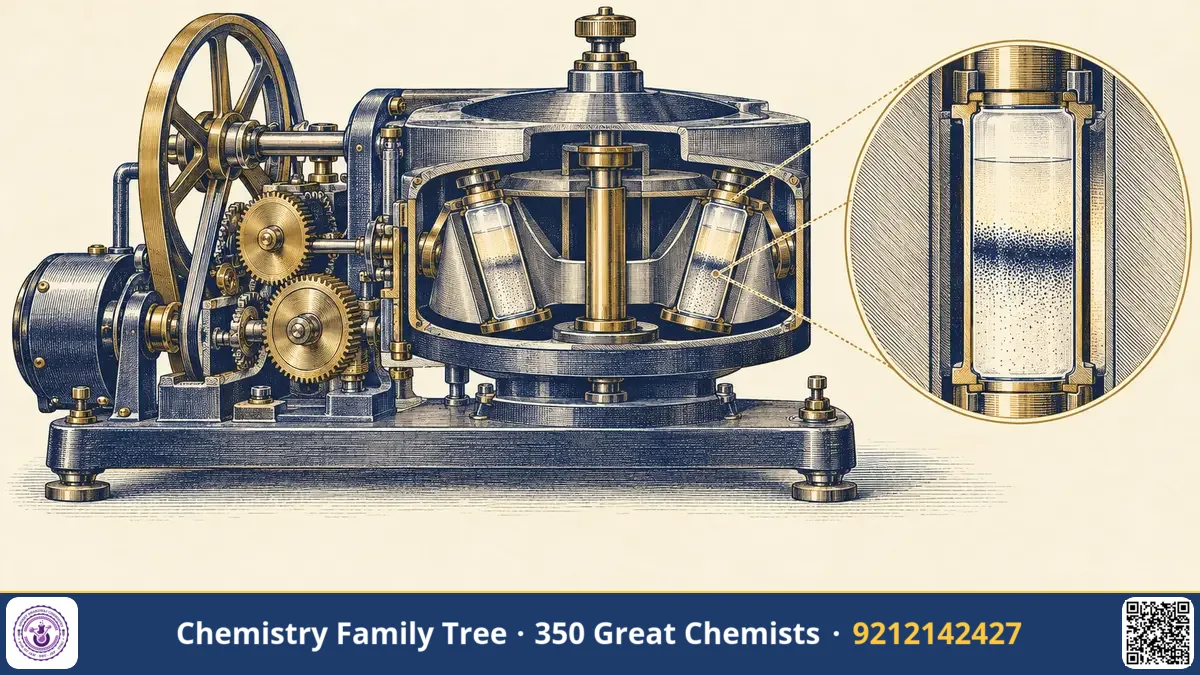
Everyone who has studied biochemistry has met the letter "S". The 70S ribosome of bacteria, the 80S ribosome of our own cells, the 30S and 50S subunits: the S stands for Svedberg, the unit of sedimentation coefficient, named after the Swedish chemist Theodor Svedberg. In the early 1920s Svedberg built the first ultracentrifuge, a machine that spins samples so fast that individual large molecules, even proteins, are driven to the bottom of the tube and can be measured. With it he proved that proteins are true macromolecules with definite molecular masses, not random clumps of smaller units. For his work on disperse (colloidal) systems he received the Nobel Prize in Chemistry in 1926.
The Scientific Problem Before the Discovery
By 1900 colloid chemists knew that sols, gels and solutions of substances like starch, rubber and proteins contained particles much larger than ordinary molecules. But how big were they? Were proteins single giant molecules with a fixed molecular weight, or were they aggregates of small molecules held together loosely, whose size changed with conditions? Many leading chemists, including supporters of the "association colloid" idea, thought the latter. Hermann Staudinger's concept of macromolecules was only just emerging and was not accepted widely.
The usual methods for determining molecular weight, such as freezing-point depression and boiling-point elevation, work poorly for very large molecules, because the colligative effect becomes too small to measure. Osmotic pressure could be used, but it was difficult and affected by impurities. Ordinary gravity also does not work: protein molecules in water stay suspended for years because Brownian motion keeps them mixed. What was needed was a force thousands of times stronger than gravity, applied in a controlled way and with a method for watching the particles move.
The Discovery: Step by Step
- Early centrifuges (1900s–1910s). Svedberg first studied gold sols and other colloids with the help of ultramicroscopy and the Brownian motion work of Einstein and Perrin. He realised that centrifugal force might be used to speed up the sedimentation.
- First ultracentrifuge (1923). At the University of Uppsala, he built a machine in which a small rotor held a cell with transparent windows. The optical system allowed him to take photographs of the cell while spinning. The first experiments used gold sols.
- Sedimentation velocity. In 1924–1926, with a more powerful design driven by an oil turbine, he spun solutions of proteins at high speeds. The rotors produced centrifugal fields of many thousands of times gravity, and later models far more. The boundary between solvent and protein moved outward and was recorded by light absorption.
- Result for haemoglobin. The sedimentation of haemoglobin showed a single sharp boundary, meaning that all molecules have the same mass. From the data, Svedberg calculated a molecular weight of about 68,000, close to the modern value of roughly 64,500 for the tetramer.
- Many proteins studied. Egg albumin, serum albumin, haemocyanin and other proteins were measured. Most proved to be single, homogeneous species with definite masses, which are multiples of a small number. This was strong evidence that proteins are true macromolecules.
- Sedimentation equilibrium. By spinning at lower speeds until diffusion exactly balanced sedimentation, he could measure molecular weight without reference to the shape of the molecule.
The Chemistry Behind It
In a centrifuge, a particle of mass m and partial specific volume v-bar experiences a centrifugal force. At constant speed, the driving force is balanced by the frictional drag, and the particle moves at a constant velocity. The sedimentation coefficient is defined as the velocity per unit centrifugal field:
s = v / (ω² r)
where ω is the angular velocity and r the distance from the axis. The unit of s is the second; one Svedberg is 10⁻¹³ s. Combining with the diffusion coefficient D gives the Svedberg equation:
M = s R T / [ D (1 − v̄ ρ) ]
Here M is molar mass, R the gas constant, T temperature, v̄ the partial specific volume of the solute and ρ the density of the solvent. The factor (1 − v̄ρ) is the buoyancy term. If the solute is denser than the solvent, the factor is positive and the molecule sediments; otherwise it floats.
In sedimentation equilibrium, the concentration distribution follows:
ln (c2/c1) = M (1 − v̄ ρ) ω² (r2² − r1²) / (2 R T)
Important points for students:
- Larger and denser particles have larger s values. But s is not additive: a 70S ribosome is made of 30S and 50S subunits, since shape and friction also matter.
- The method is non-destructive and works in solution, close to physiological conditions.
- A single sharp boundary indicates a monodisperse sample; a broad boundary indicates a mixture (polydispersity).
- Density-gradient centrifugation (for instance with CsCl) separates molecules by buoyant density; the famous Meselson–Stahl experiment on DNA replication used it in 1958.
Applications Today
- Biochemistry: measuring molar mass, purity, oligomeric state and binding of proteins and nucleic acids by analytical ultracentrifugation.
- Cell biology: differential centrifugation separates nuclei, mitochondria, lysosomes and ribosomes from cell homogenates.
- Medicine: centrifuges separate plasma from blood cells in every pathology laboratory in India; lipoproteins (LDL, HDL, VLDL) are classified by their flotation in ultracentrifuges.
- Pharmaceutical industry: vaccine purification and characterisation of virus particles and antibody aggregation.
- Polymer science: molar mass distributions of synthetic and natural polymers.
- Molecular biology: ribosome classification as 70S (prokaryotes) and 80S (eukaryotes).
Exam Corner
- Theodor Svedberg received the Nobel Prize in Chemistry in 1926 for his work on disperse systems.
- One Svedberg unit (S) = 10⁻¹³ seconds. Prokaryotic ribosome = 70S (30S + 50S); eukaryotic ribosome = 80S (40S + 60S).
- Svedberg equation: M = sRT / D(1 − v̄ρ); the sedimentation coefficient s = v / ω²r.
- Sedimentation velocity gives s; sedimentation equilibrium gives M directly.
- Meselson–Stahl experiment used CsCl density-gradient ultracentrifugation to show semi-conservative replication of DNA.
Common Misconceptions
- "S values add up." They do not, because they depend on shape as well as mass; 30S + 50S gives 70S.
- "A centrifuge separates by size only." It separates by mass, density and shape together.
- "Svedberg invented the centrifuge." Ordinary centrifuges existed; he made the ultracentrifuge with optical observation.
Quick Revision Box
- First ultracentrifuge built at Uppsala in 1923.
- Proved proteins have definite molecular masses (haemoglobin about 68,000 in his work).
- Unit of sedimentation coefficient: 1 S = 10⁻¹³ s.
- Equation: M = sRT / D(1 − v̄ρ).
- Nobel Prize in Chemistry, 1926, for disperse systems.
- Student Arne Tiselius won the 1948 Nobel Prize in Chemistry for electrophoresis.
FAQ
Why is the unit called the Svedberg?
It honours Theodor Svedberg, who introduced the use of sedimentation coefficients. One Svedberg equals 10⁻¹³ seconds.
What does a 70S ribosome mean?
It means the ribosome sediments at 70 Svedberg units in an ultracentrifuge. It consists of a 30S and a 50S subunit, and the values do not simply add up.
How did the ultracentrifuge prove that proteins are macromolecules?
Proteins sedimented as sharp single boundaries with a defined mass, which would not be expected if they were loose, variable aggregates of small molecules.
Is this topic useful for GATE and NET?
Yes. Molecular weight methods (osmometry, viscometry, light scattering, ultracentrifugation) are standard topics in polymer and physical chemistry sections.
Published by ABC Chemistry — IIT-JAM | CSIR-NET | GATE Chemistry Coaching. Visit abcchemistry.com
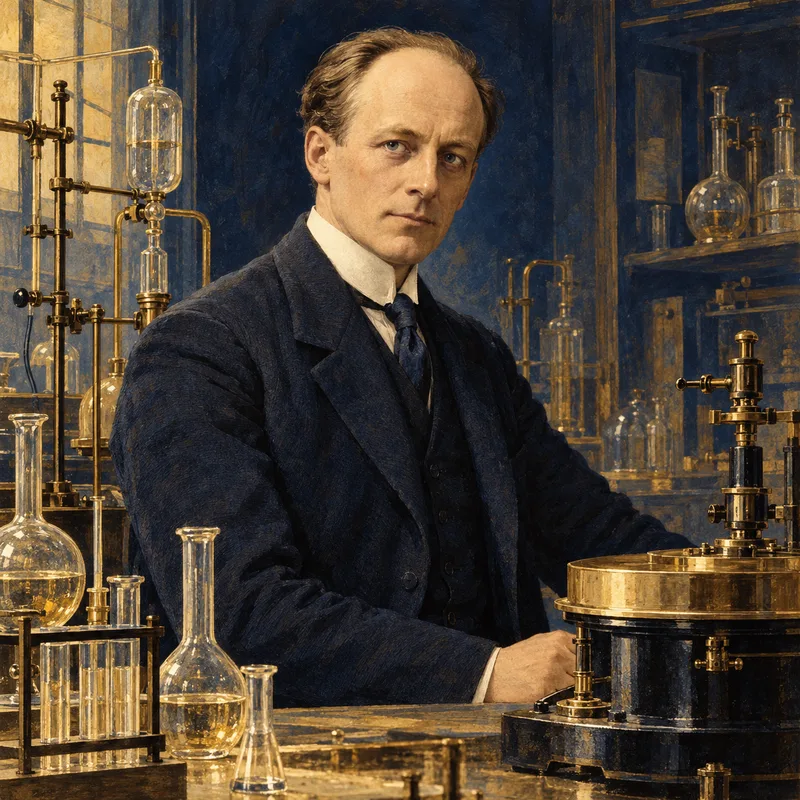
About the chemist
Theodor Svedberg
1884-1971 · Sweden · Nobel Chemistry 1926
Ultracentrifuge, disperse systems