The discovery, explained · Chemist no. 103 of 350
Theodore William Richards and the Art of Exact Atomic Weights
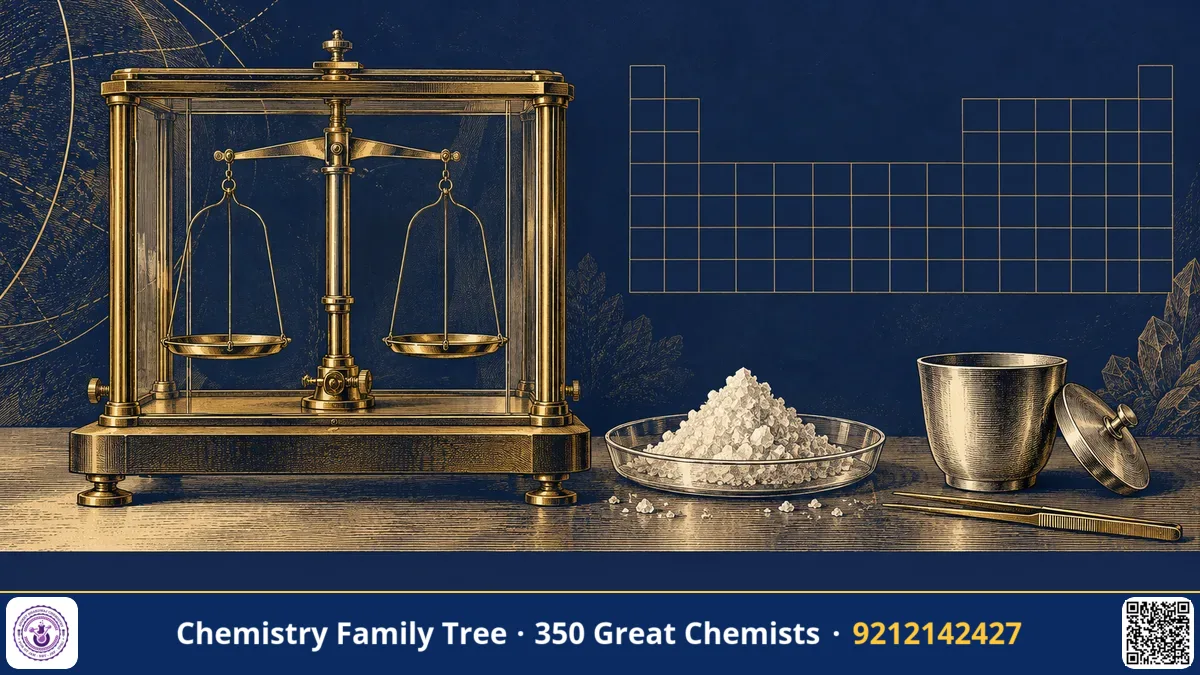
Every numerical answer in chemistry depends on the atomic masses written in the periodic table. If those numbers are wrong in the third decimal place, then every molar mass, every titration calculation and every yield is slightly wrong too. At the turn of the twentieth century, the American chemist Theodore William Richards of Harvard University set himself the task of measuring atomic weights with a level of accuracy that no one had achieved. He redetermined the atomic weights of about sixty elements, developed new methods to avoid hidden errors, and in doing so even found early evidence that lead from different sources has different atomic weights, a hint of isotopes. For this work he received the Nobel Prize in Chemistry in 1914, the first American to win it.
The Scientific Problem Before the Discovery
The concept of atomic weight goes back to Dalton and was refined by Berzelius, Cannizzaro and Stas. Dmitri Mendeleev's periodic table of 1869 depended on these numbers, as did the predictions he made for undiscovered elements. By 1900, chemists agreed on most values, but there were disagreements in the second decimal place, and sometimes even in the first. The reasons were practical. Precipitates carried traces of water or other ions, filter papers retained impurities, and reagents were rarely pure. Weighing balances were sensitive but were affected by air buoyancy.
There was also a theoretical question. Prout's hypothesis, proposed in 1815, suggested that all atomic weights are whole-number multiples of that of hydrogen. Accurate work by Stas had already shown it was not exactly true, but better numbers were needed to understand what the deviations meant. The International Committee on Atomic Weights needed reliable data. Richards took up this task at Harvard, and for more than two decades he made atomic weights his life's work.
The Discovery: Step by Step
The central strategy was to compare the element under study with silver, through the very precise reaction of silver ion with a halide. The atomic weights of silver, chlorine, bromine and iodine could then be linked in a closed web of ratios. For example, to determine the atomic weight of an element X from its chloride XCln, Richards measured how much silver was needed to precipitate exactly all the chloride.
- Purification. The salts were recrystallised many times, often in platinum or quartz vessels, until no more impurities could be detected. Water was distilled repeatedly, and reagents were prepared in a dust-free environment.
- Drying and weighing. The halide salt was dried to constant mass, often by fusion in a stream of dry HCl gas, in a special weighing bottle. The mass was corrected to vacuum to eliminate the effect of air buoyancy.
- Titration with silver. A weighed sample was dissolved and treated with a solution containing a nearly equivalent amount of weighed pure silver (dissolved as silver nitrate). The silver chloride was formed according to
Ag+ + Cl- → AgCl. - Nephelometry. To find the exact end-point, Richards developed the nephelometer, which compared the cloudiness of tiny amounts of AgCl in the solution. Adding small portions of silver or chloride until no more opalescence appeared gave a sharp, objective end-point.
- Calculation. From the ratio of the masses, and the known value for silver, the atomic weight of the element was calculated. Each experiment was repeated many times to check consistency.
Richards also noticed that precipitates occlude (trap) small amounts of foreign matter inside the crystals. He studied this carefully and designed procedures to correct for it. His careful research on the sources of error gave his numbers their reputation.
The Chemistry Behind It
The principle behind the method is the law of definite proportions and the idea of stoichiometric equivalence. If an element X forms a chloride XCln, then:
XCln + n AgNO3 → n AgCl↓ + X(NO3)n
By weighing the mass of XCln and the mass of silver needed, one gets the equivalent mass of X relative to silver. Combined with the valency n, the atomic weight follows:
Moles of AgCl = mass of Ag / 107.87 = n × moles of XCln
Molar mass of XCln = n × 107.87 × (mass of XCln / mass of Ag)
Atomic weight of X = molar mass of XCln − n × 35.45
(modern values for Ag and Cl are used here to show the logic.) Because the ratio is between two weighed masses of very pure materials, the accuracy can be extremely high, provided there is no systematic error.
Richards extended this work to other classical methods too, such as conversion of one salt into another, and the combustion analysis of hydrogen in metal hydrides. He also measured compressibility of elements and compounds, specific heats and heats of reaction using an adiabatic calorimeter he developed, as well as the "theory of compressible atoms". His thermochemical work on electrochemical cells, with the discovery that the heat of reaction and the free energy differ at low temperature in a way consistent with the third law, was a step towards Nernst's heat theorem.
Lead from different sources
Around 1913–1914, Richards examined lead taken from uranium minerals, which would be expected to contain the end-product of radioactive decay, and compared it with ordinary lead. He found that the atomic weight of radiogenic lead was lower than that of common lead, about 206.4 compared with 207.2. This confirmed that atoms of the same element can have different masses, an idea proposed by Frederick Soddy as isotopy. It was a beautiful use of precise atomic weight measurement to support a new theory.
Applications Today
- Standard atomic weights: modern IUPAC tables descend directly from the careful work of Richards and his students, now refined using mass spectrometry.
- Analytical standards: primary standards such as pure silver, sodium chloride and potassium hydrogen phthalate are used in titrations on the same principle of weighable, high-purity materials.
- Geochronology: the uranium–lead method for dating rocks relies on the fact that lead isotope ratios differ, as Richards' work first showed in bulk.
- Gravimetric analysis: determination of chloride as AgCl, sulfate as BaSO4 and nickel as the dimethylglyoximate in laboratories and industry (including quality control in Indian pharmaceutical and fertiliser plants).
- Nephelometry and turbidimetry: still used in water testing and clinical analysis.
Exam Corner
- T. W. Richards won the Nobel Prize in Chemistry in 1914 for accurate determination of atomic weights of a large number of chemical elements.
- He was the first American chemist to win the Nobel Prize in Chemistry.
- Atomic weight of radiogenic lead (from uranium ores) is lower than that of ordinary lead, supporting the concept of isotopes.
- Gravimetric chloride estimation:
Cl- + Ag+ → AgCl; occlusion and co-precipitation are sources of error. - Prout's hypothesis said atomic weights are whole-number multiples of hydrogen's; the mass defect and isotopes later explained the deviations.
Common Misconceptions
- "Atomic weight is the mass of one atom." It is the weighted average of isotopic masses relative to one-twelfth the mass of carbon-12 (the modern standard).
- "Richards discovered isotopes." Soddy proposed the concept; Richards provided precise evidence for lead.
- "More precise means just a better balance." Richards' real contribution was the control of impurity, occlusion and buoyancy, not only the instrument.
Quick Revision Box
- Nobel Prize in Chemistry 1914, awarded for atomic weight determinations.
- Method: ratio of weighed halide to weighed silver, using AgCl precipitation.
- Nephelometer: instrument for sensing the end-point by turbidity.
- Radiogenic lead has lower atomic weight than ordinary lead.
- Worked at Harvard; first American Nobel laureate in Chemistry.
- Also studied compressibility of atoms and electrochemical thermodynamics.
FAQ
Why was silver used as the reference?
Silver can be obtained in extremely pure form and precipitates halides almost quantitatively, with insoluble AgCl, AgBr and AgI that can be weighed accurately.
What is occlusion?
It is the trapping of foreign ions or solvent inside growing crystals of a precipitate, leading to errors in gravimetric analysis. Richards studied and corrected it.
How does his lead work relate to isotopes?
Lead formed by decay of uranium is mainly Pb-206, whereas ordinary lead is a mixture of several isotopes. A different atomic weight showed that the same element can have atoms of different mass.
Is atomic weight work still relevant?
Yes. IUPAC still revises standard atomic weights, but today mass spectrometry is used. The principle of careful purification and error control remains the model of good analytical chemistry.
Published by ABC Chemistry — IIT-JAM | CSIR-NET | GATE Chemistry Coaching. Visit abcchemistry.com
About the chemist
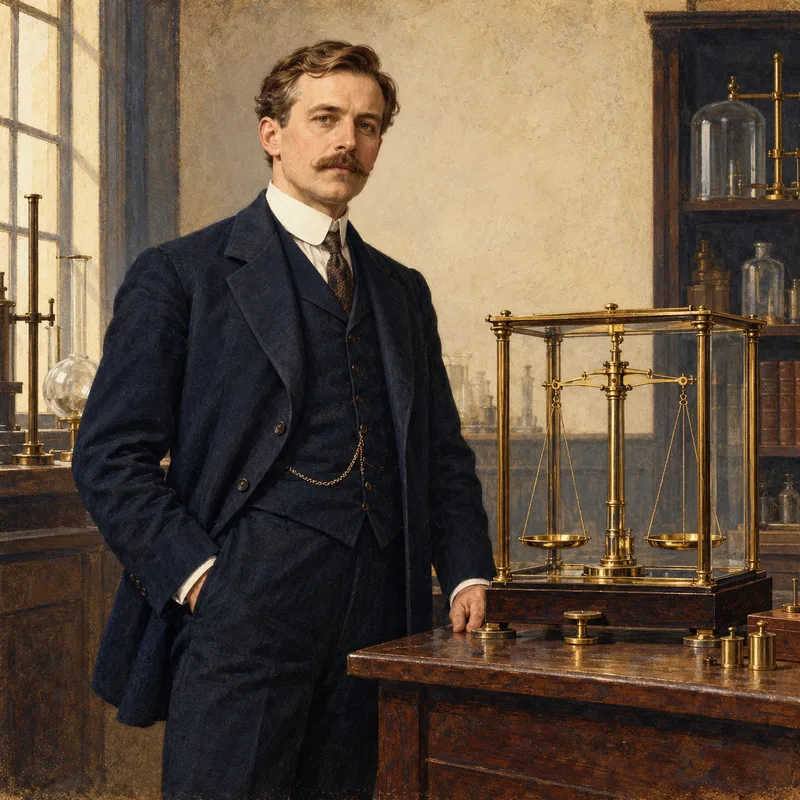
Theodore William Richards
1868-1928 · United States · Nobel Chemistry 1914
Precise atomic weight determinations