Biography · Chemist no. 103 of 350
Theodore William Richards: Complete Life and Legacy
Introduction
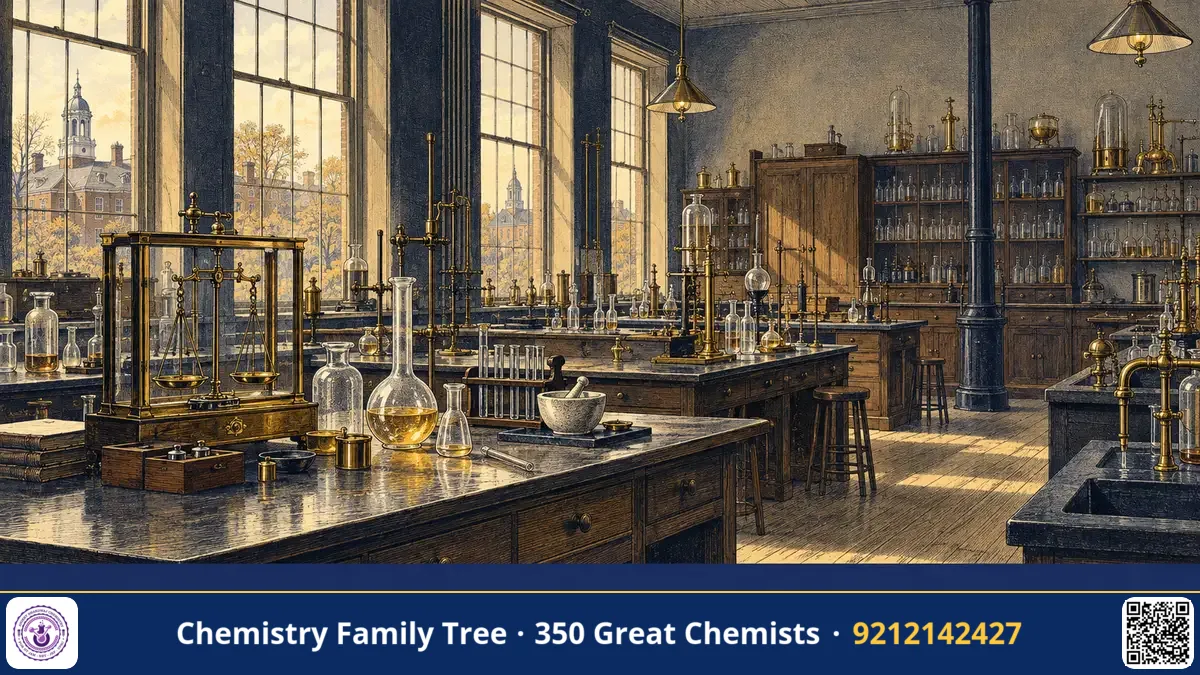
Theodore William Richards (1868–1928) was an American physical chemist who made the periodic table more trustworthy. By purifying materials to extraordinary levels and weighing with great care, he fixed the atomic weights of about sixty elements to a precision never seen before. In 1914 he became the first American to receive the Nobel Prize in Chemistry. His laboratory at Harvard trained a generation of leading chemists, including Gilbert N. Lewis, James B. Conant and Farrington Daniels. His legacy is the idea that accurate measurement is itself a creative scientific act.
Early Life and Family
Richards was born on 31 January 1868 in Germantown, Pennsylvania, near Philadelphia. His father, William Trost Richards, was a well-known American landscape and marine painter. His mother, Anna Matlack Richards, was a poet and writer. The household was therefore artistic and intellectual, and Theodore grew up among paintings, books and discussions.
His early schooling was unusual. He was largely educated at home by his mother, who taught him subjects ranging from languages to literature. The family spent time in England, where his father painted coastal scenes, and Theodore received part of his schooling there. He showed an early interest in science, and his parents encouraged it. Later, in his chemical work, observers noted that the artist's eye for fine detail and exact observation had come from home.
Education and Mentors
Richards entered Haverford College in Pennsylvania when he was still very young, around fourteen years old, and received his bachelor's degree there in 1885. He then transferred to Harvard, where he earned a second bachelor's degree in 1886 and a PhD in 1888 at the age of twenty. His mentor at Harvard was Josiah Parsons Cooke, a professor of chemistry who had himself done important work on atomic weights. Cooke's own interest in exact measurement was passed on to Richards, and his doctoral thesis dealt with the atomic weight ratio of hydrogen and oxygen.
After the doctorate, Richards travelled to Europe on a travelling fellowship and worked in Germany with Walther Nernst in Göttingen and with Victor Meyer, and in Leipzig with Wilhelm Ostwald. These visits introduced him to the new field of physical chemistry, with its focus on thermodynamics and electrochemistry. He later returned to Germany several times, and he kept friendly ties to German science.
Career Timeline
| Year | Event |
|---|---|
| 1868 | Born in Germantown, Pennsylvania on 31 January. |
| 1885 | Receives bachelor's degree from Haverford College. |
| 1888 | PhD from Harvard under Josiah P. Cooke. |
| 1889–1891 | Travels to Germany; works with Nernst, Ostwald and others. |
| 1894 | Appointed assistant professor at Harvard. |
| 1901 | Becomes full professor at Harvard. |
| 1903 | Appointed to the Erving professorship of chemistry. |
| 1912 | Serves as exchange professor at the University of Berlin. |
| 1913–1914 | Shows that radiogenic lead has a different atomic weight from ordinary lead. |
| 1914 | Awarded the Nobel Prize in Chemistry. |
| 1928 | Dies in Cambridge, Massachusetts, on 2 April. |
Major Scientific Contributions
- Atomic weights: redetermined values for around sixty elements by the silver-halide ratio method, using purified materials and the nephelometer. See our discovery post for details.
- Nephelometer: an instrument that detects tiny amounts of turbidity for precise end-points.
- Occlusion and co-precipitation: studied the sources of error in precipitates and developed corrections.
- Adiabatic calorimeter: introduced a way to measure heats of reaction accurately by preventing heat exchange with the surroundings.
- Compressibility of atoms: measured the compressibilities of elements and related them to atomic properties, proposing the "theory of compressible atoms".
- Electrochemistry and thermodynamics: studied cells at different temperatures. His results on the relation between heat of reaction and free energy at low temperatures gave support to the ideas that led to Nernst's heat theorem (the third law of thermodynamics).
- Lead isotopes: provided key evidence that atomic weight of lead from uranium minerals differs from ordinary lead.
Awards, Honours and Nobel Prize
The Nobel Prize in Chemistry for 1914 was awarded to Theodore William Richards "in recognition of his accurate determinations of the atomic weight of a large number of chemical elements". Because of the First World War the ceremony was affected, but the recognition stood. He was the first American to receive the Nobel Prize in Chemistry.
He also received the Davy Medal of the Royal Society of London (1910). He served as President of the American Chemical Society and was a member of many academies. He chaired the International Committee on Atomic Weights for a time.
Personality, Struggles and Lesser-Known Facts
- Prodigy. He finished his Harvard doctorate at twenty, an age when most students today are still in their bachelor's degree.
- Artistic parents. His father, William Trost Richards, was a painter and his mother, Anna Matlack Richards, a poet; the family home was full of art.
- Wartime stand. During the First World War, he was known to be deeply troubled by the conflict between nations whose scientists he counted as friends. He had strong German ties, and he tried to maintain scientific relations as far as was possible.
- Health and strain. The extremely demanding precision work required long hours, and in his later years his health weakened. He died in 1928 at the age of sixty.
- Family of scientists. His son-in-law, James B. Conant, was a chemist who later became President of Harvard University; Richards' daughter Grace Thayer Richards married Conant in 1921.
- Teaching legacy. Many of his students became leaders in their own right. G. N. Lewis, who proposed the shared-electron-pair covalent bond, was one of them.
Legacy and Influence on Modern Chemistry
The immediate legacy of Richards is the table of atomic weights. His values formed the backbone of the international table for decades, and they were used to check the mass-spectrometric work of F. W. Aston and others on isotopes. When Aston discovered that neon and chlorine are mixtures of isotopes, the explanation for non-integral atomic weights, the foundation had been laid by the exactness of the chemical measurements.
His second legacy is methodological. Gravimetric analysis, co-precipitation, occlusion, calorimetry and the nephelometer remain part of analytical chemistry. His third legacy is human: the students he trained spread careful experimental habits to many universities, including Lewis in Berkeley and Conant at Harvard. In India too, standard analytical chemistry courses reflect his insistence on pure reagents and consistent method.
Lessons for Students
- Accuracy is hard work. Behind every number in the periodic table lies someone's careful effort.
- Study your errors. Richards made progress by finding where earlier chemists went wrong, such as occlusion.
- Combine skills. Analytical care, physical chemistry and thermodynamics worked together in his research.
- Be generous with credit and students. His laboratory produced several future leaders.
- Seek scientific friendships across borders, even in difficult times.
Quick Facts Box
- Born: 31 January 1868, Germantown, Pennsylvania, USA.
- Died: 2 April 1928, Cambridge, Massachusetts, USA.
- Nationality: American.
- Field: Physical and analytical chemistry.
- Famous for: Precise atomic weights; nephelometer; lead isotope evidence.
- Nobel: Chemistry, 1914.
FAQ
Why did Richards win the Nobel Prize in Chemistry?
He received it in 1914 for his accurate determinations of the atomic weights of a large number of chemical elements.
Who were his famous students?
Gilbert N. Lewis, James B. Conant and Farrington Daniels were among the notable chemists trained in his Harvard group.
Was Richards the first American Nobel laureate?
He was the first American to win the Nobel Prize in Chemistry. Americans had received other Nobel Prizes earlier, such as Albert Michelson in Physics (1907).
What is a nephelometer?
It is an instrument for comparing the cloudiness of suspensions by the light they scatter. Richards used it to detect the tiniest excess of silver or chloride when determining atomic weights.
Published by ABC Chemistry — IIT-JAM | CSIR-NET | GATE Chemistry Coaching. Visit abcchemistry.com
About the chemist
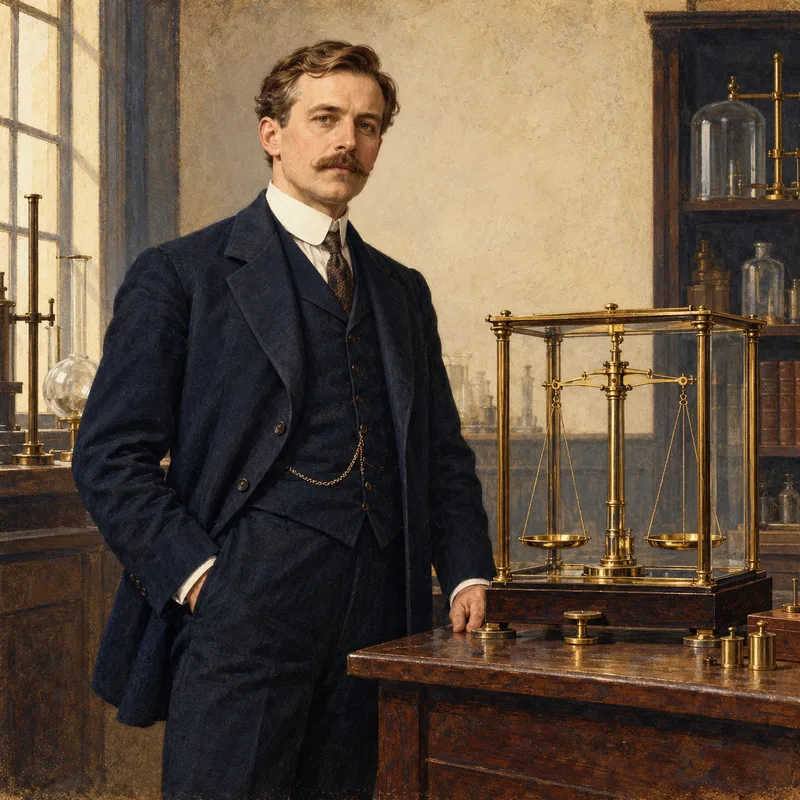
Theodore William Richards
1868-1928 · United States · Nobel Chemistry 1914
Precise atomic weight determinations