Biography · Chemist no. 192 of 350
Thomas A. Steitz (1940-2018): The Crystallographer Who Saw the Ribosome Make Proteins
Introduction
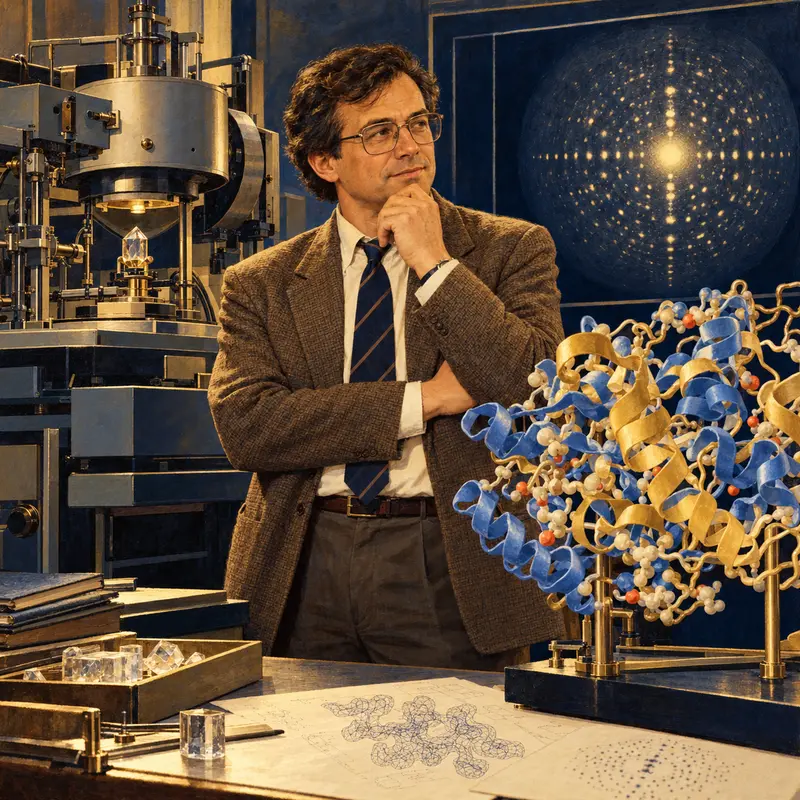
Thomas Arthur Steitz was an American molecular biophysicist and biochemist who spent most of his career at Yale University. He is remembered as a master of X-ray crystallography, the technique that turns the diffraction of X-rays by a crystal into a three-dimensional atomic model. His legacy is simple to state: he showed that the ribosome, the cell's protein factory, uses RNA to form peptide bonds. He shared the 2009 Nobel Prize in Chemistry with Ada Yonath and Venkatraman Ramakrishnan.
Early Life and Family
Steitz was born on 23 August 1940 in Milwaukee, Wisconsin, in the United States. He grew up in the American Midwest and attended school there; he later spoke of an early interest in science and the outdoors. He married Joan Elisabeth Argetsinger, who herself became a well-known molecular biologist, and the couple had a son. Joan Steitz studied RNA-protein complexes and splicing at Yale, and the two were an unusual scientific partnership at the same university. Details of Steitz's childhood beyond these basics are not widely documented, so we stay with what is known.
Education and Mentors
Steitz studied chemistry at Lawrence University in Appleton, Wisconsin, graduating in 1962. He then moved to Harvard University for graduate work, where he studied under William N. Lipscomb, who won the 1976 Nobel Prize in Chemistry for the structure and bonding of boranes. Lipscomb's laboratory worked on the crystal structure of the enzyme carboxypeptidase A, and Steitz's doctoral training gave him a deep foundation in protein crystallography. He completed his PhD in 1966. Steitz also did postdoctoral research at the MRC Laboratory of Molecular Biology in Cambridge, England, a centre then led by figures such as Max Perutz and Francis Crick, where he absorbed the culture of molecular biology. He joined the Yale faculty in 1970.
Career Timeline
| Year | Event |
|---|---|
| 1940 | Born in Milwaukee, Wisconsin |
| 1962 | BS in chemistry, Lawrence University |
| 1966 | PhD at Harvard under William Lipscomb |
| 1967-1970 | Postdoctoral work in Cambridge, UK |
| 1970 | Joined the faculty of Yale University |
| 1970s-80s | Solved structures of proteins that bind DNA and of enzymes such as hexokinase and the catabolite activator protein (CAP)-DNA complex |
| 1990s | Structures of DNA polymerase I (Klenow fragment) and reverse transcriptase complexes |
| 2000 | 2.4 Å structure of the 50S ribosomal subunit published |
| 2009 | Nobel Prize in Chemistry |
| 2018 | Died on 9 October |
Major Scientific Contributions
Steitz's early independent work centred on proteins that interact with nucleic acids. His laboratory solved the structure of the Klenow fragment of E. coli DNA polymerase I, revealing how a polymerase holds its DNA template and has a separate site for proofreading by 3'→5' exonuclease activity. His group also studied the CAP-DNA complex, which showed how a protein bends DNA when it binds, a key lesson in gene regulation. Other structures included the enzyme hexokinase, which showed the induced-fit change when glucose binds, and work on T7 RNA polymerase and HIV-1 reverse transcriptase.
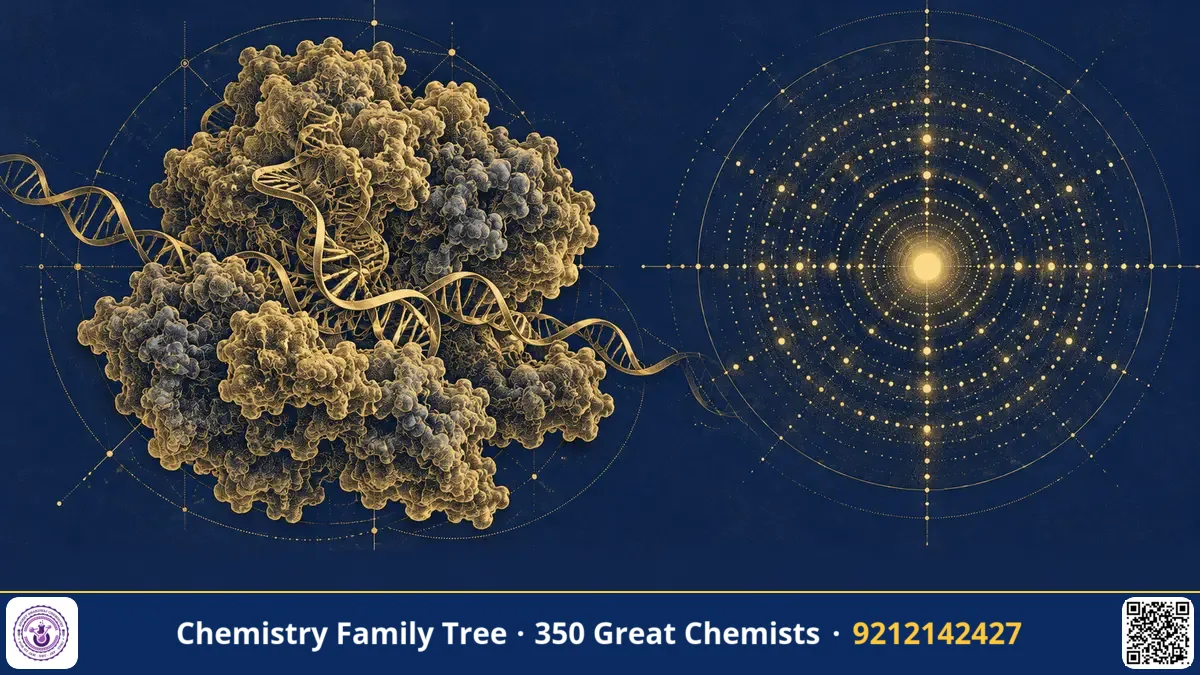
His most famous contribution came in 2000. With colleagues including Peter Moore, Nenad Ban and Poul Nissen, he determined the atomic structure of the 50S subunit of Haloarcula marismortui and showed that the peptidyl transferase centre is made of RNA. The ribosome is therefore a ribozyme, a result supporting the RNA world hypothesis. For the chemistry in detail see our discovery post on the ribosome structure. Afterwards, his group solved structures of many antibiotics bound to the ribosome, such as macrolides and chloramphenicol, giving a molecular basis for their action and for resistance.
Awards, Honours and Nobel Prize
- Nobel Prize in Chemistry 2009, shared with Venkatraman Ramakrishnan and Ada Yonath, "for studies of the structure and function of the ribosome".
- Election to the US National Academy of Sciences and to the American Academy of Arts and Sciences.
- Membership of the Institute of Medicine (now the National Academy of Medicine).
- He was a longtime Investigator of the Howard Hughes Medical Institute and held the title of Sterling Professor at Yale.
Personality, Struggles and Lesser-Known Facts
- A decade-plus bet. The ribosome project was risky. Many colleagues thought a structure of such a large RNA-protein assembly was impossible within a normal career. Steitz persisted for years before results appeared.
- A scientific family. His wife Joan Steitz is a leading RNA biologist, and they discussed research at home as well as at work.
- From drug design to company founder. He co-founded a biotechnology company, Rib-X (later renamed Melinta Therapeutics), to develop antibiotics using ribosome structures.
- Mountain enthusiast. He enjoyed outdoor activities such as hiking and mountaineering.
- Rapid reaction to the Nobel. When the 2009 prize was announced, the Yale community celebrated a researcher many in the field had expected to win for years.
Legacy and Influence on Modern Chemistry
Steitz changed how we think about the origin of life and about drug design. The idea that a catalytic RNA sits at the heart of every living cell gave strong support to the RNA world theory. In medicine, his ribosome-antibiotic structures turned blind screening into rational design. In methodology, his career showed how X-ray crystallography could be scaled from small proteins to giant molecular machines, which prepared the ground for today's cryo-electron microscopy. Students he trained went on to lead their own laboratories in structural biology across the world. He died on 9 October 2018 in Branford, Connecticut, aged 78.
Lessons for Students
- Choose hard problems. The most valuable questions are often the ones others call impossible.
- Master fundamentals. Steitz's training in chemistry and crystallography under Lipscomb supported everything he later did.
- Be patient. The ribosome structure took years of failed crystals before success.
- Connect science with society. Structures matter most when they help design better medicines, as with antibiotics for resistant bacteria.
Quick Facts Box
- Born: 23 August 1940, Milwaukee, Wisconsin, USA
- Died: 9 October 2018, Branford, Connecticut, USA
- Nationality: American
- Field: Structural biology, biochemistry, X-ray crystallography
- Famous for: Atomic structure of the 50S ribosomal subunit; showing the ribosome is a ribozyme
- Nobel: Chemistry 2009 (with Ada Yonath and Venkatraman Ramakrishnan)
FAQ
Who was Thomas Steitz's doctoral supervisor?
William N. Lipscomb at Harvard, himself a Nobel laureate in Chemistry (1976) for work on boranes and chemical bonding.
Which subunit of the ribosome did Steitz solve?
The large 50S subunit from the archaeon Haloarcula marismortui, at 2.4 Å resolution in 2000.
Why was the 2009 Chemistry Nobel important?
It honoured the first atomic-level views of the ribosome, which explained how proteins are synthesised and how many antibiotics stop bacterial growth.
How is Steitz connected to Joan Steitz?
Joan Steitz, his wife, is a distinguished molecular biologist at Yale known for work on small nuclear RNAs and splicing. They were one of the best-known scientific couples in American biology.
Published by ABC Chemistry — IIT-JAM | CSIR-NET | GATE Chemistry Coaching. Visit abcchemistry.com
About the chemist
Thomas A. Steitz
1940-2018 · United States · Nobel Chemistry 2009
Atomic structure of the ribosome